
Personal
How We Use (And Don’t Use) AI At My Company
Listen to this: 15 years ago, I was invited to be an early investor in an app where you press a button and a stranger picks you up in their car. I laughed it off. It was Uber. I have benefited greatly from being an early adopter of blogging and social media, but I don’t always have the business foresight that maybe others do (well, I said no to a lot of NFT startups, thank god). I’ve been extremely interested in AI for years, devouring articles and podcasts, mostly to understand how this is going to affect society writ large (spoiler: we don’t know). I know a lot of the goods and bads. So when my algorithm started feeding me all these women who were “waking up having all the work done overnight”, I thought at first, Wait, how?? And then I was genuinely curious if I could be one of these women. Maybe AI could really benefit my life and company and solve all my problems.
Should I scramble to be an AI early adopter? Should I train my AI agent to be my clone??? Will she be hotter than me?
***UPDATE: I wrote this post last week, just as Anthropic’s CEO, Dario Amodei, called for an international pause because their advanced AI was showing signs of “recursive self-improvement” – that is, being able to make better and more powerful versions of itself. While he’s notably one of the good guys in the field (Not a Zuckerberg or Musk type), he’s still racing towards an IPO, so for him to say this, it must internally be TERRIFYING. Also odd/scary that most of the mainstream media barely covered it.
Anyway, unless singularity happened over the weekend, I’ll assume you are all still here reading, so here’s what I wrote…
Of course, I have the typical extreme fears that a handful of men are playing God with society, the economy, the future of humanity, our kids’ brains, and the earth, with no regulation. In the realm of “inventions,” we aren’t sure if this is going to be more like electricity (yay!), ultra-processed foods (boo), or worldwide human decimation (…). But it’s here, and it’s not going to go away because it’s driving too much wealth and power. It’s a speeding runaway train, and as a small business owner and mom in 2026, I have zero ability to stop it, so I’ve been curious if I should get on it, just take the ride and see if/where I can understand it better/benefit from it.
The Bad (For Me): How AI has Affected Our Business


Left: Styled: Secrets for Arranging Rooms, from Tabletops to Bookshelves | Right: The New Design Rules: How to Decorate and Renovate, from Start to Finish: An Interior Design Book
Pre-AI (the blog glory years), when a potential new reader googled “what size rug should go in a living room,” our site would pop up first, thus driving traffic and hopefully converting someone who was “design curious” into a daily blog reader (or just having them read the post long enough for the ads to refresh). Now it’s an AI explanation of my exact tips at the top, and you have to scroll down to find the source. Our Google traffic decreases 20% YOY. Oh, and both my design books were part of the lawsuit by Penguin Random House that claimed OpenAI read and mirrored all the content for ChatGPT. “We” won – $3k. Clash action money baby!!! LOL (haven’t seen a penny). So yes, AI has “mirrored” (stolen) 16 years of what should have been proprietary research, content, opinions, and tips, and all the Google traffic that went along with it. Boo.
I Hit The AI Acceptance Stage
But that’s just how digital media and tech work. Sometimes we benefit from it (like when Pinterest came out), and other times we don’t. So, I’m currently in the “accept and iterate” phase, and we try to write non-AI-able content that still grabs Google traffic. For educational design posts (like the rug example), we make sure to have them drenched with personal anecdotes, nuanced problem-solving, and expert-driven opinions so that AI features us highly, knowing that it wasn’t an AI-written post. I feel really lucky that we have enough diverse revenue streams and loyal readership to be financially healthy (it was scary for a bit). We navigated it well because my team is rad. The irony is that while digital media tech built this company, the more flawed and human we are is the only way to maintain it as AI continues to take over. Challenge, accepted.
I think we can all agree that AI stealing creative work and jobs, in every industry, is a net negative for society. Using it for productivity? Sure. Using it in place of human creativity? Nope.
The Good – Yes, Of Course, There Is Good!
Clearly, the advances in AI in science, healthcare, medicine, and tech are astounding. Its research capabilities at such incredible speed are off the literal charts. Innovation in all technology is happening so fast (speeding train, no known destination). But these are specific industries. I liked this article a lot. I know that for a lot of people, there are some productivity tools that can save time in their industries. I’m only speaking from my perspective in my creative and female-forward industry. Speaking of which…
The AI Pressure – Giving Icky “Girl Boss Energy??”
Last month, Reese Witherspoon (whom I like), Mel Robbins (mixed feelings), and Sheryl Sandberg (whom I blame for youth algorithmic addiction) took to social to say, “You (women) cannot be left behind when it comes to using technology that is shaping the way that work is evolving,” The backlash ensued.
My response was “Sure, but how!?” and then “Wait… I need to be good at a new tech, again?!??” This article from NYMag asserted that this is just the “Girl-bossification of AI”. You see, in the mid-2010s, women were told to “lean in” (cue middle finger to Sandberg), rise and grind, be the mom and be the CEO! At the same time! Hustle culture was at an all-time high, but since we are yet to be cloned (LOL – I guess that’s their point??), it didn’t go well, and the Girl Boss era ended in mass burnout. Speaking from experience, the pressure to win on all fronts was too much then and now. The only reason I’m still here is because Brian was the stay-at-home parent, I have a great team, and I chose to scale back instead of grow. But there is no computer program that can prevent burnout with that level of pressure, no matter how many AI apps you shove down my throat.
Besides, Mel was being paid by Microsoft Copilot, and listen, I get it, it was probably at least a 6-figure reel, but it feels problematic (and she seems not to even know how to use it herself). Their overall “public” thesis is that men are using AI more, and if women don’t hurry to catch up, they’ll continue to race by us. And maybe they will. My field is 95% women, so I’ve never felt an existential male threat, but if that’s true, then sure, let’s perk up and lean in. If their point is that AI will empower women and give us back some time, so that we don’t burn out, then sure, I want in on this fantasy.
But what if it’s just another thing we are being told we need in order to stay on top or to make our life “better”, but it actually just takes more of our time, pulls our brain space, and makes things worse? There is zero evidence yet that it’s a net positive for women in its current iteration. They didn’t talk about how they are using it at all or give any concrete information, “just don’t get left behind!” The panic to adopt is giving NFTs and Crypto.
So how does someone like me use AI to benefit me?????? If I don’t want to hand over any of my creative tasks (because I don’t), then can it make me more productive?
Back To The AI Agents Doing Your Work In The Middle Of The Night…
Brit Morin (formerly Brit and Co, now an investor in a lot of AI) does these reels asserting that those who adopt AI now and have AI agents will have a massive advantage in life.
So yeah, we are told to list our pain points, and once trained, our AI agent will solve them. If you are unfamiliar with AI agents, it’s essentially this: you “train” your AI agent on all your devices (by integrating their program on your computer) – they read every email, Slack channel, text message, they crawl your calendar, listen to every phone call, or if you wear a “wearable”, they’ll record every in-person conversation. As it learns how you talk, act, work, what you like and don’t like, it will start doing it for you, as you. It becomes a proxy of you. A digital clone. It will collate your ideas from multiple sources and will write all your email responses, create the presentation, book the travel – all before you wake up. No more EAs or human assistants needed.
Outside of the TOTAL CREEPINESS OF IT ALL, in the name of curiosity, I explored it, and it seems to me that I’m not the right candidate for this right now. Maybe my job isn’t corporate enough, or my business is too small and manageable, or my personality is too much a part of the business. Or maybe I simply like to be the one in control? I’m not saying it won’t work for others in larger or more tech and data-driven companies, or people with such huge jobs that they don’t have time to read their emails, but in its current iteration, I don’t think it makes sense. I might still try it (for research), but it would mostly be to get rid of all my relentless spam emails. I mean, that’s worth the price of robots taking over my life if you ask me! Also, they make A LOT of mistakes, which means you look like YOU make a lot of mistakes.
But there are a lot of people drinking the Kool-Aid, wearing these wearables, in a race to early adoption. Read this article by Ezra Klein about the paranoia and AI panic that abounds in Silicon Valley. People genuinely believe they will get left behind. And hell, if you work in AI or tech, you probably will. And maybe I will. Literally, one knows how this is going to play out. But normal people should feel ok taking a beat – this article explains all the mistakes these “agents” can make on your behalf.
To be clear, I think all college students should 100% learn about AI, just not learn FROM IT. They should be informed of AI, just not informed by AI. By using it, we are using less of our brains. Just as planned. Less brain exercise means less smart humans. Their plan is working!!
Is this another moral panic as parents, a la Rock and Roll? Or is this our kids’ generation’s “Social media” epidemic? Will Jonathan Haidt write the book about the first generation of AI natives in 20 years? Learning about it is important, but we shouldn’t feel pressure to adopt it fully in its current iteration.
How We Are Using AI????
Right. That was the whole point of the post. The short answer is “Only when it really makes sense”. But these are the specifics.
AI integrations In Some Design Programs
Of course, there are design programs that can “design a room” in 1 prompt, 10 minutes (i.e furnish my room to look like Nancy Meyers’ kitchen). I’m not discounting how frustrating design can be for people who want a better-looking home and can’t afford a designer or have zero time. So I actually think certain programs could be valuable just to envision, shop, and check the box. I think if you are reading this blog, you are likely not one of those people because you want a more uniquely personal home, but for many people who don’t have time to care and just want “better,” I absolutely see the value here.
We’ve tried using ChatGPT (premium) to switch out things so we can envision what a different sofa would look like in my living room, for instance, and at times it has worked OK. But it takes a long time (sometimes 15 minutes to do one thing), and it often gets it wrong (that’s a long time to wait to just have to do it again). The endless tweaking is too time-consuming and frustrating. So we gave up. What my team has found is that taking away something is easier in ChatGPT, but we still have to add it in Photoshop to get it right (until we discovered Spoak). Nano Banana seems to work better, and this might be something we explore to solve readers’ problems in Design SOS. I haven’t used it yet, but Mal says that it’s fast and just gets it more. You are still prompting and designing, selecting choices, etc. But it renders better and faster. That makes sense to me.
Every sophisticated design software now has built-in AI capabilities that are super useful, visually impactful, and absolutely time-saving while allowing you to be the creative driver. SketchUp, Photoshop, AutoCAD, Spoak – these don’t design for you, they just save the time it would typically take to make your design look even better. We use Spoak to better show us and you our designs in a specific room, using our ideas/prompts. It’s incredible. But it’s only 10% AI; most of what we use is their proprietary software. And re Photoshop: It used to take 5-7 minutes to get rid of something unsightly in Photoshop that we couldn’t remove in real life (think a gross mole hole near where I’m standing in the yard) and now it takes seconds. That’s absolutely time back for Kaitlin or us while editing. (Note: we don’t manipulate photos ever, just remove something that is unnecessarily distracting).
So yes, we are still exploring how we can use AI to better illustrate our design ideas both for personal projects and the blog/social. But we’ll obviously never be interested in handing over the design process to AI – what’s the fun in that? But we are open to ways that make persistent good common sense.
What About Writing And Editing?

Me? Not yet. Blog posts? Nope. Again, I love the process of writing, and I’m fast at it, so I wouldn’t want to hand it off (ironically, this post took me 12 hours). But here’s how we’ve used it in other ways.
- Marlee will plug in an older blog post of mine and ask for bullet-pointed tips that can be developed into a short script for a reel that I’ll then say. We still have to edit it, but since it’s my own words and tips, it’s accurate and saves a lot of her time.
- Quarterly internal presentations – Caitlin (partnerships and revenue lead) and Marlee and Mal (social media leads) are starting to use AI to analyze and collate months of data. They think this has saved them 10-15 hours a quarter, so they don’t have to do it manually. That’s 2 days, and when we are busy, that’s a lot!
- As of now, we don’t use AI to fully edit. We just use Grammarly (which is why some grammar mistakes fall through the cracks). All I can say is that the human editor (the wonderful Jess) can not be replaced. Not only does she help with tone, efficiency, and redundancies, but we have to interlink every post and make sure that all the metadata is in there, etc. So sure, we could also add AI as an additional editor, and I’m sure they’d catch these mistakes, but it’s just not part of our protocol right now. I’m open to it.
- Sometimes we use it for research for posts. We usually Google first, but recently Jess wrote the post about “things other countries have in their kitchens,” and ChatGPT was way more thorough than Google and led her to the sites where she could do more research. So in that sense, ChatGPT brought new traffic to sources that Google couldn’t.
- Collating lists. ChatGPT is better than Google at showing me “20 rooms where Emily Henderson used wallpaper,” for instance.
- Brainstorming. There are times when knowing what works for others is helpful to spark new ideas (full disclosure, I haven’t done this, but people on my team have). Maybe it’s a hook for social that sparks our own idea or title.
AI Seems To Be More Beneficial In Specific Industries, But Not Mine Yet
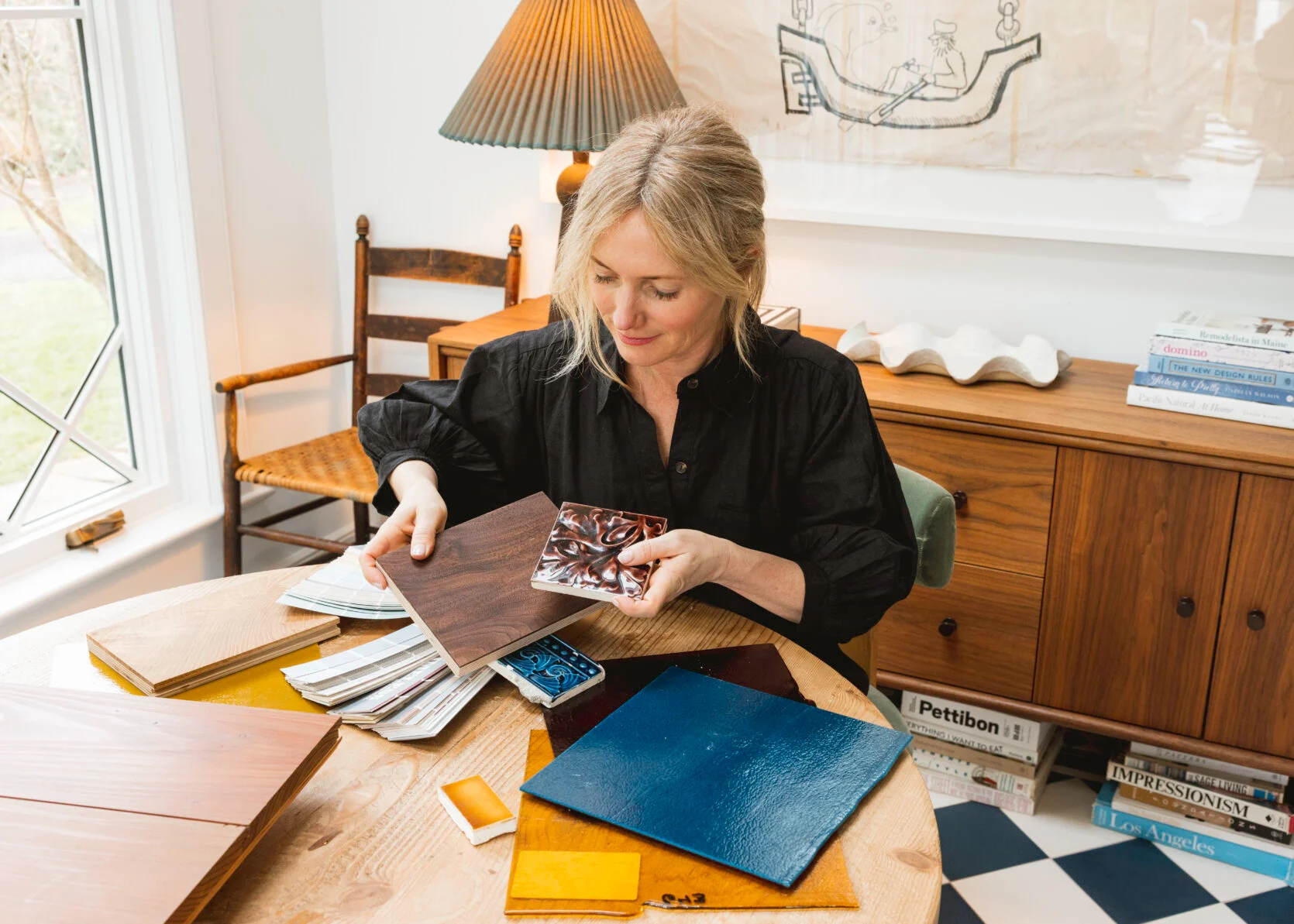
Admittedly, maybe our industry isn’t going to ever be one that gets totally devastated by AI because of the creative and personal nature of blogging and social media. What my industry needs is more backend tech to link every blog post or to auto-link every product. Hell, if I could go on a walk and dictate a personal post and it was written, cleaned up, formatted, and auto-populated with photos (to then be edited by a human), that would be awesome. I’m open…and wary.
If I were just starting out, building my business, I’d explore it for a lot of accounting, payroll, HR systems, and legal documents (the stuff that creatives are bad at). Before my first hire (which is terrifying), I would see if AI could help. But we are established enough, with good systems in place overseen by humans, so for me to transfer tasks to an AI agent feels like way more work, money, and anxiety just to… maybe save me work, time, and money (??).
As of now, there isn’t a lot of AI alignment in the small creative business (without a big mental cost). If you are a scientist and find writing tedious, I could absolutely see how ChatGPT could help speed up your communication. That’s fine! There is zero judgement from me if it’s working for you. But if you are in a creative industry and have panicked that you feel like you are clearly missing the benefits, getting “left behind,” know that it’s ok to keep researching before adopting. Pay attention, but don’t panic.
But obviously we all use AI, intentionally or not. Every time we Google anything now. It’s great for travel deals and tips on boiling eggs (which is stolen from food bloggers, I know). The other day, I asked ChatGPT to “plan a 5-day itinerary for a couple to go to Iceland in September, willing to splurge on adventure and spas, no helicopters”. And my goodness, it was a solid plan with hotel links and exact routes (I then felt gross that it had crawled so many travel bloggers, so I deep dove into their sites). Honestly, I love researching trips, so I wasn’t that relieved to have it done for me. But I could see how others would, for sure.
I’m not anti-AI. I’m anti the panic and pressure to integrate something so unpredictable and new, fully into my life and business, in its current iteration. I’m not saying no or never. Just being thoughtful about when and how. And just aware that every time I use it, there is a hidden but big impact on creators and the environment.
AI, in 2026, is not there yet.
It’s a whole industry in beta form (and no one wants the first beta form of tech). The glitches are popping, the securities and regulations aren’t there, and there might be more bugs than features. It’s going too fast, and the general population doesn’t have access to any real information, so we are just told how much better it’s going to make our lives, but with no evidence to prove it. Is it creating more work to help us have slightly less work? And I wonder if these apps are capitalizing on working women’s overwhelm, and this whole “don’t get left behind,” and the “AI Gender gap” stuff is just propaganda pressuring us into using a tech that might actually subjugate us and burn us out even more.
I’m glad I was an early adopter of blogging, but I’m taking a beat on full AI integration. I look at it like I do plastics, processed foods, and buying from Amazon. I’m going to try to avoid it where possible, but I know that there is a time and place where it might make sense. Currently, I think it’s a net negative for society.
It’s ok to wait and see. Do research, learn, pay attention, ask everyone in your industry, and keep your head out of the sand. But decide for yourself without the pressure of any “falling behind”.
What I really want is more time, not more tech. I don’t want to download more cooking apps; I want more BBQs with our neighbors. I want more IRL playing with my kids, not another tech and screen to get addicted to, that is actually wrong a lot. I know that this is the promise – time. But at what cost? It’s an international arms race to no one knows where. It’s up to us to figure out if and how it actually benefits us individually before we upend all our systems to integrate it deeply and permanently into our lives.
**Just calling for a ban on AI and shaming anyone who uses it is unproductive – it’s controlling all our markets right now, and unless you aren’t on the internet (and you are), then you are also using it. What I’d genuinely love to hear about is who is using what AI programs that are actually helpful, from real women (not paid AI spokespeople). And not just things they’ve heard of, real personal experiences from you. This is the missing link to the story. Give me real tips from real women, please.
*Photos by Kailtin Green



Fantastic and inspiring writing. Reminds me of that meme that was popular some time ago: I need AI to do my dishes and the laundry so that I have more time for writing, not the other way around.
Same! My “pain points” are opening my actual mail (and then doing whatever it wants me to do – just sits in a pile), doing dumb returns when I order my kids shoes too small, power washing the outdoor cushions, etc. I am going to try to find a program to deal with my spam email though 🙂
I’d love it if you’d do an unbiased review of all the tech that is available right now for home care (robot vacuums/mops, robo mowers, pool cleaners, window washers, litterboxes, grill cleaners, home security drones, home health monitors, etc…). So many options but I’m very skeptical about some of the “glowing” reviews.
Are you using rules at all? Creating a simple rule in your email if “Unsubscribe” exists in the body can cut down on a LOT of spam.
Wonderful article! I align with your prospective so much.
Great perspective!
Generative AI is the death of everything creative and human.
Generative AI is the death of everything creative and human.
Will ponder this after the caffeine hits….but what I’m really thinking about is Where did the beloved Blimp go?!?
It’s in her porch dining room!
Generative AI is the demise of everything creative and human.
Will ponder this after the caffeine hits….but what I’m really thinking about is Where did the beloved Blimp poster go?!?
It’s still in the sunroom, you can see the bottom of it on the wall behind Emily in the photo with the samples.
In her dining room.
This was an interesting, timely read that feels like an authentic, on-going conversation rather than a “winner take all” debate. Couching questions about AI in the day-to-day processes of your specific business (that you know well, and where you already have systems in place) is really helpful. I would love more of this, e.g., similar to regular women recommending swimsuits, have folks you know in other industries give a similar breakdown of how they’ve tried and adopted or rejected AI in various parts of their work/life, and why.
Thank you so much. I don’t know anyone who is using any AI program, outside of the occasional chat GPT. I don’t have that many colleagues left in blogging, but i’d love to hear from other content creators to see what they are actually using (but not sure they would say). I haven’t ask my friends who work corporate marketing in a while, would love to know if they are.
Yes, can confirm that AI is encouraged and heavily used in the digital marketing world, at least from an agency perspective (our clients are ultra-luxury hospitality/travel). Everything from trip planning to booking engine to SEO and AIO/GEO optimization to ensure websites and digital media are able to be read and digested by LLMs (large language models aka ChatGPT/Claude/Gemini/Google AI). The goal is to optimize media from a traditional Google Search lens so that humans can find the content by searching for it, and for it to show up at the top recommended results within AI Agents. So they kind of work together at this point. The talk track seems to be to use AI to streamline workflows and create efficiencies. We have developers and engineers using it constantly to write code and troubleshoot website bugs. Heck, you can build your own website from scratch within minutes using Claude Code. Now, not saying it would be anything award-winning or beautifully designed compared to a human developers/web designer… but it’s getting there. Problems we run into when looking into new AI programs is that the “free” version is extremely limiting, so it’s hard to actually understand the full capabilities unless you fork… Read more »
Adding on here to Brenna’s perspective. I work in a private tech company running a team of program managers who manage sales operations. We get immense pressure at every turn to “just AI it” or “AI can solve it” with a great deal of urgency. Often though, it’s up to me in my middle-management role to set expectations around there being a quick fix for anything where a bunch of humans are being asked to change/adapt their behavior. On a personal level, I’ve noticed that the quality of my listening and analytical skills have decreased due to the sheer amount of information I’m asked to process on a daily basis. Similarly, many of my colleagues are burnt out and talking past one another in this race to nowhere. Reading your experience, Emily, is emboldening me to focus on applying AI in strengthening my weaknesses in my job (or the things I despise doing) rather than replacing my strengths. I need to keep my critical thinking muscles sharp through writing things out. I’ll need to create the time and space to do so, even if others are impatient with me while I do it! I also had my first baby this… Read more »
Thanks so much, Alexia (and congrats on your baby!). I really appreciate the time you took to comment. Going through round two of the comments, full of so much insight. xx
I want to hear about the robots in people’s lives. We still have two older Roombas (model980) that are going strong (two because we hate the noise of the vacuuming and two cuts the time in half). They just vacuum don’t mop. Can’t decide if we should spring for newer options. And do the window cleaning robots work?
As someone who recently replaced my Roomba (had both vacuum and mop functions, but to mop you had to block off any rugs, swap out the dust bin with a water tank and attach a mop pad, swap back out after, etc and then no vacuuming until it’s fully dry so…we never used the mop function) with a Roborock that can mop and vacuum and empty itself/clean its own mops,.my only regret is not making the upgrade sooner. The Roborock is wayyy quieter (sounds like that would be a big plus for you!), does a better job, gets stuck on things less, etc. It’s truly effortless – I only have to touch it once a week when it needs the water tanks emptied and refilled. I’ve been running it since March for hours per day most days, with a dog and two long haired cats, and haven’t had to replace the dust bag that it self-empties into yet.
My 3 young adult sons are inheriting a world I am glad I didnt have to navigate at their ages. I am glad AI can’t paint a room or forge connections with new clients the way I can. Their dad is a locksmith- AI also can’t come and make a new key fob to replace the one you dropped in the lake. I think there will always be the need for a human to do certain tasks and I am grateful for that.
This was thoughtfully written. Well done.
Thanks, Susan. xx
Great article! Making me think! But AI has rejected several of my responses to this article.
Why don’t you like Mel Robbins?
I wondered same.
I don’t really connect to her personality. I liked her on Smartless and Armchair expert but on her own podcast I find I have a negative response to her personality (although I have liked some episodes). I admire her hard work and her openness. I feel the same about Jay Shetty – just kinda rubs me the wrong way. I’ll edit that out. no need to be catty 🙂
I find her kind of aggressive and fear-based in her approach. Emily also mentioned that AI ad that sounded like a money grab
I am DEEPLY CONCERNED about the environmental impact of AI.
80% of the Western US will experience severe drought this summer. Virtually NO snow pack means no water for fish, birds, wildlife — they will die in historic numbers as rivers, lakes and streams run dry. No water also means no crops, so food prices go up. And fires due to trees and brush being dried out.
Meanwhile, data centers that use insane amounts of water are being built all over the West with zero input from nearby communities. I urge everyone to find out if a data center is being built near them, what the environmental impact will be (no one knows), and get involved in slowing all of this down.
This. I was surprised this issue wasn’t one of the main points in this post.
Same here, I kept scrolling thinking that environmental impact would be the title of a next section and…nope. Thinking of the 2025 LA fires and Caitlin’s Antarctica trip, it kind of disappointed me that the climate impact was not detailed more by this team.
This wasn’t an article about the damage of AI on the world because its obviously terrible for humans and the environment (although I did reference it a few times). My article was already way too long for the internet (I had a huge thing in there about it, but just felt like ‘duh’ and not relevant to my thesis). But yes, its just so clearly bad for the environment, i just had to stay focused on the business stuff, and mostly assumed that everyone knows how bad it is for the environment at this point.
I’ve seen detailed arguments (which I’m not allowed to link here but you could search online) arguing that bingeing Netflix and being on your smartphone is actually worse for the environment than AI use. As well, I think about all the people who are regularly ordering clothing from companies like Q*e, which relies on AI and promotes excess consumption generally. I don’t personally watch tv or streaming services and keep my phone on airplane. I’d never order from Qu*ce and rarely buy any clothes at all – when I do, it’s in person, locally. I also do not own a car or travel frequently or have children. Just saying, I think we need to be less selective in our analysis here.
My middle schooler taught me that you can add “-AI” to the end of any google search and it will skip the AI summary! You can also download browser extensions that will block AI (to stop automatically summarizing your inbox, for example).
I work in the nonprofit sector and am similarly curious about if and how it might eventually be helpful, but I really don’t like how it’s just showed up everywhere without us opting in.
Amy I didn’t know this!! And yes, I want that browser extensions. That summary is annoying and distracting (same with the text summary your phone does). it just means you are reading something twice.
Amy I didn’t know this re -AI!! Tell your middle schooler thank you 🙂 And yes, I want that browser extension. That summary is annoying and distracting (same with the text summary your phone does). it just means you are reading something twice. Thanks for sharing. These are good tips!
Oh my gosh, Amy, I actually teach in middle school and did not know that. Thank you!!
Appreciate the transparency and perspectives!
I would just want to add that AI is contributing to climate change, water shortages, land grabs, and human rights violations. We cannot unlink ourselves from the terrible systems we live within, but for me it’s incredibly important that I see a clear and significant benefit for the use of AI. Each query has a human and environmental cost. So when I use it (occasionally for work), it has to pass a high threshold of usefulness for me to use it. I have found some uses that have offered a significant assistance with things that would have either been incredibly time consuming or not easily possible (ie: I don’t know how to code), but being a bit helpful or saving a bit of time isn’t worth it, to me. Not to mention that it requires checking all sources to be confident that AI is not making mistakes (which it often does, which is not acceptable for something I am putting my name to, for example), which is just a different time suck.
Thanks, SB. I totally agree. I like your perspective about it needing to be ‘significant assistance’ not just ‘kinda helpful’. The environmental impact is HUGE.
I have so many thoughts on this and am so appreciative of your thoughtful and deeply curious exploration. So many of your comments deeply resonated, thank you! As I’ve been starting a new business I’ve felt like I’ve come full circle with AI. In the beginning, thought it would be sooo helpful and in the end, I find it does a few things well (research, synthesis, etc.) but it takes a heavy hand from me and a lot of it I genuinely don’t like the results. I feel like we’re watching this online world lose its color as everything becomes this very stnadardized, sterile AI. What gives me hope about this is I think this will make humans, our connections, our imperfections more desirable. When it is easy to get averaged or standardized, those unique attributes of what it means to be human will become even more important. A few suggestions: 1) You mentioned that Anthropic is playing seemingly a more ethical approach but then using ChatGPT. Could you switch your org to using Claude? 2) Have you read “I am not a Robot” by Joanna Stern Its on my libby holds after listening to an excellent interview with the… Read more »
Thank you so much, Lindsey. I really appreciate you taking the time to write all that. I LOVE Kara Swisher (I listen to Pivot religiously) but I missed that interview so I will absolutely listen to it asap. And yes, I should just use Claude instead of ChatGPT (but I honestly use it so rarely that I don’t want another program that I also don’t use). Thank you thank you.
I work in “big tech” for a company that doesn’t create technology, but pushes consumers to use it more to buy our products. my role is very technology driven and I am building tech products daily. My AI usage is complicated. I know it is “everywhere” and it’s “running in the background” as I use my brain to make real decisions. It also helps me write when I need to save 30 minutes. It helps with my presentations to Exec Suite because Im not naturally able to speak that language. I like that I can write a prompt in Gemini with details like “this presentation is for the sales team, and we need to avoid tech-heavy language” and the agent understands that. My biggest worry is the drain on resources and the environmental impact. Billioanires pushing for AI have zero ability to think long term. It’s amazing to me that in 2026, with AI thinking and planning for these billionaires, that no one has been able to come up with a solution to mitigate the water needs of a data center. To me, that would be the first problem that I would be trying to figure out, so that I… Read more »
I work in “big tech” for a company that doesn’t create technology, but pushes consumers to use it more to buy our products. my role is very technology driven and I am building tech products daily. My AI usage is complicated. I know it is “everywhere” and it’s “running in the background” as I use my brain to make real decisions. It also helps me write when I need to save 30 minutes. It helps with my presentations to Exec Suite because Im not naturally able to speak that language. I like that I can write a prompt in Gemini with details like “this presentation is for the sales team, and we need to avoid tech-heavy language” and the agent understands that. My biggest worry is the drain on resources and the environmental impact. Billioanires pushing for AI have zero ability to think long term. It’s amazing to me that in 2026, with AI thinking and planning for these billionaires, that no one has been able to come up with a solution to mitigate the water needs of a data center. To me, that would be the first problem that I would be trying to figure out, so that I… Read more »
I’m in the legal field…. estate planning specifically. At first AI was awful at EVERYTHING. It has become sufficient at spitting out forms if you know how to prompt it.
I recently asked for a will in a specific and it gave me a version that our state bar provides (pretty sure a copyright was STEAMROLLED over).
The difficulty is that a will form isn’t a plan. So people relying on this, just like the old school paper forms you can pick up at any office supply store, still means things will be messy. Way messier than is should or could be.
So as far as my industry, I’m not worried because AI will always lag on the strategy front. What sucks is that people will think things will be fine and not have a true plan.
I also do probate law so I’m also busy when things are messy but… it really sucks for families.
I’m in the legal field…. estate planning specifically. At first AI was awful at EVERYTHING. It has become sufficient at spitting out forms if you know how to prompt it.
I recently asked for a will in a specific and it gave me a version that our state bar provides (pretty sure a copyright was STEAMROLLED over).
The difficulty is that a will form isn’t a plan. So people relying on this, just like the old school paper forms you can pick up at any office supply store, still means things will be messy. Way messier than is should or could be.
So as far as my industry, I’m not worried because AI will always lag on the strategy front. What sucks is that people will think things will be fine and not have a true plan.
I also do probate law so I’m also busy when things are messy but… it really sucks for families.
Hi Emily, I appreciate your nuanced take on AI. One practical aspect of AI I find frustrating as a researcher in education and as an educator is that the summary’s presented by Google and other search engines routinely make things up! I was trying to find an article and entered in key words from their analysis— the Google summary parroted back those points in longer form and then provided links to support the summary. I went through those links and found no information from their summary in those links!!! I’ve switched my iPhone Safari browser to Duck Duck Go and it’s so nice— much better than it used to be to be. You don’t have to have those AI summaries! I minimally use Chat GPT— mostly for tasks I just don’t have time for as an educator such as writing a letter of recommendation for a colleague. I tell it to not use common AI style language such as “It’s not X, it’s y.” I also prefer to keep my working memory intact. MIT published research on AI’s impact on cognition in TIME Magazine—it’s not good folks. The book “The Digital Delusion” by Cooney Horvath is great for understanding the… Read more »
Love Duck Duck Go! Said “goodbye” to Google a long time ago, their search results now are so worthless because they only link to paid product placements. Complete waste of time I can’t believe people still use it.
Love Duck Duck Go! Said “goodbye” to G oogle a long time ago, their search results now are so worthless because they only link to $$$ product placements. Complete timewaster I can’t believe people still use it.
Really appreciate your nuanced take on this topic, Emily. I am in education and find the ways it’s being used in my field really problematic. I feel like it’s something I need to protect my students from until they have the knowledge and skills to use it appropriately, which will be after many years of experience, not as undergrads! Your discussion about how women are being told they need to learn how to use this technology or they’ll be left behind echoes a conversation I had with my husband. The same week I was hopping mad because I’d encountered a really inappropriate use of AI that violated my intellectual property rights my husband was at an AI training. When he told me I shouldn’t have a “victim mentality” about AI I just about lost it. I felt like he was mansplaining away the real and potentially devastating impacts AI is having on my field and the whole human project of reading, learning, and writing. Ugh. I would be less worried about it if I had any confidence that those pushing it were engaging in good faith with its potential harms AND would throttle back what they’re doing if they could… Read more »
Testing to see if I can comment–I had a longer comment but I got a pop-up that said my comment was unacceptable. I promise it wasn’t problematic!
same thing happened to me. looking into it!
I get that message all the time!!! And on the most innocent things. I wonder if that’s why the interaction has dropped off so much here.
Me too
me, too. looking into it. i’m sorry!
Relieved to hear this is happening to lots of people. I thought I had been shadow banned by Emily!
Same.
Really appreciate your nuanced take on this topic, Emily. I am in education and find the ways it’s being used in my field really problematic. I feel like it’s something I need to protect my students from until they have the knowledge and skills to use it appropriately, which will be after many years of experience, not as undergrads! Your discussion about how women are being told they need to learn how to use this technology or they’ll be left behind echoes a conversation I had with my husband. The same week I was hopping mad because I’d encountered a really inappropriate use of AI that violated my intellectual property rights my husband was at an AI training. When he told me I shouldn’t have a “victim mentality” about AI I just about lost it. I felt like he was mansplaining away the real and potentially devastating impacts AI is having on my field and the whole human project of reading, learning, and writing. Ugh.
I recently read a study from the media lab at MIT called “Your Brain on ChatGPT” that found that using LLMs to help write not only created less brain connectivity than writing independently, but that relying on the LLM created an ongoing “cognitive debt.” Basically, your brain is less active while using it AND after using it. I’m not personally ready to outsource my brain exercise.
Thanks for posting this article! Sending to a lot of people : )
I like to think and solve problems and muddle through!
Yes. I often say “I wouldn’t send a robot to work out at the gym for me, and then wonder why I can’t move this heavy piece of furniture“.
It’s the same with your brain. I have spent a lot of years training mine, and I’m not going to let it get unfit and lose muscle mass now!
I’m really glad that you aren’t going to change up and start using AI here! You didn’t touch on how bad it is for the environment! That is my biggest worry!
I did! i mentioned a few times because yes its awful, but this was already so long and the post needed to be more about my relationship with it at work.
I’m sure there are many positives about AI. What worries me is the absolute absence of regulation & oversight. Feel like it’s a runaway train.
For context, I was helping my sisterinlaw with all printed materials for a large memorial service for her father, who was a very well known surfer in Hawaii, and beyond. There would be a couple hundred people at the service, including the entire Honolulu fire department, and a lot of old surfers. She provided a lot of pictures for the program, which ended up being 4 pages long. I only had pictures enough for 3 pages, so I decided to put her father’s favorite picture of himself surfing on the 4th page along with a poem. How hard could it be to find a poem, right? Right. My sisterinlaw hated every poem I sent for approval. This one had snow mentioned, that one was about trees growing. I must have sent her 50 poems, and was truly pulling out hair over this when my husband suggested asking chatgpt to make a poem. WTH I thought, why not. In seconds, after my prompts, it came out with an acceptable (to me) poem. Sisterinlaw loved it, the Aunties loved it, her friends loved it. Bam, done. The materials were printed and ready to go (thank you Canva) when sisterinlaw wanted to know… Read more »
So wild! When Chat GPT first started the kids and I had it make a rap for Brian for fathers day, based on our prompts (likes, dislikes, quirky things about him, etc). Five seconds later it was done and it was funny and good, but made me feel icky! We did perform it for him, but made him cards and promised to not use AI for gifts again (too easy, and took the joy out of the process). But your situation was different – when you are desperate I think it can totally help!
If someone reads an AI poem at my funeral I’m coming back to haunt them.
Yes, but it’s already done and she can’t go back in time and change what happened. Why pile on
Your AI-generated text may have been many things, but it was not a poem.
Signed, an Irish Person
At the beginning of March, the house at our farm burned to the ground. (This is a second home, not our primary one.) Although I have photos and videos of much of the house, the thought of coming up with a list of all the contents — and a value for each item — is overwhelming. Enter ChatGPT. I upload photos and videos of one room at a time and ask it to come up with a value and description of each item in a downloadable spreadsheet. Game. Changer. I have to monitor the spreadsheets carefully for mistakes, and I still have to account for contents that aren’t in a photo or video, but this has relieved so much stress and pressure.
I work in an office where I pull and format reports from various databases. Two in particular used to take me 2 hours weekly. I spent probably 4 hours training ChatGPT, and now I pull the raw data, feed it into ChatGPT and it pops out both reports in less than 2 minutes. I’m thrilled! I use my extra 1 hour and 55 minutes to do projects that only a human can do! On the other hand, I’ve tried to get it to write my blog posts – knowing I’d want to edit them – but it just can’t get it right. I’ve given up and actually feel better about my posts being all written directly by me. As you say, there’s good and bad. Thanks for this – I love your measured and thoughtful take on the whole situation.
This brings up a good point! There’s so many things I wish I could do – I just don’t have time to do in my job. When im feeling hopeful about AI, I’m hoping I can use the time saved with giving AI some tasks to improve the program I manage and provide better customer service
The fear of being left behind is basically saying that it’s better to trample than be trampled…and it’s this very premise that makes American capitalism American. It is that fear that caused our ancestors to enslave African humans, who were the “labor saving technological advantage” of the day. It is that fear which has driven a cancerous consumerism that can never be sated by something that can be purchased. It is that fear that has led to the tiered luxurification (my word) of our most basic survival needs to the degree that no creature is able to live here with any kind of dignity. And it is this fear that is causing us to accelerate the destruction of all life on this planet we call home in the face of the irreversible damage we have already done to ourselves and our flora and fauna neighbors. I genuinely appreciate your thoughtful approach and the ensuing discussion… although I confess to believing any discussion of AI without acknowledging the technology’s incomprehensible energy demands to be irresponsible. My two (or twelve) cents is that our energy might be better spent discussing how to tear down the ladder we’ve all somehow agreed (?) to… Read more »
Thank you for refocusing!
THIS!! I completely agree with your thoughts on people fearing being “left behind” so we feel like we have no choice but to go along with it, regardless of the consequences (immediate and down the road.) I am far from perfect, but I definitely don’t plan on using AI just to make my life “a little easier” and I cancelled and deleted my Amazon Prime app about a year ago and good riddance. When we aren’t actively voting, all we can do is “vote” with our actions and dollars and F Jeff Bezos.
THIS!! I completely agree with your thoughts on people fearing being “left behind” so we feel like we have no choice but to go along with it, regardless of the consequences (immediate and down the road.) I am far from perfect, but I definitely don’t plan on using AI just to make my life “a little easier” and I cancelled and deleted my Amazon Prime app about a year ago and good riddance. When we aren’t actively voting, all we can do is “vote” with our actions and dollars.
Thoughtful and interesting post. Thanks, Emily, for taking the time to think out loud with us. I’m really resistant to AI. My last few semesters as a professor were ruined by AI plagiarism, which created a sense of opposition between profs and students and seemed to yank the foundations out from under the entire premise of higher education. Now, as a university administrator focused on supporting research and writing, AI still feels like a cheap trick. But I agree that its integration will be field-specific, and it’ll be fascinating (and a little chilling?) to watch it play out. One last thought: do you listen to the podcast Despicable Lies? Their most recent episode is a deep dive into Sheryl Sandberg’s Lean In and the “girlboss” era, and it made me rethink everything I thought I knew about Sandberg.
love diabolical lies! katie and caro (the author of yesteryear) have incredible chemistry and their deep dives – well every episode really as that’s the format – are so intelligent, thoughtful, fact based and illuminating.
ooh thank you for the rec! never heard of it but feels so far up my alley. thank you!
Fans of Quince should know that it relies on a proprietary system of AI-driven forecasting.
I do not use generative AI at all, and I actively avoid businesses that are obviously promoting it. I do not want a data center making noise in my backyard, killing wildlife, poisoning our soil, destroying our drinking water, taking jobs. Plus I want to use my brain to solve problems and keep it active and healthy. I really do not understand this argument asking to see both sides / consider the nuance. If we do not have a healthy place to live, nothing else is going to matter.
I was very surprised that there was no mention of the environmental impact or loss of human jobs.
I said more in my first comment but it wasn’t allowed.
Let’s try this…
I mentioned the impact on the environment 3 times. I just didn’t go too far into it because its frankly so well known that I thought it was obvious and this post was more about my business and my personal relationship with it. I also didn’t go too far into the existential threats because thats also obvious and not my wheelhouse. But running a business as a woman is my specialty so I focused on that so that it wasn’t like 60 pages long 😉
I enjoyed the article and the commenter’s input – none of use are immune to AI though I feel quite insulated from it as a wicker basket weaver. My craft can’t be replicated by a machine. Anyway.
I think Em says it all when her team use AI to literally and figuratively remove a mole hill…made my day…keep AI down to earth
As a designer, art director and writer, I will happily be “left behind.” The empty promise of a shortcut is a lesson I already learned.
As a designer, art director and writer, I will happily be “left behind.” The empty promise of a shortcut is a lesson I already learned.
This is a thoughtful and nuanced take. I’d note that recently I followed a link of yours on this blog to some awesome outdoor furniture. But the measurements in the photo (ai rendered) v description was wrong. No problem! I’ll just call the retailer. I got an AI “assistant” who was totally unable to answer the question, just spouting the same mathematically impossible measurements (yes, I was confident the measurements of a couch were NOT in fact three inches by eight feet by thirty four feet, thank you). I couldn’t get through to a human. Online chat was the same. The result was I grew so frustrated that I went to a different source entirely, which sucks, bc I know you guys get a cut of the click-through sales and I ended up spending a lot of $$$ and wouldn’t have found the furniture without you. I love your blog and always want to support, but this new tech is FRUSTRATING. Even the idea of ‘assisstants’ angers me, like why in the world should I bother reading an email someone didn’t bother writing, and are we going to get to the point where AIs are just … corresponding with each… Read more »
This is a thoughtful and nuanced take. I’ll note that recently I followed a link of yours on this blog to some awesome outdoor furniture. But the measurements in the photo (ai rendered) v description was wrong. No problem! I’ll just call the retailer. I got an AI “assistant” who was totally unable to answer the question, just spouting the same mathematically impossible measurements (yes, I was confident the measurements of a couch were NOT in fact three inches by eight feet by thirty four feet, thank you). I couldn’t get through to a human. Online chat was the same. The result was I grew so frustrated that I went to a different source entirely, which sucks, bc I know you guys get a cut of the click-through sales and I ended up spending a lot of $$$ and wouldn’t have found the furniture without you. I love your blog and always want to support, but this new tech is FRUSTRATING. Even the idea of ‘assisstants’ angers me, like why in the world should I bother reading an email someone didn’t bother writing, and are we going to get to the point where AIs are just … corresponding with each… Read more »
42 year old stay at home homeschool mom here…. so no real working women perspective. BUT I have been reading design/decorating blogs for the past 15 to 20 years and you are the only blog that I read that consistently posts “wordy” thought provoking posts. LOL. All others have gone the way of instgram, TikTok, Facebook, etc. I do not have social media. So thank you for hanging with those who enjoy reading a blog! 🩷
Ditto!
Just suggestiong an edit – I think you meant to type Class Action, not Clash Action: We” won – $3k. Clash action money baby!!! LOL (haven’t seen a penny).
Opps – Ironically I hit send before editing: should read: Just suggesting an edit – I think you meant to type Class Action, not Clash Action: We” won – $3k. Clash action money baby!!! LOL (haven’t seen a penny).
HAHAHAH. indeed. whoops!
I am a nurse practitioner and AI note taking (live transcribing of conversations with patients, with consent, of course) has changed my life for the better. I can be more present in my conversations with my patients and with rules I have created, the notes that used to take me 30+ mins to write are now taking me two mins to review and edit once written my my AI scribe. I think it is a game changer for clinicians who routinely list the documentation part of our jobs as a major contributor to burnout. A couple years ago I transitioned to an area of medicine that is a much more talk heavy, and I honestly didn’t think I would be able to continue to do what I was doing until AI transcription came into play. I also am concerned about the environmental impacts, but I recognize that the way I am using it allows me to provide better, more present care to more people, which is a win in my opinion.
That’s awesome. I love hearing the good, too. xx
Thank you so much for this post!! I’m definitely nervous about AI, but have started exploring it lightly for my job in state government administering the federal child nutrition programs. It’s helpful for summarizing key themes from the many, many surveys we do, and to help make the explanation of complicated federal regulations more accessible. Our state agency has a Google for work account and we had a great intro webinar to the AI tools schools are using in the classrooms. One feature is called “LM notebook” it’s essentially a curated collection of sources (that you can control so it’s not just searching random things on the internet ) that you can ask questions of. We might link to the code of federal regulations that govern our programs and start using it to be able to comb through all of the program guidance to help us answer questions. But first we’ll have a discussion with our team about the pros and cons of this, would this reduce important in person discussion and collaboration as we try to decipher the laws together? In the webinar one of our supervisors mentioned an 80/20 rule that I found helpful, let AI take you… Read more »
My husband and I both have businesses related to AI. He develops custom AI workflows (for example, he created a tool that collated all the news about a certain topic then the humans can choose which ones to share on their social media and it writes the posts, editable by humans). I help companies develop and implement AI policies to empower humans to use AI as a tool, not a replacement.
My slogan is “AI is an intern.” It’s eager, it’s quick, it knows the basics or where to find the information, but it doesn’t have the context, the experience, the full knowledge base. So let it help you, but you’re still responsible for its work.
So, I’d say we’re on a similar track. We see its benefits but we are focused on doing it as pro-human as possible.
Thank you so much for your insight. I really like the intern analogy. I’m going to steal it (and give you credit) :))
I love, LOVE your very intelligent and perceptive opinion on this and how honest you are with your readers on how you use or don’t use AI. Please never stop doing your own writing: your voice always come through so clearly and is especially refreshing now in the era of AI slop.
I work in government/nonprofit and I’ve found it most helpful for helping me through the editing/brainstorming process. I’m not having AI write complete letters or grant proposals for me, but I am using it typically in one of two ways. Either I’m starting with writing something myself, and then using AI to edit it for redundancy, tone, character limits, etc. or I’m using it as a kicking-off point when I am having a brain block. I use it as a back-and-forth editor, not to replace everything I’m doing.
Personally, what I’d like AI to do for me is take over the truly tedious daily chores, like preparing meals every day, coming up with ideas, and making sure they’re healthy and balanced for everyone in the family (I love cooking, but I’M SO OVER the daily dinner grind!), properly cleaning the house (better than the already very capable robot I have, which doesn’t dust or vacuum the cobwebs off the ceiling! ;-)), the windows, the laundry, the bathrooms, etc.
Otherwise, as a preschool teacher, I don’t really have much use for AI. Well, I think…
This was so thorough, and thoughtful. Thank you! I’m just a mom who is a late adopter to most/ALL technology forever. But even I … used chat to plan a month of meals for my picky family and desire for nutrition lol. 10/10