Design
A Design Opportunity You’re Probably Missing – Enter: The Power Transition
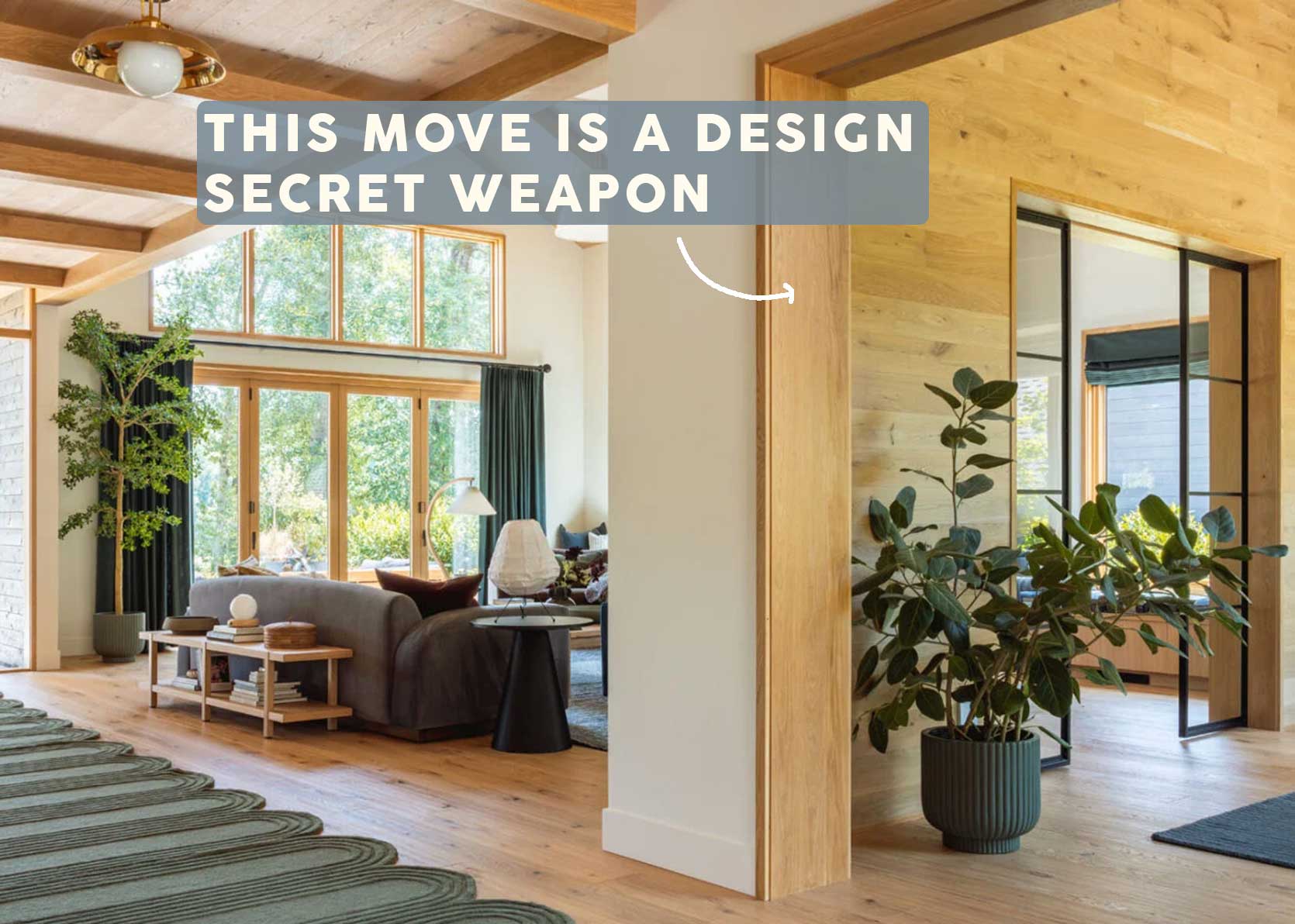
There are some details in our homes that are so powerful, just a touch of them is all you need to transform a space. The “Power Transition” is one of those. And for anyone wondering what exactly that is, no, I don’t mean some kind of bridge between your electrical outlets. It’s a design opportunity that involves not overlooking a very small but potent area of your home—the doorway, arch or cased opening between rooms. Honestly, I’ve never put much thought into any of mine. Possibly because I’ve always been a renter, but until you see it done well, you don’t even ponder what’s possible.
But don’t worry, because today, you get to take in all the inspiration. You’ll see how a tiny bit of paint or wallpaper or tile, for instance, can become the star moment in your room. Some are budget-busting natural stone portals (that made me think “how much could some red marble *really* cost?!?) and others are easy, cheap, and impactful concepts even renters can use. The Power Transition doesn’t discriminate. Studio apartments all the way to estate dream homes welcome the P.T.
I organized all the intel I gathered for this post in seven categories, listed from most easily reversible and affordable to aspirational, because hey, everyone spends their money differently. Let’s start with the greatest common denominator of design tools: Paint.
Power Transition Type #1: Paint & Wallpaper Borders
I just love the contrast between the white walls and the glossy burgundy archway interior (the foot-wide wood paneling-esque baseboard is a close second). A detail like this does some serious heavy lifting in a small space, and adds character and warmth to a simple, modern home.
Is there nothing a checkerboard pattern can’t fix? For something a bit more eye-catching and funky, skip the solid paint and go for some alternating colors. If your walls are already a color, I love the idea of pulling from that to use a darker and lighter shade of it for some colorblocking magic. Of course, a complementary hue would also be quite powerful.
Orlando has taught us all how impactful using paint can be in thick borders around the edges of a room. That same principle applies to the Power Transition. This room, though not the least bit humble, tbh, doesn’t even have baseboards; just the blue paint is used to add whimsy and interest.
If you have a rectangular opening, you can paint inside or outside of the passage, but with an arch, the move is always to paint inside of it. And again, you just can’t go wrong with a classic check.
Though something like a chic solid black can do a lot for an all-white room. (In all fairness, I think the inside of this arch is painted wood or another material, but something similar can be achieved using paint, as well.)
Or you know, an electric blue…
Some homes only have cased openings and doorframes, but fear not. The Power Transition can be as straightforward as choosing a paint color to contrast your walls for the millwork around your door (bonus points for painting the door itself, too).
Let’s not let paint have all the fun here. I just love the wallpaper borders from Studio Atkinson (this isn’t the first time I’ve shared them around these parts), especially when I see them used in this application. (If you have the patience and steady hand of, say, Michelangelo working on the ceiling of the Sistine Chapel, you could also do this by hand with just paint and tape.)
Power Transition Type #2: Art
As you can see, there is so much you can do with paint, but let’s move on to some more unusual Power Transition applications. I came across this doorway wrapped in a variety of frames and vintage oil paintings, and I had to include it because I’ve never seen anything like it. I’ve seen a full wall of photos and art, but never an arch made of art. Can we perhaps call it an “artway” instead of an “archway”?
And now that I’ve embarrassed myself with that bad joke, we can keep it movin’…
Power Transition Type #3: Curtains
Not all Power Transitions happen along the inside or outer edges of a pass-through. Some are the pass-through. Case in point: Curtain panels. I’m a devout follower of Arent & Pyke, and I just love how pared back this entryway is, but thanks to every single hard-working detail—including the velvet drapes—it’s still a feast for the eyes.
For some “Castle: Impossible” energy, use tasselled tiebacks to keep your drapes from impeding the flow of traffic between rooms.
Power Transition Type #4: Tile
Now, we get to the next part of my list, which I coined (to myself) the “Achievable Commitment” kind of Power Transition. Is it DIYable? Sure. Is it something you’d want to do if you have a lease rather than a mortgage? Probably not.
Two colors are all designer Patricia Bustos needed to create this eyeball suckerpunch of beauty. Framing it out in a micro-checkerboard pattern that matches the floor is like a bullseye invitation into the wet room.
This treatment isn’t just for bathrooms. I love the thicker and rounded top version between this kitchen and dining area by designer Tim Veresnovsky.
A room pass-through like this isn’t something you just happen upon in your builder-grade tract home. But if you’re in the process of renovating and looking for a “wow” moment, something like this would be well worth it. A neutral tile on the interior of the extra-thick archway feels like the inside of a metro station, but you know, in a very good way (I promise).
There’s no secret to my love of the Delft tile, and OMG YOU CAN USE THEM FOR A POWER TRANSITION. Obsessed. Thank you, Vaughan Design & Development, for bringing this into my life to mentally bookmark for my future.
I know we’ve seen a small checkerboard style here already, but I wanted to include this photo, shared by K & L Design Studio, to draw attention to how they brought through the black-and-white pattern into the perimeter of the vanity. A Power Transition can stand alone, but if you find a way to echo it in a small but intentional way, you level up its power even more.
Power Transition Type #5: Stately Molding & Bookshelves
“Achievable Commitment” was a short category but let’s end it strong:
Power Transitions aren’t all color and pattern. Some can just be books. And not only is something like this eye-catching, but it’s also a fantastic use of space thanks to the built-in storage.
What you see in the above image is a gorgeous pediment, which was a classical architectural element above windows, building entrances, and gabled roofs in ancient Greek and Roman temples. If you can find one at an architectural salvage store, it would make a killer Power Transition when painted in a color that stands out against the wall paint or wallpaper.
Power Transition Type #6: Custom Millwork
Similar to a checkerboard pattern, a scallop or wave detail can work with so many different styles. Here, a custom wood trim wraps the opening in this stunning room (and yes, you can get a similar effect with paint, too).
Just as you can paint the inside of an arch, you can take it a step way further and get it custom clad with wood. It’s really such a stately look.
To be fair, this is a 3d render of a design by Rana Gunes, not a real, finished room. But the rounded wood trim was such a standout moment to me, I had to include it. Such a cool design element, for sure.
Power Transition Type #7: Natural Stone
And finally, we’ve reached the crown jewel of the Power Transition: Natural stone. There’s just nothing quite like it visually (or budget-wise).
This image will forever live inside the folds of my brain. If my body is ever exhumed to be studied for science, whatever remains of my brain will still have this red marble casing ingrained in it.
Nothing says “I’m rich!” quite like a heavily veined statuary marble a foot-plus deep, separating your towel room (?) from your freestanding tub room. Much like gazing into the face of Jonathan Bailey behind the glass of your iPhone, you can dream, can’t you?!?
I leave you with another heart-pumping crushable marble moment. My goodness, it’s just so good.
—
So, from paint to books, to art, to tile, to “I cashed out my 401K to wrap my doorway in marble,” the Power Transition works in every iteration. What are your thoughts on it? Would you try it in your home? Reversible and affordable is where I’m living now, but I’ll keep all the extra drool-worthy ones in my heart for whenever that windfall of money I may just get somehow, someday drops into my lap. 🙂
Until next time, friends…
Opening Image Credits: Design by Emily Henderson and Max Humphrey | Photo by Kaitlin Green | From: My Brother’s River House Living Room Reveal – With A TV On A Tiled Fireplace
Love this! A real interior design post 🫶
I painted a glossy green border on the archway leading to my dining room. Anytime I come across old pictures without it painted, the archway looks empty and unnoticeable. It took some guts to do.
These examples you shared are spectacular!
Oh I love the sound of that!
Inspiring to see all these ideas! Thanks for putting all this together, Arlyn. I’ve got a 15-inch thick doorway between our bedroom and bathroom. The threshold has already been stained aquamarine, and now I’m playing around with wallpaper or paint for the rest of this transitional strip. So, yes, I would do this. I am doing it!
Wow 15 inches! Sounds amazing.
Right, it deserves its own mini moment, maybe a wallpaper that can work as a narrow strip, or a custom wallpaper, or a stenciled design, or even freehand-painted. We’ll see. It’s really fun to consider these little areas as being special in their own right.
I love the way you write, Arlyn. Learned a lot from this post, thank you!
Thanks Tracy! 🙂
Love this. I have a doorway with no door between my kitchen and bedroom. I am interested in the idea of putting lush curtains there, but every image I see of using curtains in an opening between rooms only shows it from the side the curtains aren’t hung on. It makes it hard for me to figure out if it would also be cute from the inside of the room. My current apartment has so many cute openings between rooms – I would love to paint them, but have seen people use washi tape as decoration as well. May try that first as a transitional design.
Yes you’re right they never show the curtains hung from the other side. I know the Arent & Pyke image I shared with the yellow curtains features a special custom ceiling inset where the curtain hardware lives. That’s not what most people would DIY for themselves, of course. I think if you have a hallway, the curtains could even be hung on a tension rod up toward the ceiling and it would still look good from both sides!
This is the post I didn’t know I needed! Getting lots of good inspiration here.
Glad I could help!
How fun!!! I have 3 interior archways in my home that connect the main entry to the living room and dining area/kitchen and one between the living and dining. My home leans towards the Spanish style, so I’m going to see what I can do. Thanks for the ideas!
Arlyn: Could you do a post on stair risers with tile, paint, etc..? I know you will be able to find some great examples.
Oh I bet a small rustic tile would be AMAZING in at least one of them!
Yes please! Second the request for an Arlyn post on stair risers.
Much more renter-friendly than painting a whole room!
Fantastic post! Checkerboard is so overdone at this point. A trend that will be connected with the 2020s. But the concepts here are super inspiring.
It’s a throwback to the late 80s/early 90s, actually. It will go through another “so overdone” phase and then just be a classic again.
Your joke about artways made me laugh this morning. Seriously, thank you for that! Beautiful round-up of inspiring transitions. I really loved that checkered archway – checkered will always be timeless in my book.
Not applicable (at all!) to the glorious marble iterations, but an extra plus for a lot of these options is that if you have an absolute favourite tile or wallpaper that’s hideously expensive, then at least you won’t need very much material-wise so the itch can be scratched without too much expense! Additionally, the small scale of the projects means that if you change your mind (or get it wrong!) then a re-do isn’t too proscriptive.
I want to try something like this in my Belizean condo. Any suggestions? sorry bad photo.
This is one of my all time favorite posts. Thanks Arlyn! Now I am checking out all my transitional spots in my house with brand new eyes<