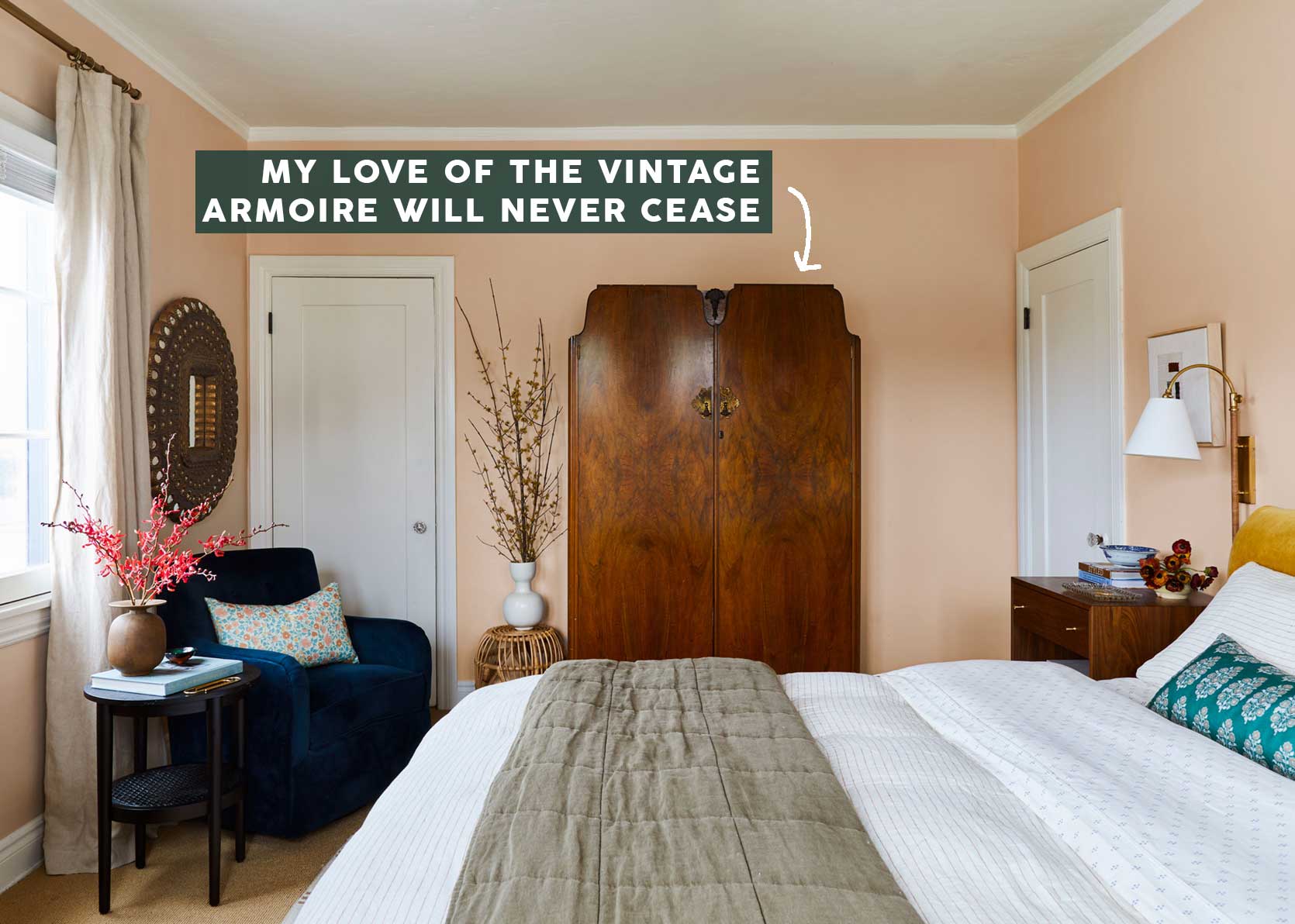
Design
Secondhand Scores: Why The Vintage Armoire Is Your Home’s Design Secret Weapon (+ How To Find An EHD-Approved One)
I make no reservations about expressing my love of the vintage armoire. You can read about it here and here. And today, it’s getting the Secondhand Scores treatment. I’ll walk you through all the things I think you should consider before buying one, some search terms to use in your search, what you can expect to pay for one, what specific styles to look for, and then we end with where in your home you can use one effectively (and beautifully).
This large, versatile storage piece is such a powerful visual statement when used in a tightly designed room, all while hiding a multitude of random things you don’t want to have to see every day. It’s a decorating heavy hitter, and you can find them for as low as $100!
What To Think About Before Buying:
Like with anything secondhand—a.k.a. non-returnable—you have to think about a few things on the front end before purchasing so you don’t end up having regrets. Some of the below bullet points are based on personal experience, and some are from anecdotal research I found.
- Structural integrity: Is it stable? Is it warped in any spot? Does it wobble? A piece this large can be a downright danger if it doesn’t pass these simple safety checks. And look, I’ve bought plenty of furnishings like this sight-unseen, but if you can see it in person and kick the tires, so to speak, that’s always best.
- Dimensions and access: Again, these things can be sizeable, so check then double-check the height, width, and depth before committing to it. Will it fit through your front door? Will it fit through your hallway? Will it fit in the room itself? As some of you may know, I had a depressing armoire fiasco when I moved into our new place a few years back. The wardrobe I so lovingly and excitedly acquired for my previous room couldn’t clear the ceiling right above my staircase, and it’s been living in the garage ever since. TBH, I think my movers were tired after a very long day and didn’t want to get creative, but better that than them thinking they could have gotten it up and scratched the whole front side, for instance.
- Condition and quality: This one relates to the price and what you expect out of it. The older the piece, the more likely it being solid wood, but that’s no guarantee. Ask questions, look at joints if you can, and figure out what you’re buying. If it’s a super low-cost piece, like say, under $200, it’s worth just buying it if you like it, but if construction material is important to you, be sure to ask and maybe look at it yourself. A quick anecdote: I bought a dresser for my daughter from Facebook Marketplace last year. I asked whether it was veneer or solid wood, and the seller told me it was solid wood. Technically, he wasn’t wrong as the construction of the body of the dresser, as well as the drawers, were wood and not particle board. But it did have a veneer on the drawer fronts and sides. It didn’t end up bothering me, as it was all in great shape, and the wood pattern it had that I fell in love with is commonly achieved using wood veneer.
- Signs of age vs. a reproduction: In a similar vein, and especially if you’re buying an expensive item or a heritage piece, you should look for signs that something is what it says it is versus a good reproduction. Old, hand-made furniture typically has dovetail joints (with an armoire may or may not have), and as these were chiseled by hand traditionally, they will be slightly imperfect. If something is so precise it looks like only a machine could have made it, then a machine probably made it. Which look, that doesn’t automatically make something garbage, but it’s important to get what you’re paying for. Do some deep research on the specific item they’re claiming to be selling you, if it has a maker name attached to it or even a year/decade, and see what was common for that brand or time era.
- Odors: This one can only be sussed out in person. Wood is a natural material, so it does absorb odors. If you’re storing clothes and other soft goods in your soon-to-be armoire, make sure it’s not a stinky situation in there.
- Does it function? Well, well, well, if it isn’t another personal anecdote of mine. So that beloved armoire of mine that I bought sight unseen had an issue that was disclosed to me. One of the doors didn’t latch properly, and I thought, “Eh, whatever, I’ll just get it fixed.” It’s been nearly four years, and it’s still not fixed, FYI. All that to say, be honest with yourself about whether there are needed repairs, and whether you’re actually going to be proactive enough to get them taken care of.
- Can you transport it? Do you need to hire a delivery service? Does it fit in your car or truck? A normal quandary with any marketplace furniture purchases, but still worth considering. Also, did you know that some vintage and antique armoires actually were meant to break down into pieces for easy transport? The top comes off some of them, and the walls come apart. It’s not the case for all, but some, yes, so see if that’s also an option.
Some Armoire Designs We’d Sign Off On
There’s a lot of ugly out there. There’s also a lot of “wait, is this ugly or is this actually nice in the right room/design?” as well. Even I go through that, trust me. But I’ve studied rooms with antique armoires in them for years, so I have a pretty good sense of what’s going to be a gorgeous statement piece, and what’s just going to look like a giant beast eating a room. Here are some I found locally to me, with their price points. In my region, the price runs the gamut, from $150 for a no-name vintage piece with some wear, all the way into the thousands from names like Lane or Martinsville. This may be different where you live, but I doubt it’s too far off.
As for search terms, try using:
- armoire
- wardrobe
- clothes cabinet
- armoire wardrobe
- tall cabinet
- storage cabinet
- closet (or closet cabinet)
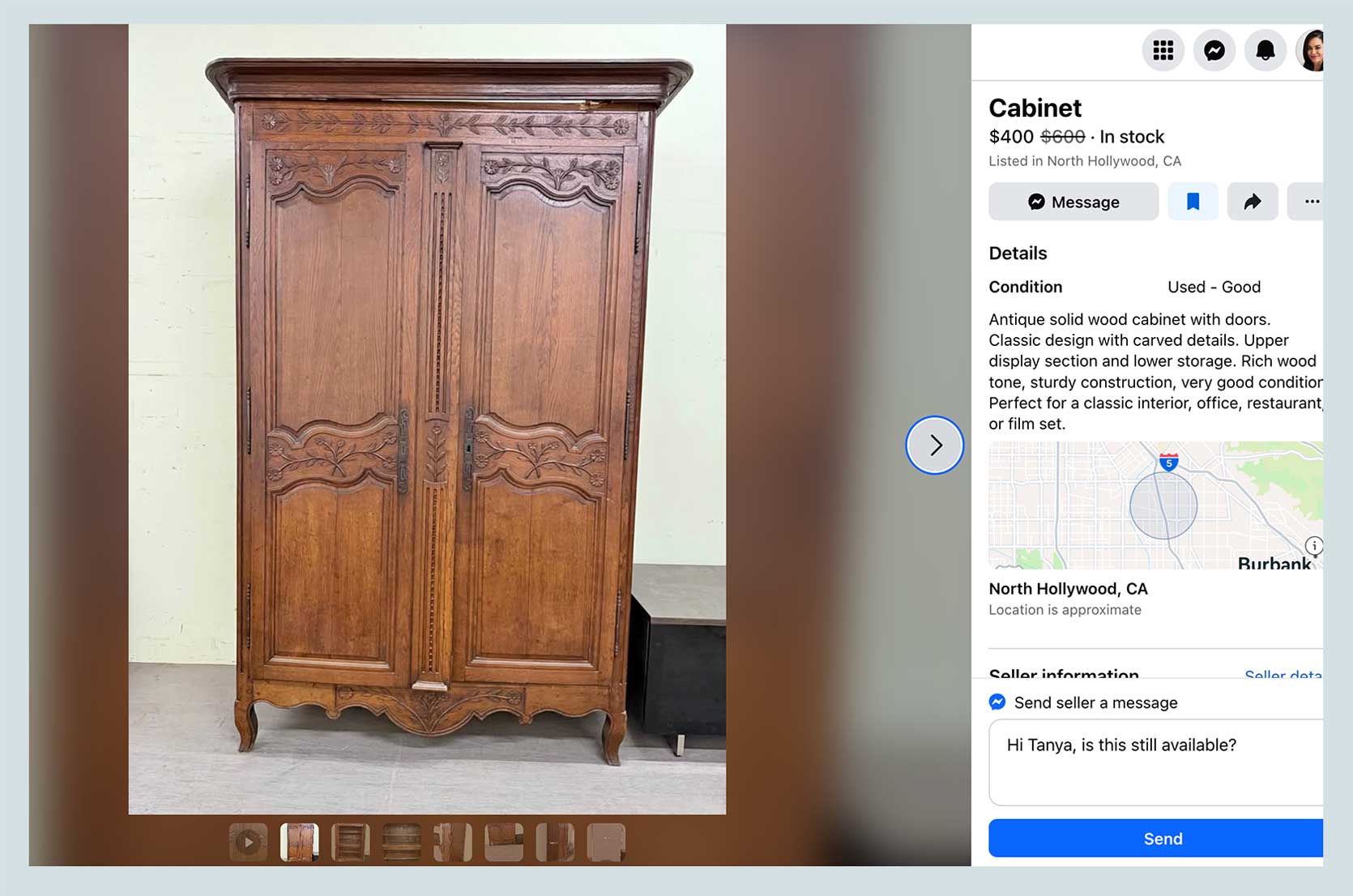
My goodness! If I didn’t already have my armoire, I’d consider this one. I love the floral details so much. I’m not sure it actually has handles (just handle plates), but if I were to ever handle (ha) that, this would be wonderful in a romantic bedroom with rich colored or wallpapered walls.
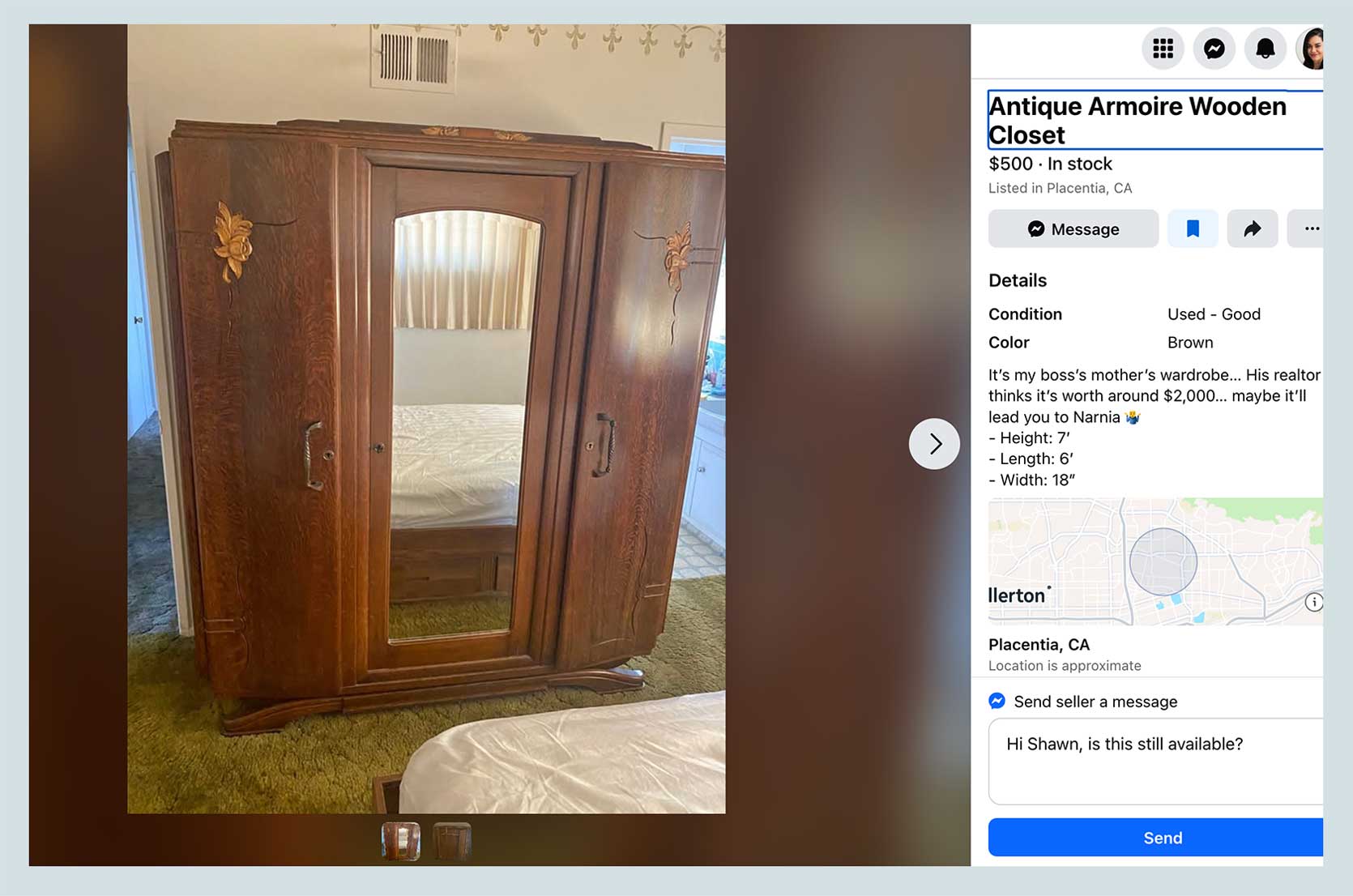
I saw so many of these Art Deco, hugely wide pieces when I was on my hunt, but they didn’t fit both the scale and size of my room. The carvings on this one and the fun little feat are so interesting. I’m not sure how this opens up, though, assuming each side and then the center mirror as well has storage behind it. $500 is a steal for something of this size.
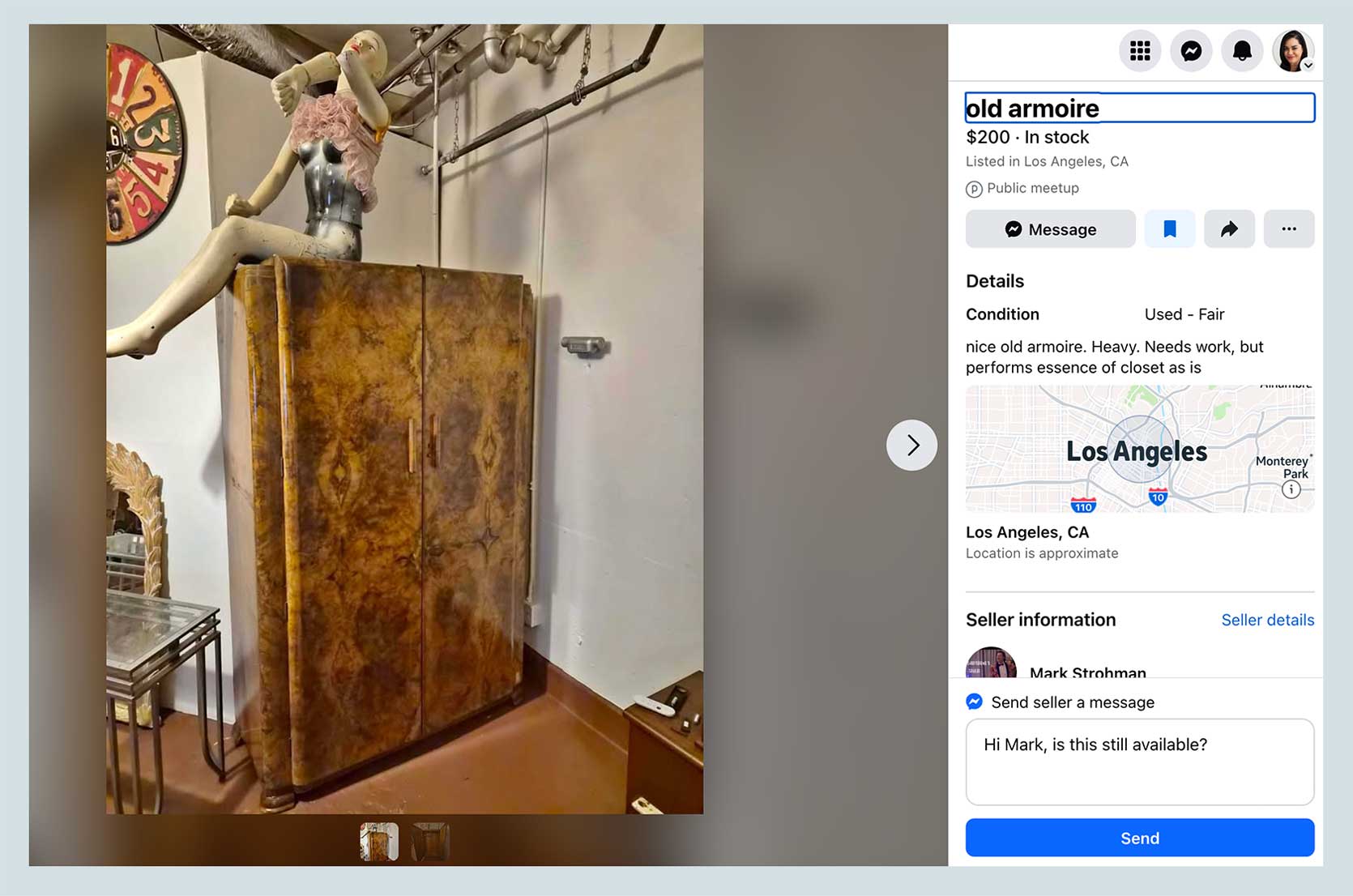
Anyone who knows me knows I love a burlwood armoire. It acts as a neutral pattern, and when used in a room that treats it like a star, it will end up being a piece everyone will ask you about. This one is $200, and the description mentions it “needs work,” but that’s the kind of thing you dig in and ask about before buying!
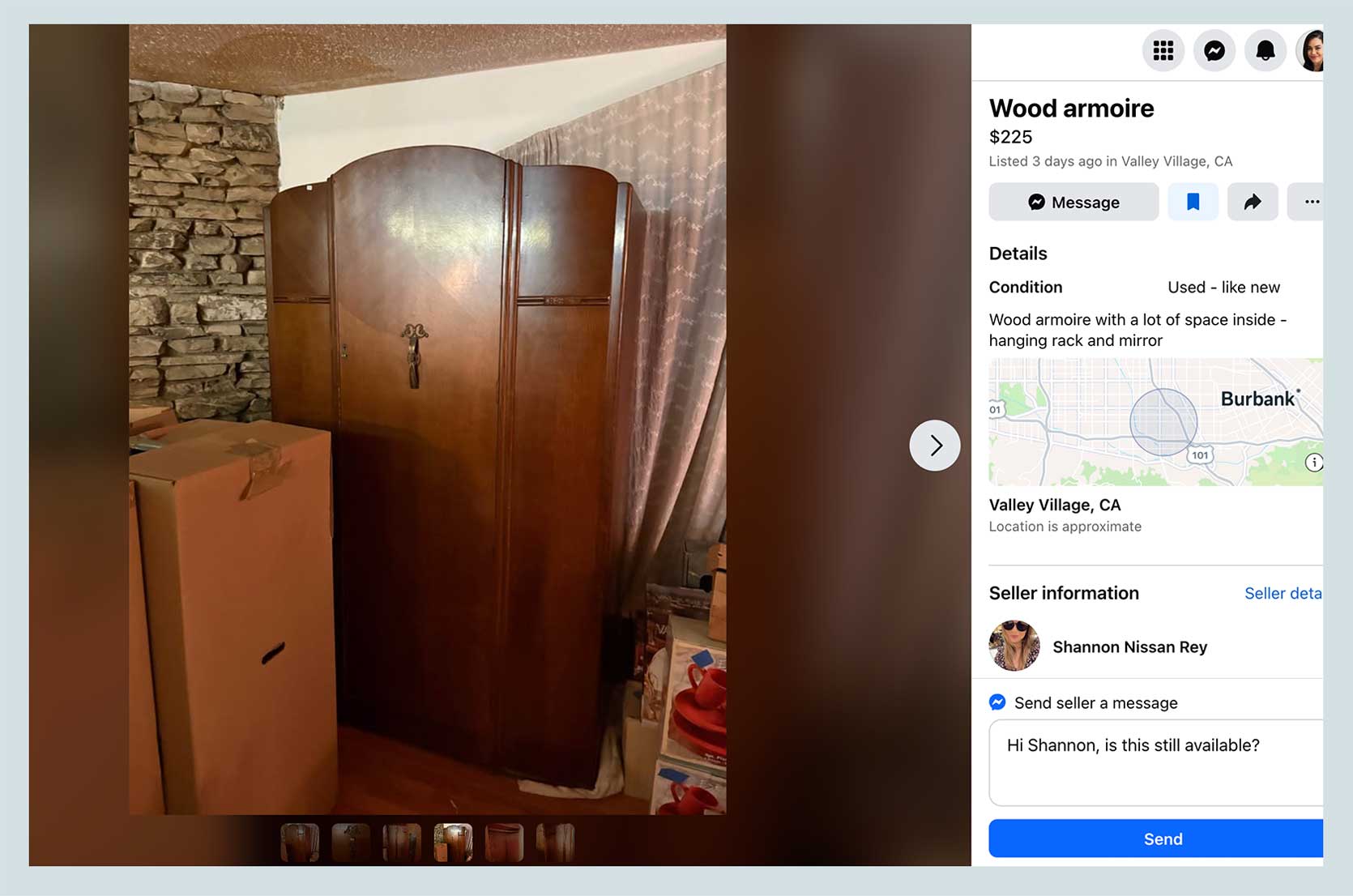
Another Art Deco armoire, which I’m partial to. Mine has a similar shape and also has a hanging rack and a mirror inside. My ultimate goal was to retrofit mine with some more storage compartments, which I never got around to. But if you only need to hang dresses or coats (or even store tall cleaning supplies such as your vacuum and broom), you won’t need much more than this.
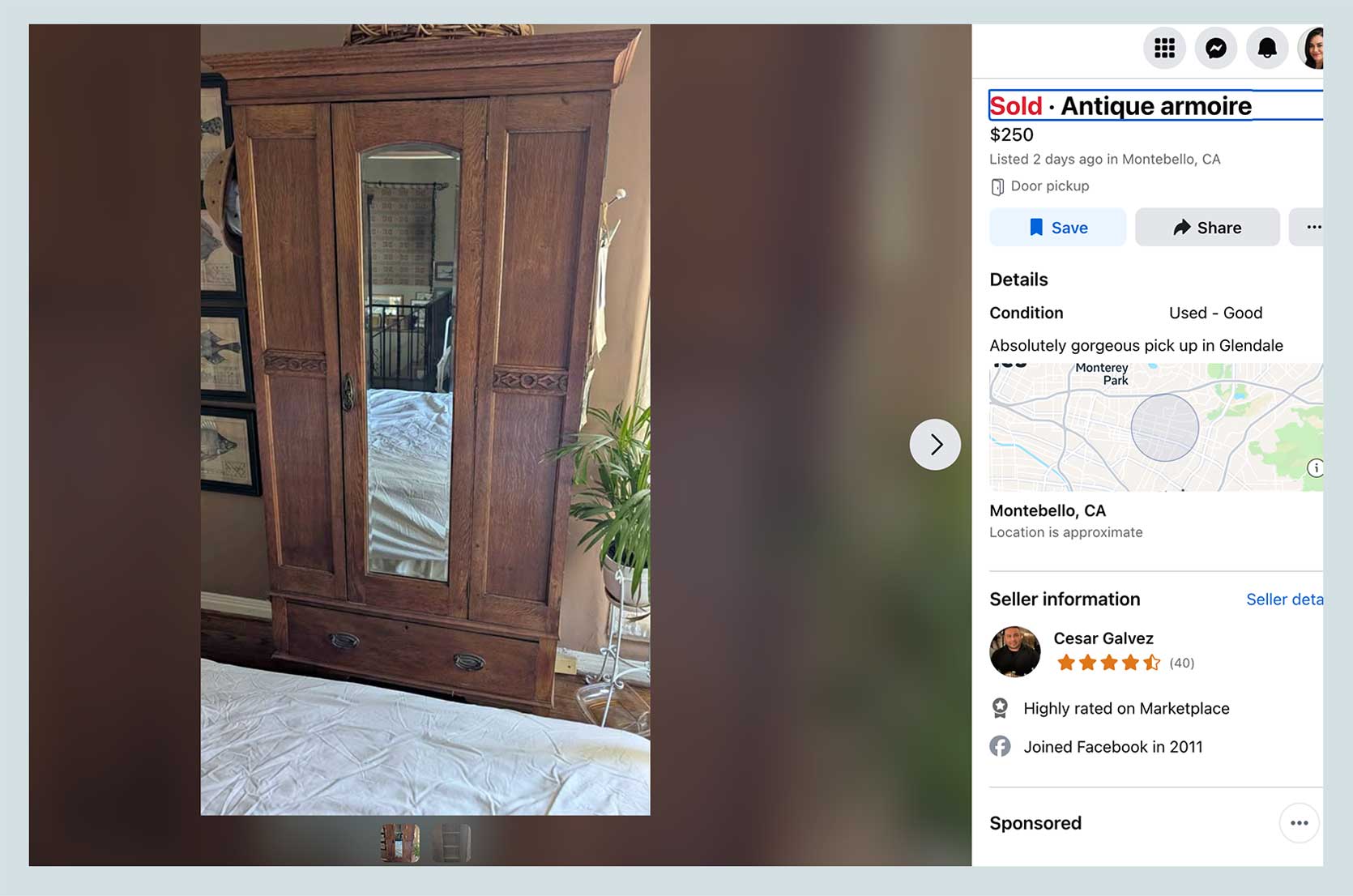
A different style here, a bit more mission, but still interesting with subtle detail banding in the woodwork. I mean, $250?!? If it’s in good condition, this is a steal.
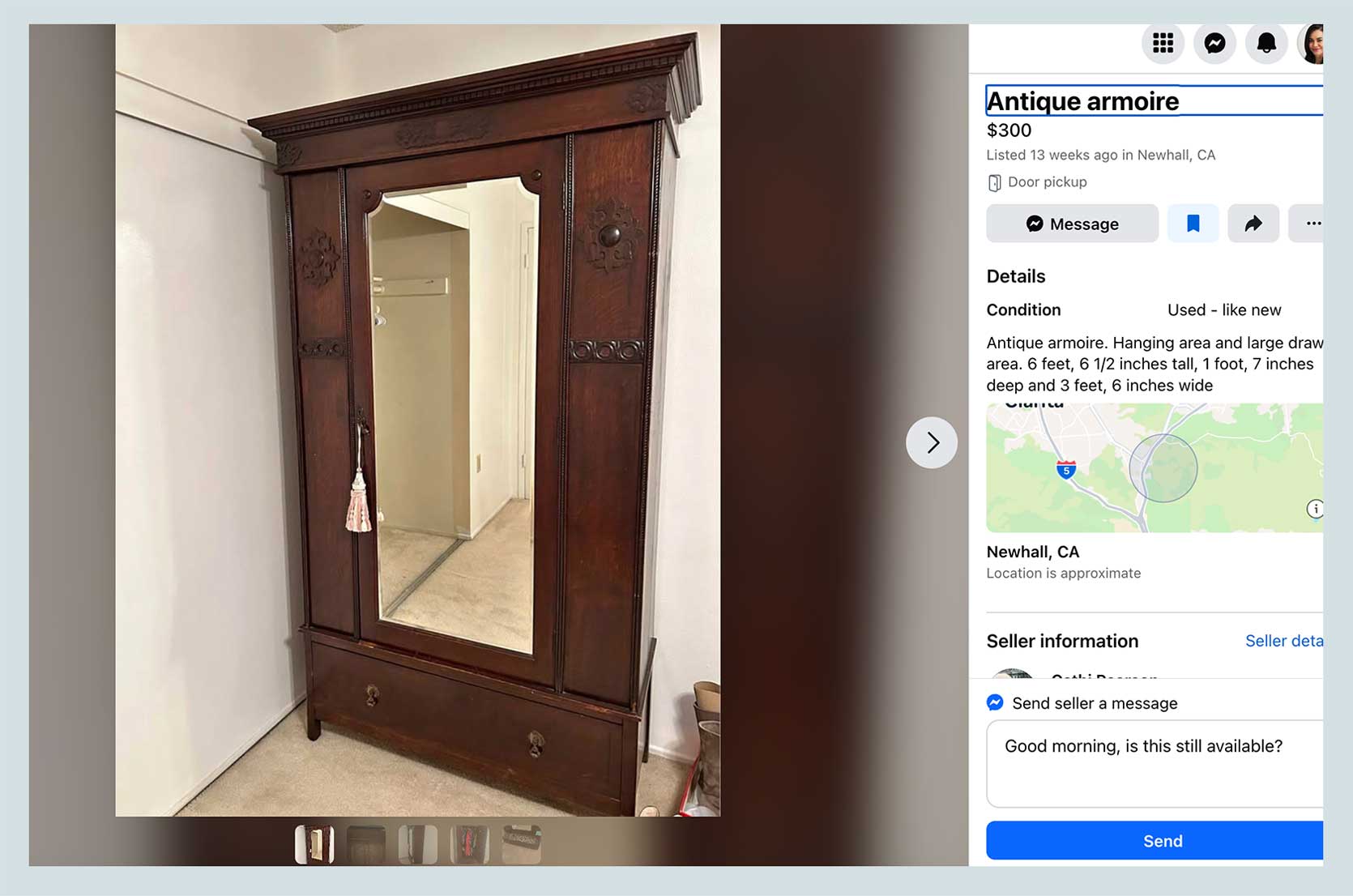
It had me at “tassel,” honestly. Bonus points for mentioning that it has a “large drawer area” inside, so super versatile for use as a linen closet or in a bedroom.
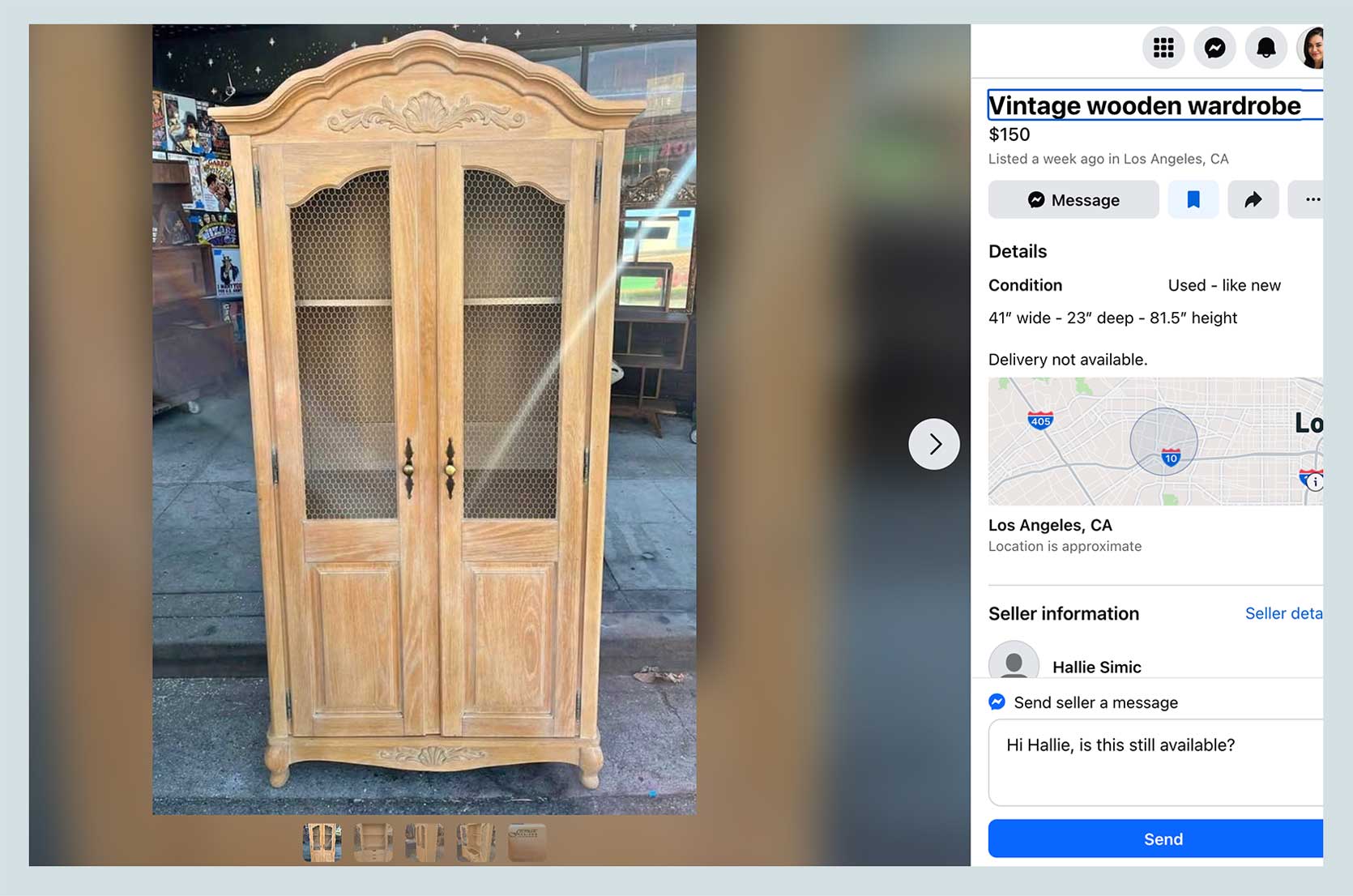
You’ll find a mix of pieces sold by dealers and pieces sold by people; this one appears to me to be from a dealer/reseller. It looks like the wood was stripped at some point, and glass doors were replaced with chicken wire (a cute look for a dining room, breakfast nook, or bathroom).
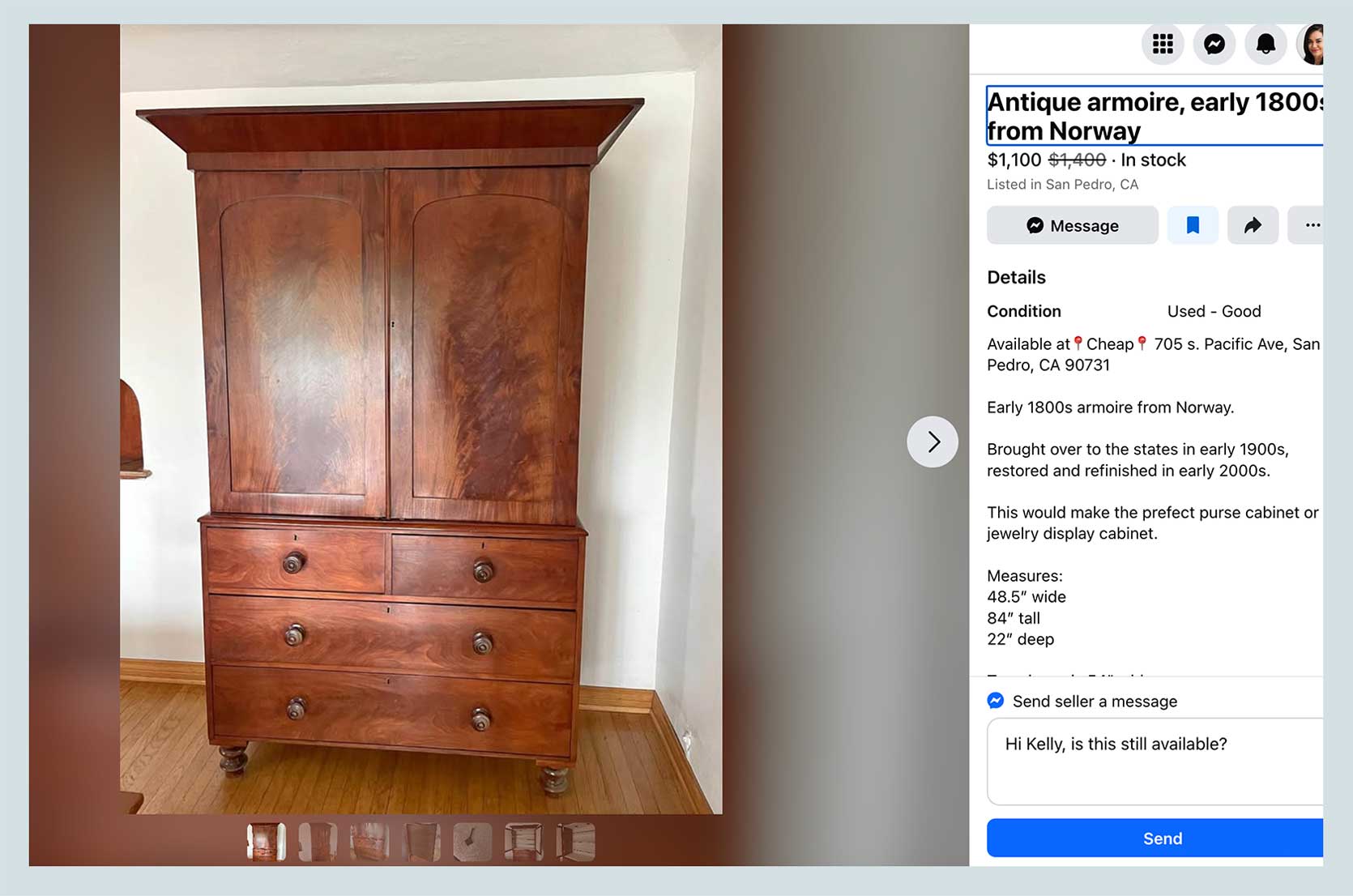
Here’s where we get into something a bit pricier. You can tell by the sheen of the wood grain that this is a rare wood type, and being an antique (as they are claiming from the early 1800s), that makes the price make sense. Note that some armoires have full-length doors with interior storage, and some are more like this with a chest of drawers and a hutch-like storage piece above.
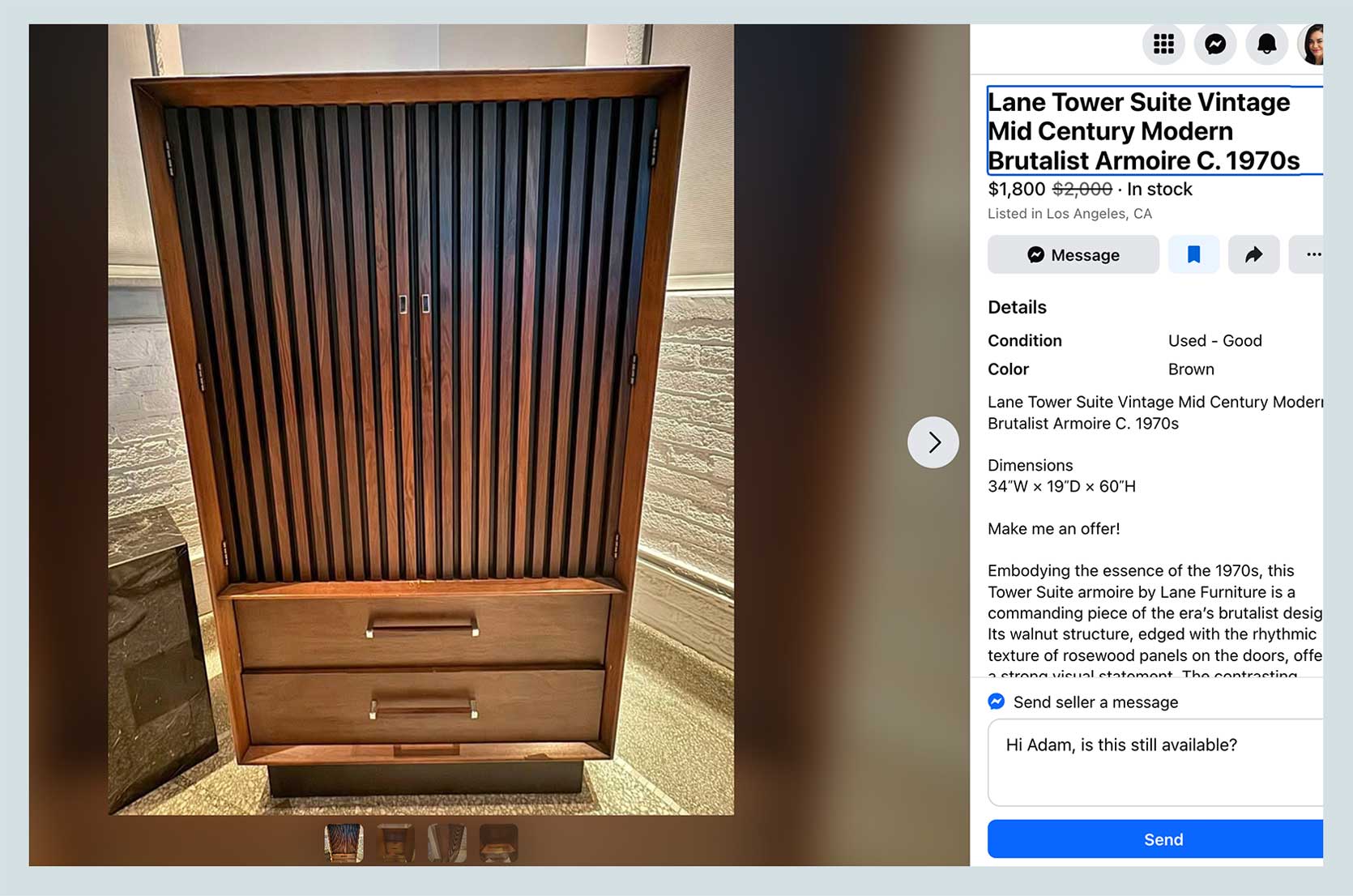
Lane pieces from the mid-century are incredibly popular, so supply and demand come into play here on pricing. You definitely want to go see something of this price in person if you can, both to check the condition of the piece but also to make sure the scale feels right. This one is likely not overly large, at about 5 feet tall by 3 feet wide.
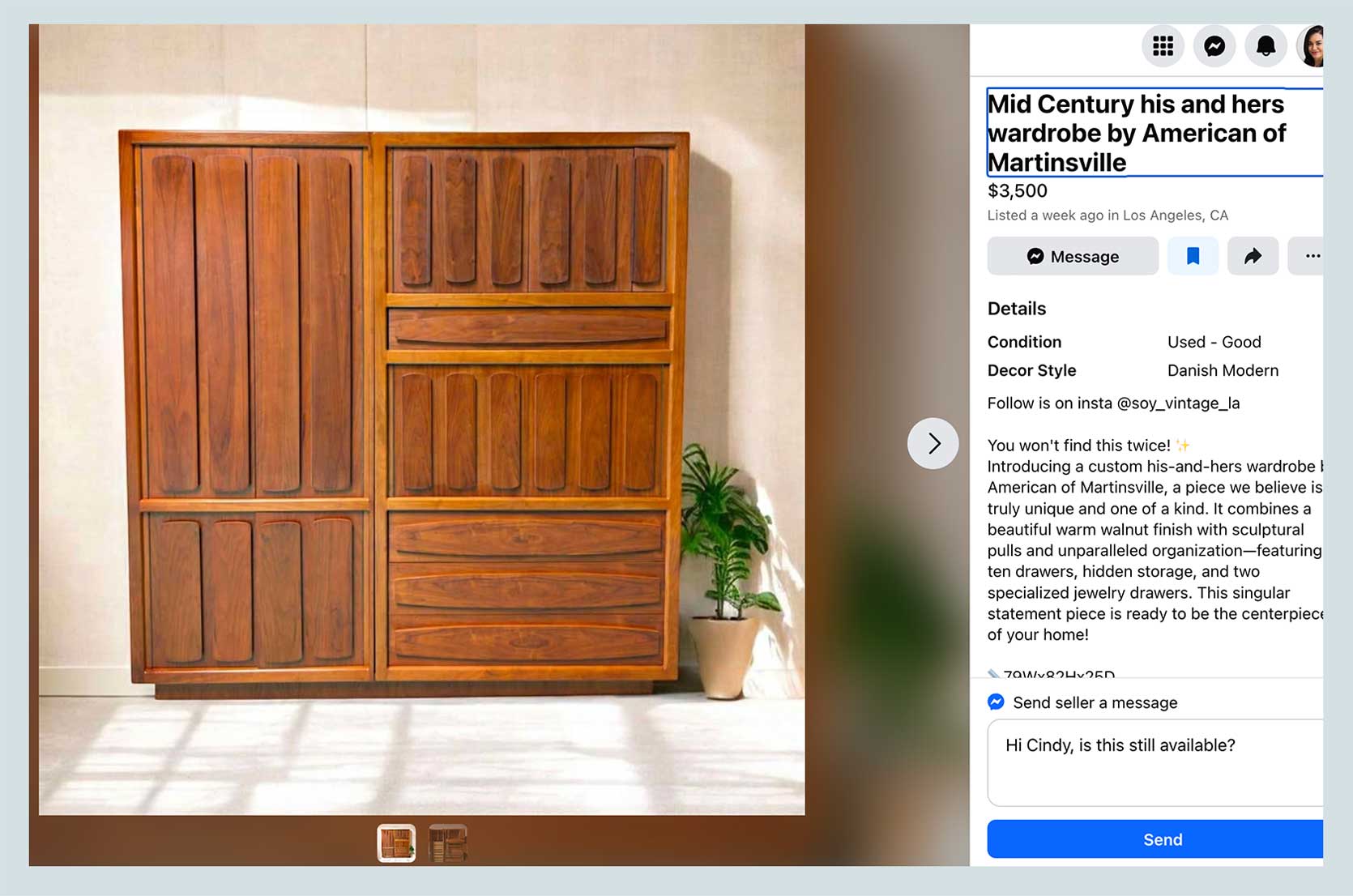
Another beast, with a price tag to match. I love the mid-century design on this one, the warmth of the wood, and it appears to have a ton of specialized storage inside.
Okay, But Where Do I Use One?
The bedroom is the most straightforward answer for where to use an armoire or wardrobe, considering they were originally designed as freestanding furnishings that held clothing before built-in closets were a thing. But it doesn’t have to stop there. Anywhere you need a large storage piece—whether for function or form—an armoire can work. Keep scrolling for some recent inspiration shots I dug up.
Vintage Armoire In A Bedroom
Interior designer Lonika Chande shared this shot of a guest room in her mom’s house. It feels eclectic yet minimal, and that’s the power of one large statement piece in a statement color, like that pinky-red armoire.
Add “castellated” armoire to my new list of dream items. If you have a large bedroom space with a lot of empty walls, an armoire is a fast fix to fill the voids, but also be incredibly functional.
Even compact spaces with low or sloped ceilings can accommodate an armoire. In fact, I find they work well in a room where you want to limit visual clutter because they have solid doors that hide mess. Whereas an open bookcase or shelves, while beautiful, can feel overbearing, full of books and decor items.
In a bedroom that is set up like a salon suite, an armoire tucked into a corner can feel really anchoring. This one is a French antique from Chairish, acquired by designer Hendricks Churchill.
For anyone who doesn’t love the antique brown wood look, yes, you can always paint an armoire. This satin black one in a bedroom by Amber Interiors is stately but doesn’t steal the show of the room’s ceilings or the view out the doors.
On the flip side of the previous bedroom is this old-world cottage bedroom posted by Shop Doen, though originally from Cabana Magazine.
Vintage Armoire In A Living Room
Now, another area of the home I love to see an armoire is in a living space, either a den, a living room, or a sitting room. They can be amazing for stashing away board games, seasonal items, sound equipment (an uncle of mine used to have this unbelievable Oriental armoire in his Manhattan apartment, and we’d just sit in the living room listening to his CDs he had inside with the stereo, and chit-chatting without a TV or phone in sight), even a small TV.
Just typing “and even a small TV” gives me inexpensive hotel vibes, but as long as the item is made of a natural wood material in a neutral tone, it’ll look great, not 1990s.
For added height, you can always store a collection of something atop an armoire; here, House Collected showcases a bunch of varied baskets.
Another one from Amber Interiors. I love the juxtaposition of the age-worn armoire flanked by the ultra-modern sconces.
This one is giving me pier mirror vibes, don’t you think?? It’s huge in comparison to the lower furniture, but it brings the eye up to what is clearly a very tall ceiling.
Obviously, this one isn’t vintage, but I like the placement of it in that shallow nook you often find next to a fireplace wall. I’ve seen a lot of people do a console of chest with art above, or add in shelves, but I love the addition of the armoire instead.
Vintage Armoire In Misc. Spaces
In this final category, I lumped together a few rooms since there weren’t enough of each for its own stand-alone bucket, but there are some great concepts here that may resonate with some of you!
An armoire in a bathroom is such a romantic move. I had a small storage cabinet (not aesthetically similar to this one, but it served the same purpose for me) in a previous bathroom when I lived in Florida. It was so convenient to have something like this, considering my under-sink storage was lacking. Mine held my toiletries, extra towels, some pretty apothecary-type bottles, extra toilet paper, and the like.
If you have an amazing woodworker or handyperson, remember that you can take the inside of an armoire and turn it into WHATEVER YOU WANT! Just take a gander at this amazing hidden bar (complete with a sink and faucet) by Nate Berkus’s design firm.
A petite armoire in a vestibule, wide hallway, or similar space is so unexpected, which I automatically love.
What an amazingly elevated way to add storage to a playroom (just be sure to anchor this thing to the wall, of course). This may be a kids’ room—by Lark Interiors—as it’s hard to tell without more context, but I still attest that an armoire in a playroom is a good concept.
And finally, put that armoire to WORK in a dining space, whether a breakfast nook or formal dining room. In this case, you’d have to have better interior storage than just a hanging bar, certainly, but if you could figure that out, it would be a great addition, especially if your kitchen cabinets were lacking.
—
And thus concludes another Secondhard Scores, with one of my favorite, most versatile of furnishings. Look around your house, and I bet you’d find a spot where an armoire could make a world of difference both for your storage needs as well as to aesthetically anchor a room.
What else do you want to see here? What other pieces do you see all the time on marketplaces that you’d love me to dive deeper on? Let me know, and I’d be happy to be of service. 🙂
Until next time, friends…
Opening Image Credits: Design by Arlyn Hernandez | Styling by Emily Edith Bowser | Photo by Sara Ligorria-Tramp | From: 3 Years In The Making Then An Unexpected Move: Arlyn’s Bedroom Reveal Is A Lesson In The Beauty Of “Unfinished” Design
Great round up! I always like Arlyn’s articles.
Armoires are often inexpensive on FBMP because they’re so hard to move and transport. It feels like some of these really need three or four people (or more!) to move them without causing damage.
I’ve found that the seller will post it at a certain price, but then the armoire will end up being almost free after weeks on FBMP — by then the seller just wants it out of her house.
Lovely post as always! Thank you. Much needed eye candy in these bleak times.
Having bought 4 vintage armoires online, I agree with everything you say Arlyn! Where I live (in Europe) we often get these for free because they are so heavy to move and take up too much space in tiny apartments. The biggest problem we have had is with height. The vintage ones are usually very tall so we have to make sure we have space to move it. It takes 3-4 people to move the larger ones that can’t be dismantled. The insides can be easily altered, e.g. putting in a rod so I suggest not overthinking that. If you get one with a mirror on the outside, note where you place it and what will be reflected, I used to prefer those until I realized that they are physically heavier and make a room look more busy due to the reflection – which was not what I wanted. In Europe they are used in salons all the time and look and function great, so go for it! They are the most versatile furniture pieces!
Wasn’t there a special Scandinavian blue hutch/armoire that Emily purchased from Europe? Did that ever find a home?
She talked about it recently in one of her posts. I think it might end up in the guest house building.
Arlyn, it’s always been so great to read your posts here and elsewhere on the internet over all of these years. Thank you! This one made me realize why the old apartments I’ve lived in had almost no built in storage. It must have been not just that people had fewer things, but that there was an expectation of the renter using furniture like armoires for storage. Maybe a post about vintage cane furniture? Here’s to a week of small joys for you and your sweet family!
Yes, up until surprisingly recently, it was common for people to fold clothes for storage rather than hang them. They also had way fewer articles of clothing, along with just less stuff in general. I live in an old house and have actually come to prefer freestanding furniture over closets. It’s more flexible!
Dying to know if you ever got your armoire out of storage. Wasn’t there some issue with it in your move?
…I am referring to Arlyn’s armoire from her bedroom reveal…
I’ve been looking for a buffet/sideboard and a vintage bar cabinet. Think you could put together another secondhand scores post on either or these two items? Thank you!
Over 20 years ago, we bought a rustic antique hutch and an ice box. Now that we are 20+ years older, and we no longer store games, school supplies, and bakeware in the ice box, we are trying to give it away, but even Habitat won’t take it because that sucker is heavy! We successfully gave our Mexican pine entertainment armoire to our friends for their music studio, though. Still, every time I spy a vintage or antique armoire, I have to stop and look.
What a fun post! I actually have one of the armoires listed here … with a collection of vintage cookie tins on top. It’s my office, as the room it’s in doesn’t have a closet. It was a pain to transport when I bought it about 20 years ago, and we had to rent a small UHaul to get that thing home. But it has served me well, and if we ever move, it will certainly come with me!
I got an armoire for $5. I didn’t have a license at the time, so had taskrabbiters pick it up for me. Unbeknownst to me, the owners had used it as an entrance for an escape room and had taken the back out, and did some bizarre things to the inside. So def get as many photos as possible before buying!
I’d love pieces on vintage china cabinets, sideboards, dressers, and secretary desks.
Holy smokes, that’s crazy!! I can’t believe they didn’t disclose that. I’m sure that was a big surprise for you when it arrived… “Uuuum, where’s the back?!” 😆 The perils of marketplace.
We have a 1920s/30s deco veneer armoire in our old house’s large but closet-less entry/mudroom, which we use for coats and misc object storage. It’s great! We’re looking for one for my mom who has a similar situation – be VERY sure to check the depth if you are wanting to use the hanger rod. Many are a couple inches too shallow to comfortably store coats on a hanger – needs 20″ and many are 17ish.
I have a shallower armoire in my guest room, and it has two rods that extend from front to back rather than side to side, if that makes sense. It works fine, but probably would be annoying for a used-every-day “coat closet.”
Can I please add another search term for those who don’t have the room for a full armoire – I bought a bonnetière quite a few years ago which is like a single door armoire. Traditionally used for hats (I think), I use it for kitchen and dining linens.