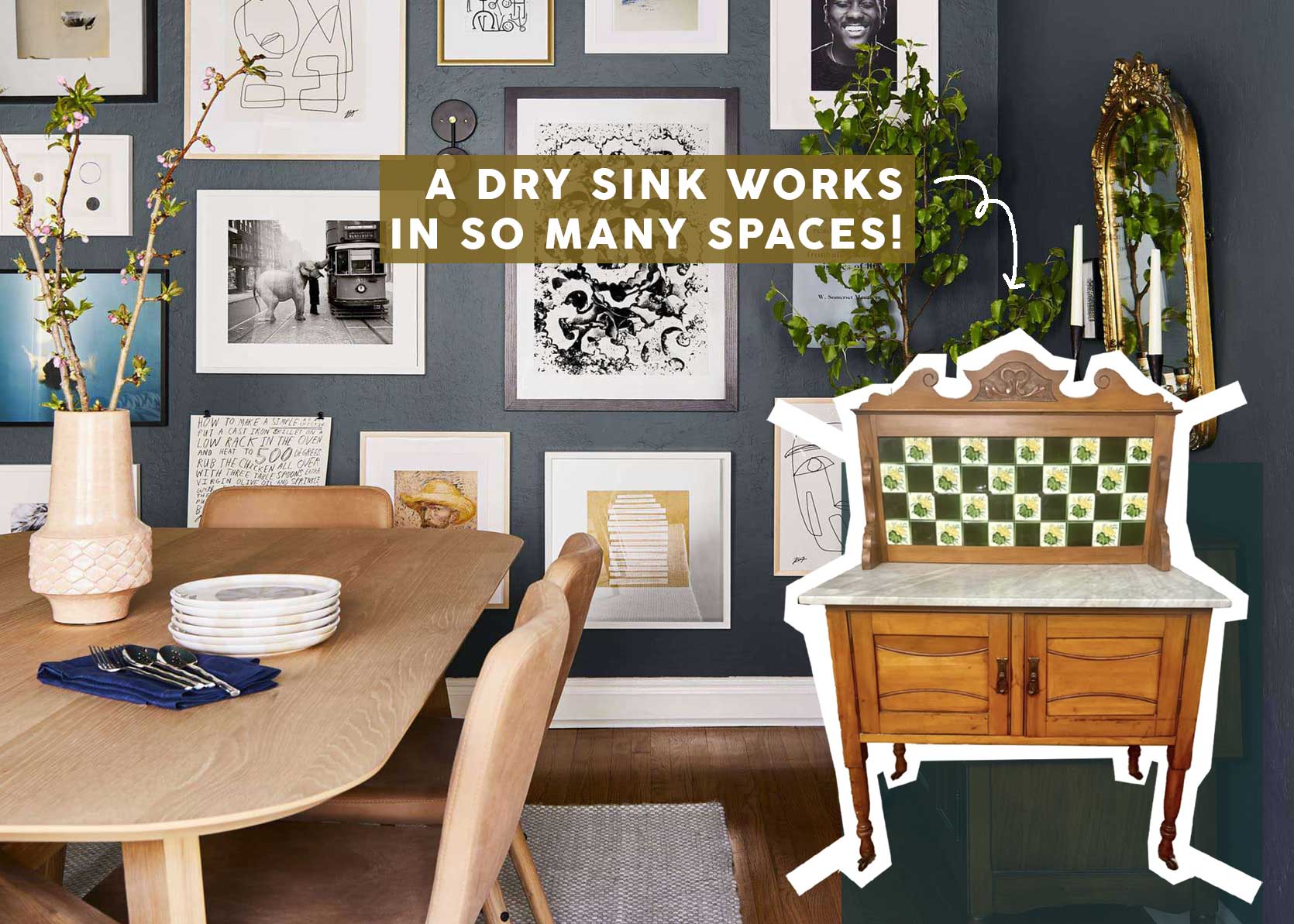
Budget Ideas
Secondhand Scores: An Antique Dry Sink Is The Useful (& Affordable) Furniture Piece You’re Overlooking
Welcome back to another installment of what I’m loosely calling “Marketplace Marvels.” Or perhaps “Secondhand Scores”…[edits headline because I like that better]. The title is a work in progress, but the heart is the same: What can you do with all those interesting, affordable, and durable vintage and antique finds you scroll or walk past on Facebook Marketplace, Craigslist, or at your local flea market? Don’t get furniture FOMO; let’s learn about them, figure out what they should cost you, and see how other people are using and styling them, shall we?
What Exactly Is An Antique Dry Sink?
A dry sink is exactly what its name suggests: A “sink” without running water. Prior to homes having indoor plumbing, this piece of furniture was used to hold a large wash bowl and pitcher that people used to wash their hands, faces, food, bodies, and the like. They had a small backsplash made of either wood, stone, or tile to protect the wall behind it from getting wet. The cabinet-like piece came into popularity in the early to mid-1800s, the predecessor to the simpler washstand, which was a compact wooden stand without enough room to set the bowl and hold the water, possibly even a towel.
Once plumbing came into play (that was the early 20th century in the US), these fell out of favor, and now are used for decorative purposes…more on that if you keep reading.
How Do You Find One & How Much Do They Cost When You Do?
As I learned from the comment section of my first article about barrister bookcases, prices vary widely on secondhand items sold on local marketplaces, depending on where you are. Perhaps it’s supply and demand. Or maybe it’s simply different inventory in different parts of the country. But regardless, I wanted to walk through some of the dry sinks I found within 50 miles of me here in Los Angeles.
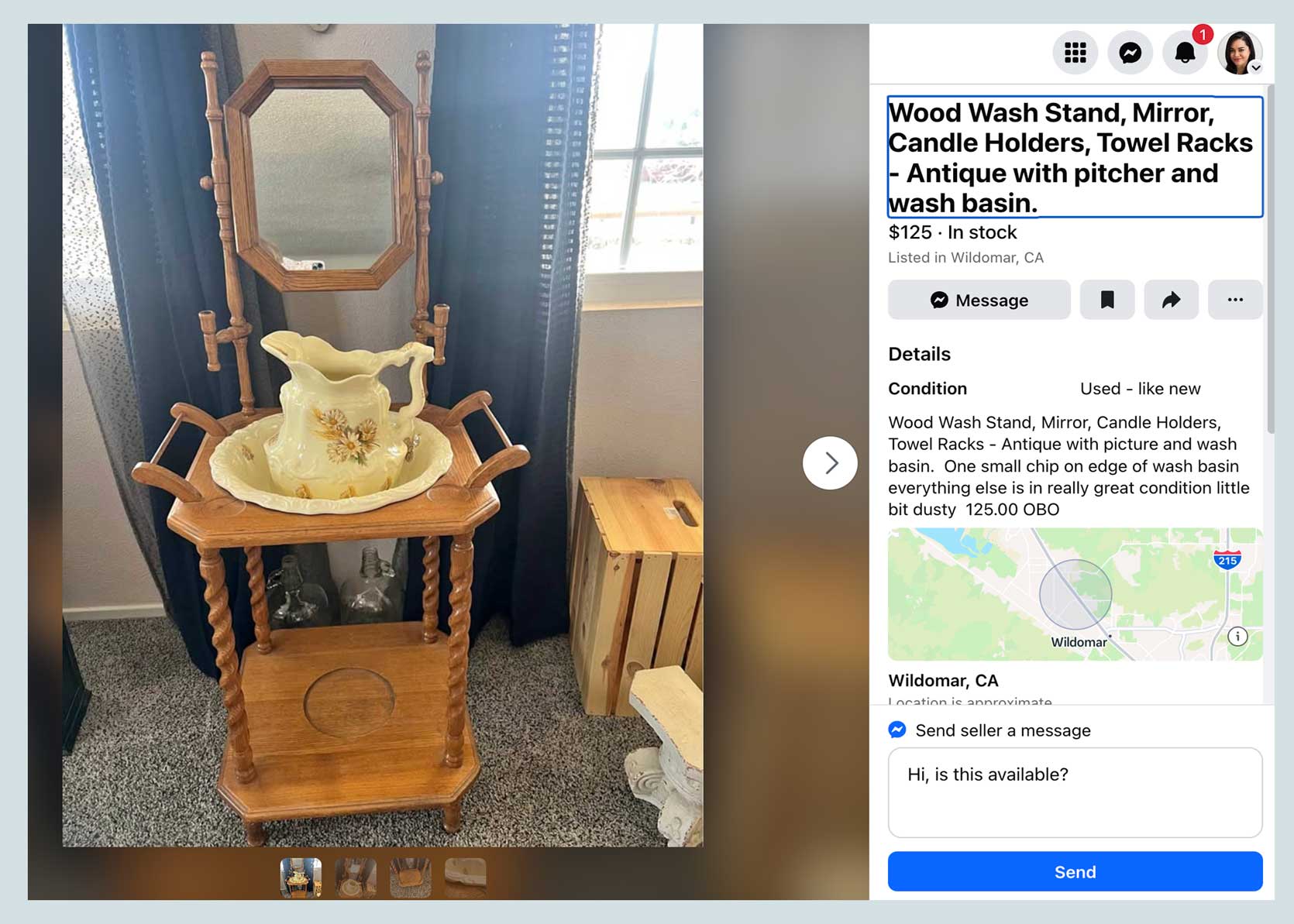
Before dry sinks emerged, washstands and wash basins were the norm. As you can see from above, it was just large enough for a bowl or basin, with room to place the pitcher below when in use. This one even has a mirror and side rails for towels. I can’t envision much of a use for this these days, but nostalgic, nonetheless.
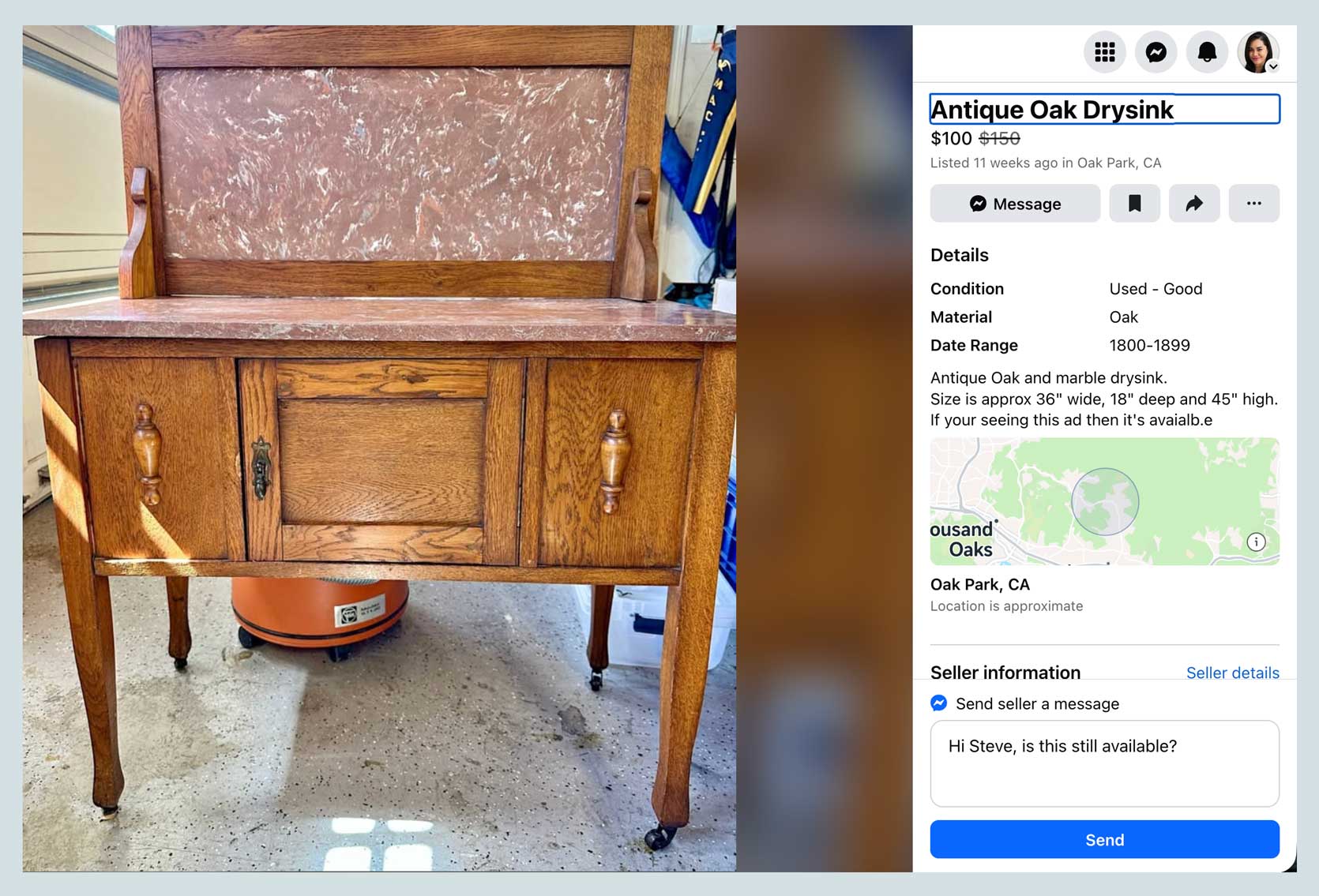
And here is a proper dry sink, as I mentioned, it’s the evolution of the wash stand we saw prior. This one is so special with its pink marble and delicate detailing. And at $100 (!!!), it’s a complete and utter steal. If you’re near Oak Park, California, please grab this one.
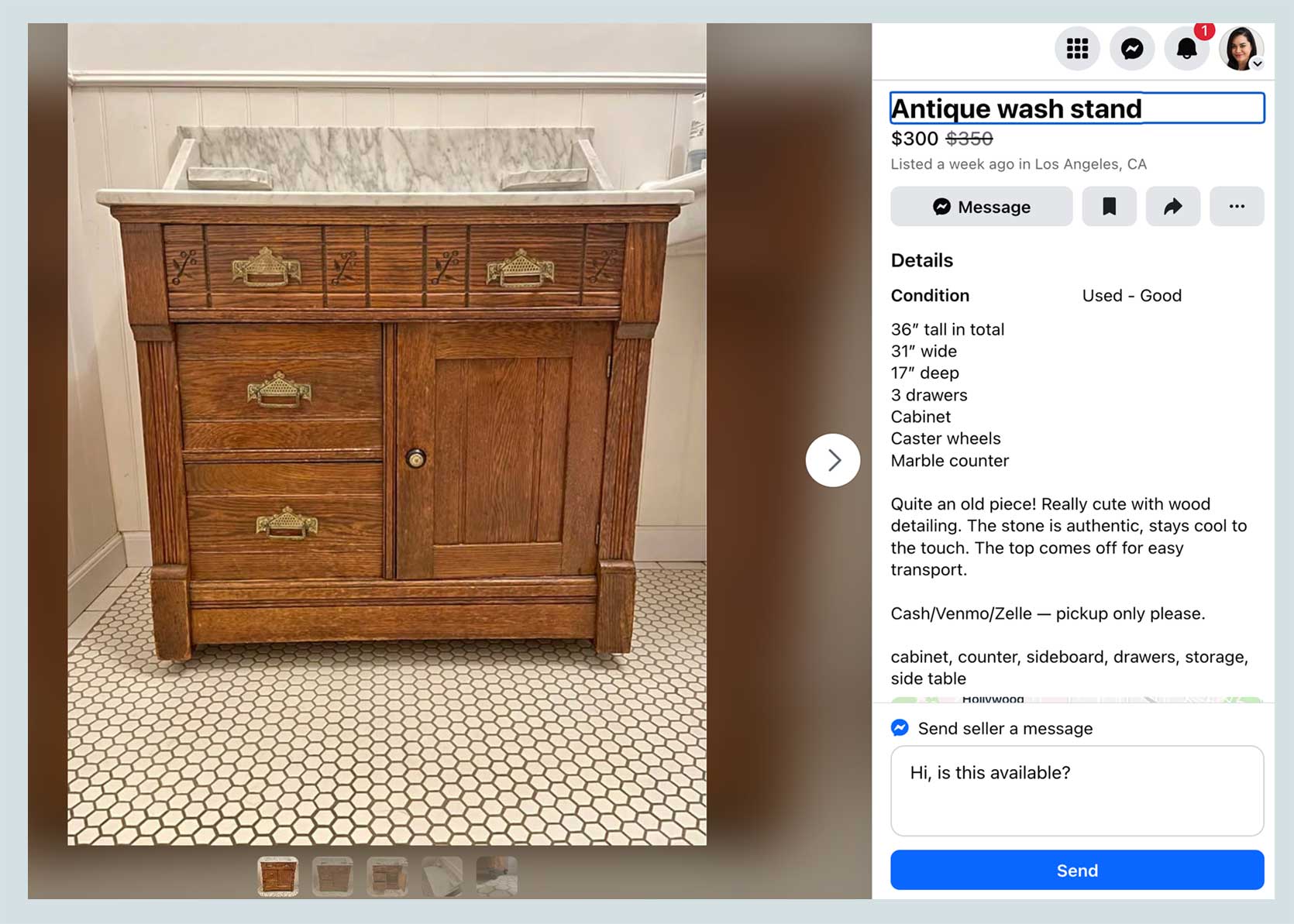
Here is one that’s a bit pricier, but still far less expensive than anything you could buy on the market new today. Solid wood, marble top, brass hardware, cute little carvings, are you kidding me? Note that this one is called a wash stand, so be sure to check both names when you’re hunting for one.
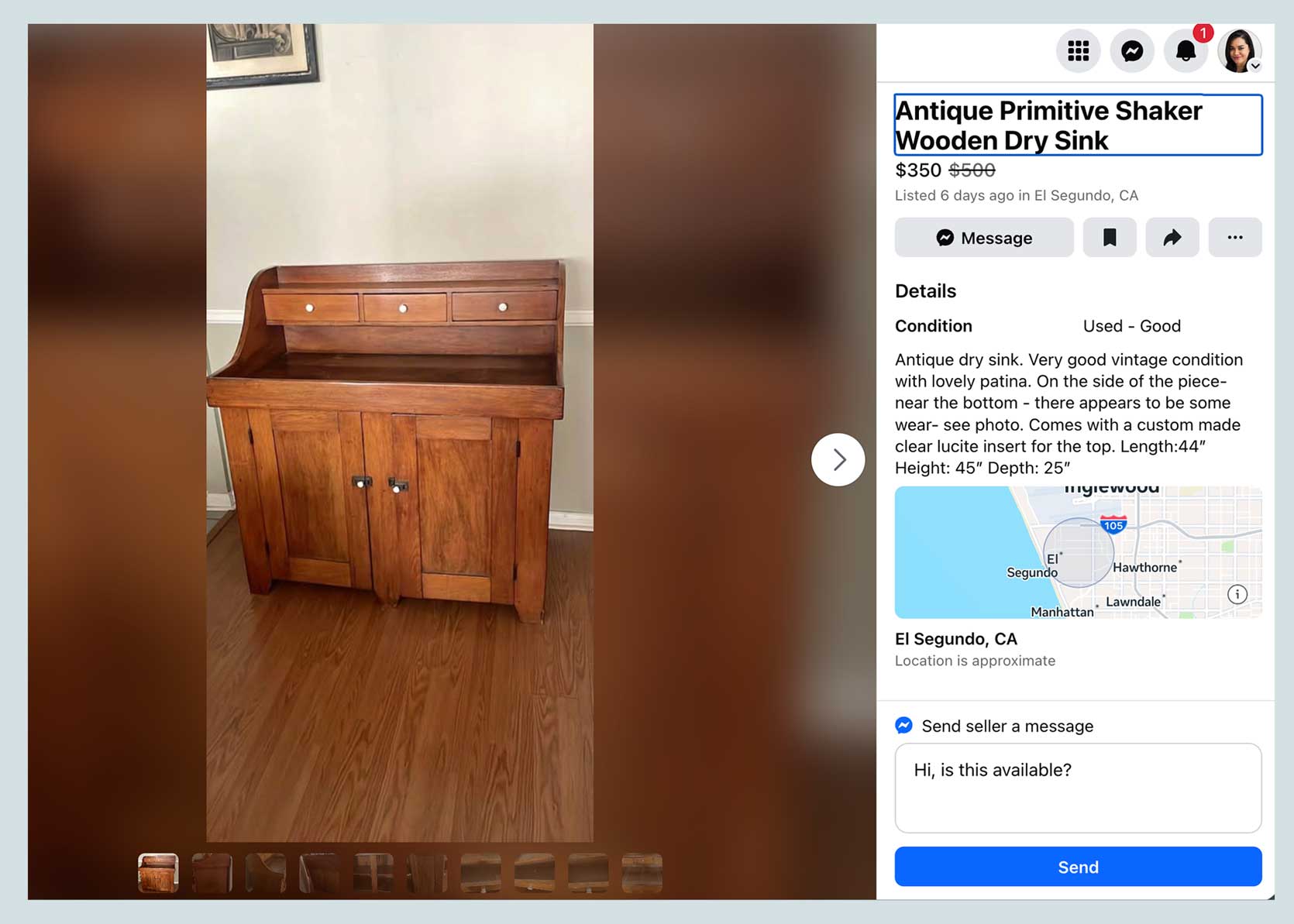
A tick more expensive than the last, but a good size at 44 inches wide. This one is in a Shaker style, which you can see through limited ornamentation and the cabinet door design we all know (and still use) today. It has a lip around the front to prevent any spills from landing on the floor.
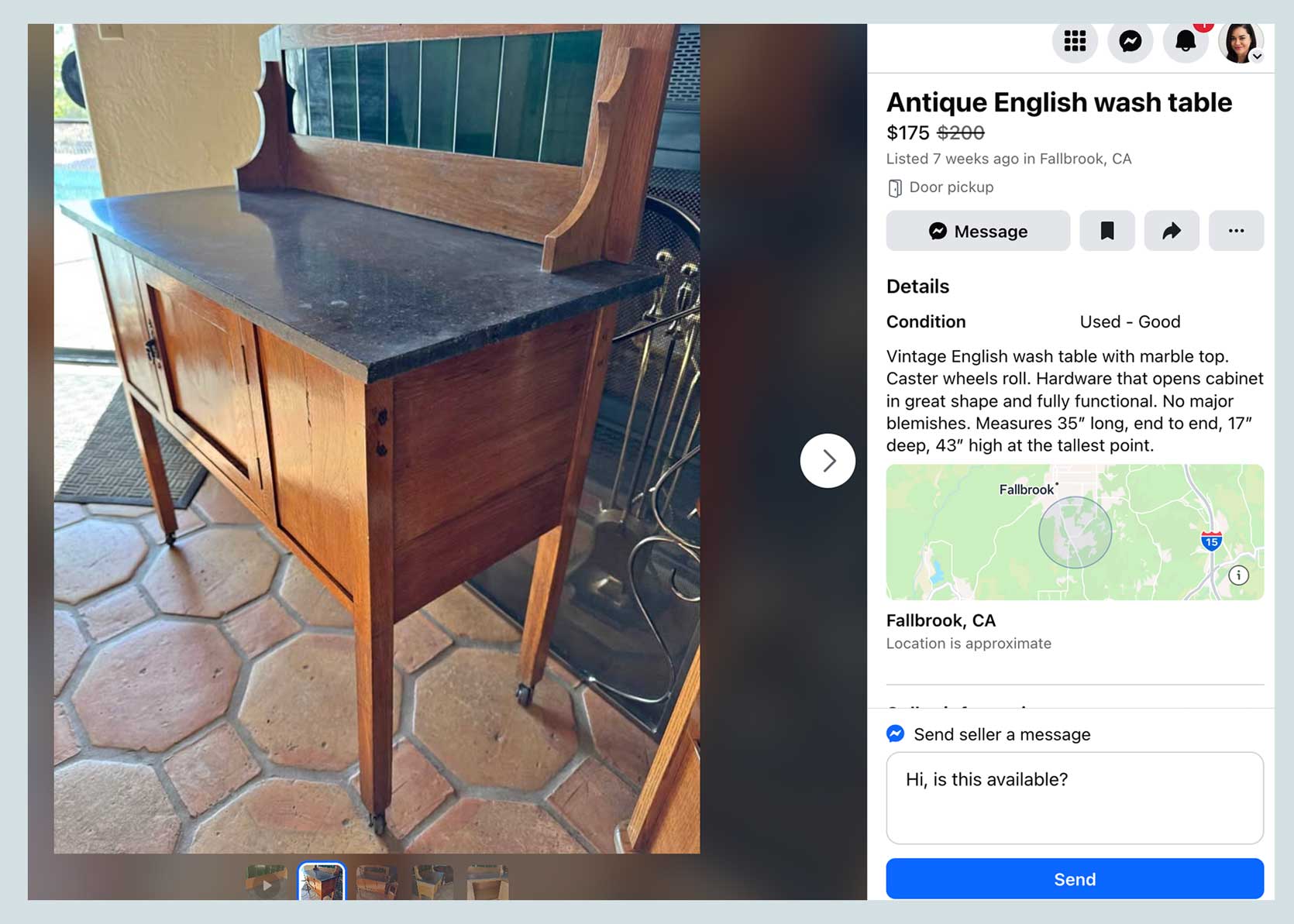
This one is called a “wash table,” so get creative with those naming conventions while you search, people! You’ll find a lot of these leggier versions on casters, which at the time, made them easy to move around as needed.
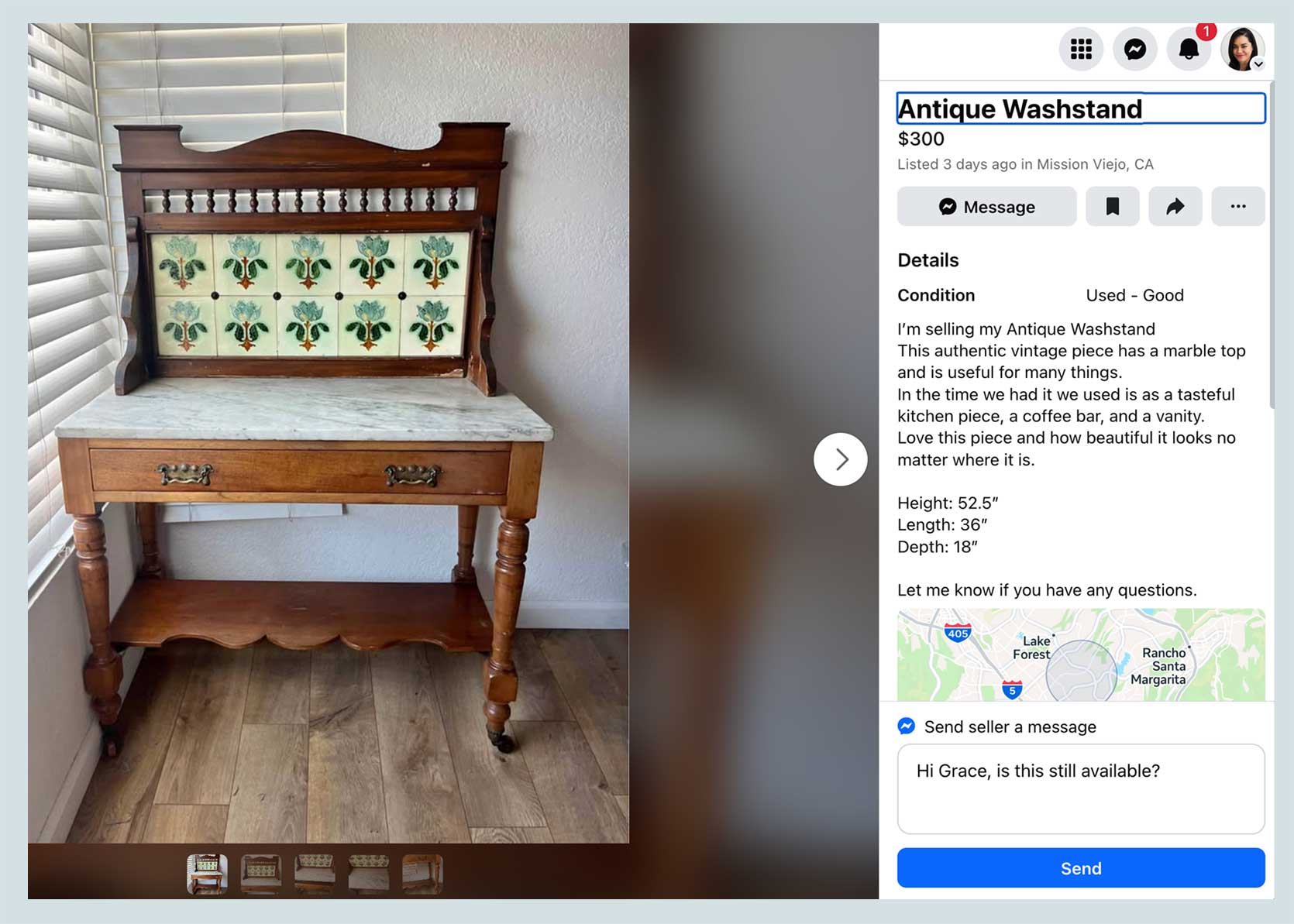
Tile work can be simple and solid colored, like the previous dry sink, or more decorative, like the one above.
The Different Kinds Of Dry Sinks
As is standard with antiques, different eras and regions dictate what materials were used and what their styling was. I’m sure there are plenty more I’m not covering here, but I do not have a degree in dry sinks (yet). Here are some of the most common ones I see when secondhand shopping:
Marble-Topped: These came into popularity in the Victorian era (mid-1800s to early 1900s). Marble was a common material at the time and was used for its durability. Around this time, a recessed basin was scrapped in place of a flat surface. Dry sinks from this time period are also a bit more ornate in their woodworking, as things were in the Victorian age.
Tile Backsplash: Tiles as a backsplash came into play in the early 1900s, when plumbing began appearing in homes. Some are in the Arts & Crafts or Mission style, others are Edwardian, such as the one above (though the seller said it might also be Victorian; it doesn’t look ornate enough for that IMHO).
Here is another dry sink with a tiled backsplash. The lister notes that it’s Edwardian; after a quick little looksie into what the hallmarks of Edwardian furniture are, I can see how this one checks the boxes: lighter-toned woods, less ornate woodworking, and floral motifs.
All-Wood With Bottom Cabinet: Some dry sinks have more storage than others, such as the one above. This one is a primitive design, from the early 19th century, and you can tell because of the recessed basin (the lip around the surface).
Some Ideas For How To Repurpose & Style One
Now that we’ve met some different kinds of dry sinks, let’s see how some people are using them in their homes. Spoiler alert: I’m gonna need a dry sink soon.
I have to admit that I didn’t really know much about these prior to a few years ago, and the petite dry sink in Caroline Winkler’s rental kitchen I watched come to life on YouTube, was one of the first I took true notice of. Anyhow, a dry sink works great in a kitchen where you need to add a little more counter space to hold fruit bowls, a coffee bar, mixing bowls…anything you need!
Here is a primitive all-wood dry sink used as a console table (or perhaps an entry table?). It’s hard to take my eyes off that amazing stained glass door, but the beautiful, rich tone of the wood on the dry sink cabinet also draws the eye.
This type of dry sink is primed to be in a dining room as a service piece. The high back and built-in shelves are pretty unique and great for little floral moments or a prized trinket.
Another primitive design, being used as a bar.
This sweet little marble-topped dry sink looks so great as a vanity table in a bathroom with some pretty apothecary jars, rolled up towels, or your most aesthetic makeup and beauty supplies.
Dry sink turned wet sink! Don’t forget you can take one of these pretty pieces and retrofit it with actual plumbing and a sink vessel. If this is the case, it’s best to find one with a natural stone surface for durability, as wood can’t handle constant water exposure.
This little kitchen station is giving me Emily Bowser vibes for some reason. Maybe it’s the collection of little…rolling pins, maybe?
Juxtapose a rustic, worn dry sink with your fanciest crystal, glass decanters and brass ice buckets or pitchers. This technique takes something old and makes it feel fresh and interesting, as opposed to looking like something sitting in an old storage unit.
Looking for a unique entry table? Grab a dry sink with some interesting tile work. It adds color and pattern without trying too hard.
As long as the integrity of the wood is intact, yes, you can use one of these as a changing table! It has a built-in lip to keep the baby from rolling. I’d suggest adding a little cushion with a built-in buckle for extra safety.
—
Raise your hand if you’ve envisioned at least two spots in your own home where an antique dry sink could add some interest and function. I don’t have a single open space of wall in my current home for one, but believe me when I tell you that whenever we move into a larger home (hopefully in the next few years), I’m going to hunt one of these down.
What pieces do you regularly see on Marketplace or when vintage shopping? I’d love to deep dive, learn, and share my findings!
Until next time, friends…
Opening Image Credits: Design by Arlyn Hernandez | Photo by Sara Ligorria-Tramp | From: Arlyn’s Moody Dining Room Reveal Is All About the Insane Power of Paint | Vintage Dry Sink via Facebook Marketplace

I found one of these at a local Restore several years ago and I gave it away. I want it back. I didn’t realize how versatile it is.
Ugh that’s an awful feeling! But there are plenty still out there for the taking.
I love this new series so much!!!’
Thank you!
Just here to say that I LOVE this new series so much!! Maybe do stand alone fireplace mantels next?
I think I have one of these and didn’t realize it was a dry sink. I picked it up at a ReStore for cheap, I think $40. I use it for kids craft storage in our dining room. I thought it was a rustic buffet but it might be a primitive dry sink. It does have a lip around the counter.
It just might be what it is!
I have a dry sink that I bought for very little many years ago. It’s missing its backsplash and the marble is cracked but it’s perfect for the space. I use it as a side table, next to an overstuffed chair in a bay window in my primary bedroom. I love it!
Love that use!
‘Dry sink’ is a new term to me – I’ve always called them washstands. Admittedly, I’m not American, but I concur with the advice to use other terms when searching for them (and would suggest ‘washstand’ as a contender).
(To be clear, ‘washstand’ as one word, not two. The former is pretty standard here in the UK.)
It may be a regional thing, but from my understanding, washstands came first, with just enough room for a basin bowl and pitcher, and then dry sinks came to be later, which are more this commode/cabinet profile.
I love these vintage finds posts! As a constant facebook marketplace user, they make me feel very seen! One thing I’d consider including in the posts is a bit more about how to pick a good one. For example, if I were buying a wash station sink, I’d want to look at the type of wood. What were the wood types that this was frequently made out of? Which ones are higher quality? Oak or mahogany have been more expensive than pine for generations, so an oak or pine piece is going to come from a maker with more money. They’re also harder woods, so they last better. That doesn’t mean pine can’t be amazing! I have a great antique pine piece in my kitchen! But it’s worth knowing that it’s probably coming from a more rustic background and may have more structural issues. Make sure to look at those pics closely. My great pine piece has some decay, but it’s in a spot I can live with. When I’m shopping for wood pieces, I’m also looking at the cut of the wood. Is it quarter sawn? Plain sawn? Once you know the difference, you’ll never look at wood furniture… Read more »
Thanks for that insight! Will keep in mind for the future. 🙂
Another amazing article, thank you! I like pieces like wood topped wash stands/dry sinks because you can generally find two that look similar enough to make mismatched nightstands. I use them in my bedroom and my kids and they are the perfect height!
Ohh, this is exactly what I need for my entryway! I had been thinking a small dresser, but the doors (vs. only drawers) of a dry sink would be great. Thank you for another great article, Arlyn!
Glad I could help steer you to some clarity!
Loved seeing this series. You got me jonesing for barrister bookcases so much – what a gorgeous way to store stemware or pottery! Also, loved seeing content from Caroline Winkler – she would be a great guest feature on this site. I would also look at xoMacenna – her farmhouse series is beyond impressive. And now she is building custom bookcases now in her Cali home and it would be amazing to see that.
I don’t know xoMacenna…looking up now!
I use our old wash stand as a bedside table – pop in a bowl and put the lamp in that. Our dry sink is all wood with a lid that lifts up under which the water bowl was stored – more protection against freezing overnight. There are always ways to use these items!
This is a really interesting series. I learned something new today while getting to look at pretty pictures.
We used ours as a changing table 🙂 All this time I had no idea it was a dry sink! It’s now a bar on top, board game storage below… it grew up with the family. Thanks for the great post!
Love that!
I once had an oak buffet with a back and sides, a two-drawer front and open space below. Now I’m wondering if it was a dry sink. What would you say are the differences?
While I’m not entirely sure of the exact difference, I’m guessing age and size? Dry sinks were on the smaller side. The back and sides may be a give away it could have been a dry sink!
I love this series, and all of Arlyn’s posts! Longtime reader, first time commenter, to mention that with a little elbow grease, you could use a dry sink as a bathroom vanity. A few coats of marine spar varnish will block the water. We converted an Art Deco bedroom vanity to a bathroom vanity using this method, and four years in, it’s still looking great and holding up well. And it’s the kids’ bathroom so it’s not minimally or especially carefully used.
Hi
I have 3 dry sinks acquired several years ago,all marble tops. I have used them in a variety of ways over the years and currently use one as a nightstand next to my bed.
Just a clarification—”predecessor” means something that came before. I think the lede means to say that dry sinks are the “successor” to washstands!