Design
The 4,000-Year-Old Decor Trend That’s Back (And Honestly Never Really Left)
Move over ceramics; colored glass is the new darling of decorating. As a certified, card-carrying member of the totally made-up Color For All of Our Homes Club (CFAOHC for short…just rolls off the tongue, doesn’t it?), I’m thrilled to bring to you an “old decor trend” I’ve been seeing everywhere lately. In fact, I started noticing it becoming more mainstream over the last five or six years, and I’m going to go ahead and say that Stephanie Summerson Hall of Estelle Colored Glass may be at the heart of it. A decade ago, I would have found it difficult to believe that I’d have a preference for a glass (especially a colored glass) vase over something ceramic. When I thought of glass decor, I envisioned dolphin figurines and Dale Chihuly knock-offs. Farmhouse pottery, earthenware, terracotta, and the like have topped our styling must-have lists for as long as I’ve been in this game. And while it’s, of course, still gorgeous and an important part of a balanced vignette, there’s simply something about the way light travels through a glass object that cannot be replaced with something matte and opaque.
We’ve written plenty about stained glass in the past few years, and that love isn’t dying down any time soon. But it’s not super accessible for many of us, whether it’s because you’re a renter or that the budget for a custom piece is cost-prohibitive. A lilac decorative glass bowl or vintage green glass sconce, though? Way more equitable.
Of course, people have loved colored glass decor for much longer than this five- to six-year window I’m bringing up. Glass and crystal objects have long been luxury pieces worth collecting or investing in, but the beauty of a trend is that it makes things easier (and oftentimes more affordable) to acquire…for better or for worse. My favorite source for colored glass at the moment is the thrift store, but keep reading for a PSA on this (spoiler: it involves lead).
Before we dive into some inspiration and shopping, let’s flip through the pages of a little history to (hopefully) gain a deeper appreciation for the art of colored glass. Because, as I’ve learned, it’s not just about adding color to glass.
A Brief History Of Colored Glass
The history of colored glass stretches back about 4,000 years, to ancient Mesopotamia and Egypt, where early artisans were making beads and vessels long before anyone had a word for “decorative object.” And somewhere along the way, humans figured out that glass didn’t have to be clear; it could hold color, carry light, and completely change the feeling of a room. Once that door opened, there was no closing it. The Romans understood this instinctively. They produced something called the Lycurgus Cup, a piece of dichroic glass that appears jade green in reflected light and shifts to a deep, glowing red when light passes through it. It’s the kind of piece that makes you believe a bit of magic was the only way to achieve its creation.
But by the 8th or 9th century, the science started coming together when a Persian scholar named Abu Musa Jabir Ibn Hayyan—considered by many to be the first true chemist—wrote Kitab al-Durra al-Maknuna, or The Book of the Hidden Pearl, the first extensive documentation of colored glass production. He documented which metals produced which colors, such as cobalt oxide for a deep blue, copper oxide for turquoise, and neodymium for a purple that shifts depending on the light source. Fast-forwarding to the Middle Ages, stained glass had become synonymous with Gothic cathedrals; then, Venetian glassmakers in Murano kept refining the craft through the Renaissance, developing techniques like millefiori (thousand flowers), which are patterns so intricate they barely seem possible. Then Louis Comfort Tiffany brought colored glass into the home in a way that felt both accessible and otherworldly, and the rest is interior design history.
While I’m no scientist, the formula seems deceptively simple. Silica + heat + a metal oxide = colored glass. The result has always been something more than the sum of its parts. Today, studio glassblowers work with pre-colored glass bars (solid rods of pigmented glass that get melted and merged into clear glass during the blowing process) or frit, which is crushed colored glass that artists roll molten pieces through to create spots, streaks, and layers of depth. The metallic oxides bond chemically with the silica, which is why the color doesn’t fade. It’s ancient chemistry dressed up in a very beautiful, contemporary object.
Which brings us to something worth knowing before you thrift that set of vintage coupes. Nearly all antique and vintage glassware was made with a high proportion of lead oxide. It’s what gave older glass that beautiful prismatic quality and that satisfying ring when you tap it. It also made the glass easier to work with during production. Uranium oxide created those gorgeous green Depression-era glasses; cadmium gave red glass its depth. All of it stunning; all of it worth handling with a little more intention than your everyday drinkware. If you’re unsure about a piece, leaded glass tends to feel heavier than it looks, has a higher-pitched ring when tapped, and catches light in a way that’s almost too pretty. Testing kits exist, though they’re not always sensitive enough to be fully reliable on glass specifically.
None of this means you have to stop buying vintage, just that it’s worth knowing what you’re working with. Display pieces, flower vases, the occasional special-occasion pour are all still fair game, but maybe skip the daily juice or wine from that pink glass cup you picked up at the antique store.
Where To Use Colored Glass Decor In Your Home
If you think vases and stemware are the only spots to enjoy a little tint to your glass in your home, the good news is it’s everywhere, from lighting (my favorite), tabletop, and catchalls, to trinket boxes and even furniture if you can stand the clinking sound of placing anything down.
Colored Glass Lighting
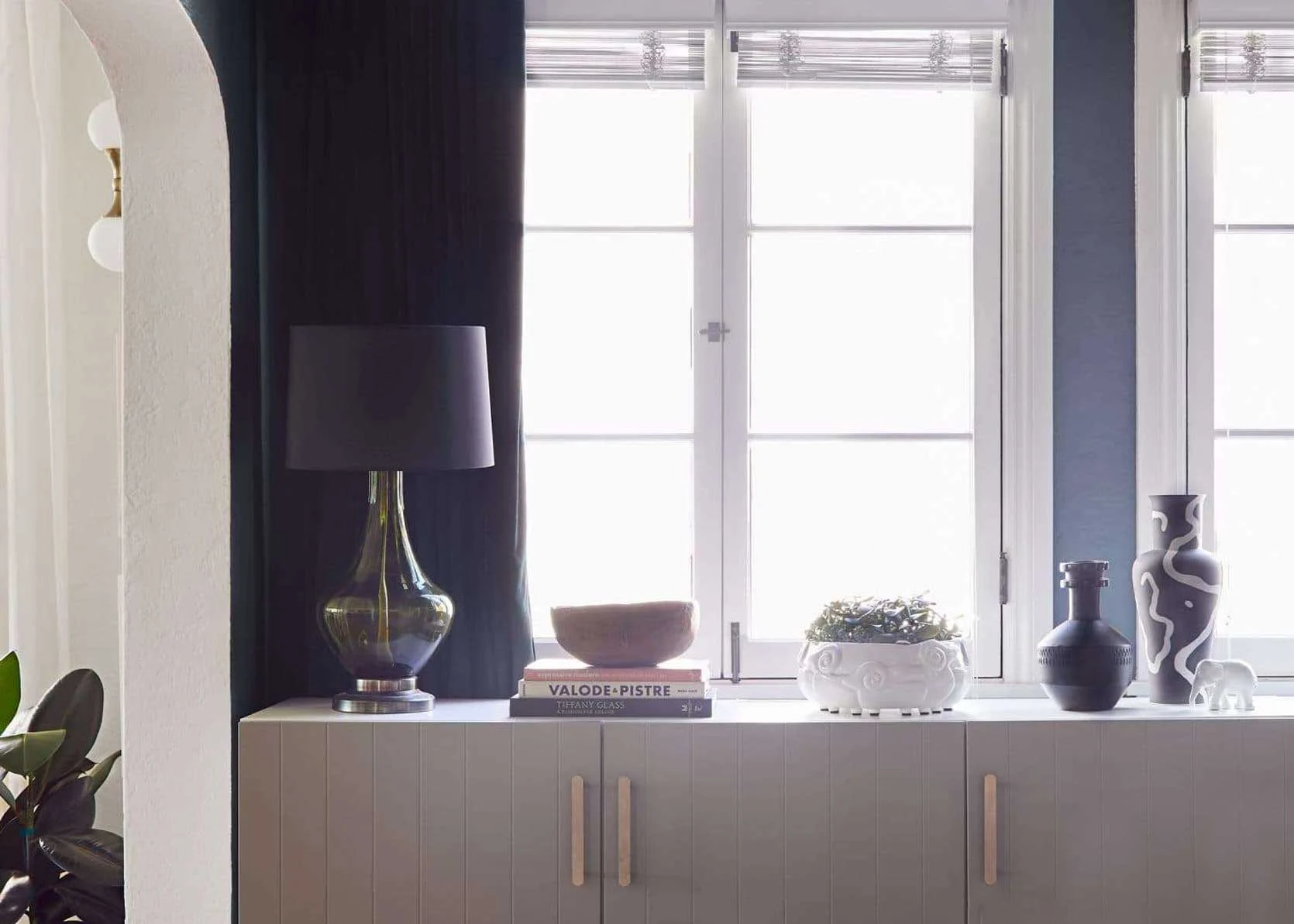
Let us begin with my absolute favorite use of colored glass: Lighting. That image at the top of this post? Those are green Venetian glass vintage lamps I bought over a decade ago at a flea market in Miami. I wasn’t typically drawn to glass in that way, but when I saw those, gleaming in the South Beach sun, I had to have them. They are currently stashed away safely in my garage, away from the danger of a rogue soccer ball kick or overzealous magic wand wave from my preschooler. However, I’m tempted to take the risk and display them proudly in my dining room again, just as I did before parenthood.
Amber is one of the “friendlist” hues of colored glass because it basically acts as a neutral with how adjacent it is to brown. Golden Design Interiors out of the UK could have gone with a metal or fabric-shaded pendant here, but the addition of the textured glass adds a worldliness and makes the traditional architecture feel storied.
Pink. Murano. Chandelier. Three words that come together to make design alchemy. Are you kidding with this!?!? It’s definitely not for every space or every home, but in the right room, it’s the star. (Unfortunately, I think this image is AI by the lighting vendor, Cherry Vintage).
What do you get when you mix the butter yellow trend with the glass lighting trend? Well, this spectacular honey-toned Murano chandelier from Studio Laurin. I just love the glamour something like this adds to a grounded wood table and chairs in a dining room.
There are many things to love in this luxe hallway by Studio Vero, but the brown glass ceiling lights just might top my crush list.
Now, before I share some shopping picks here and throughout the post, I want to call out one thing: There are so many dupes out there right now. There are websites dedicated exclusively to selling trendy knock-off lighting, and I tried very hard to avoid those when I could and recognized it for what it was. I’m not saying this is a perfect list of solely original designs, as I’m human and I do make mistakes, but places like Vakkerlight and Radilum didn’t get included. I’ve linked to them in the past and saw comments from readers that it was hit or miss. So while the explosively viral Vera Sconce from In Common With costs nearly $2,000 and is not something I could even begin to afford, I decided to let you be your own guide as to your comfort level with buying a dupe versus pining for the real deal. Granted, unless it’s something squarely contemporary, much of what is sold today is essentially just a “knock-off” of an antique design, so take this all with a grain of salt. It’s very nuanced, but this is what I decided for today’s post, and I wanted to explain why there are limited “budget” options linked below.
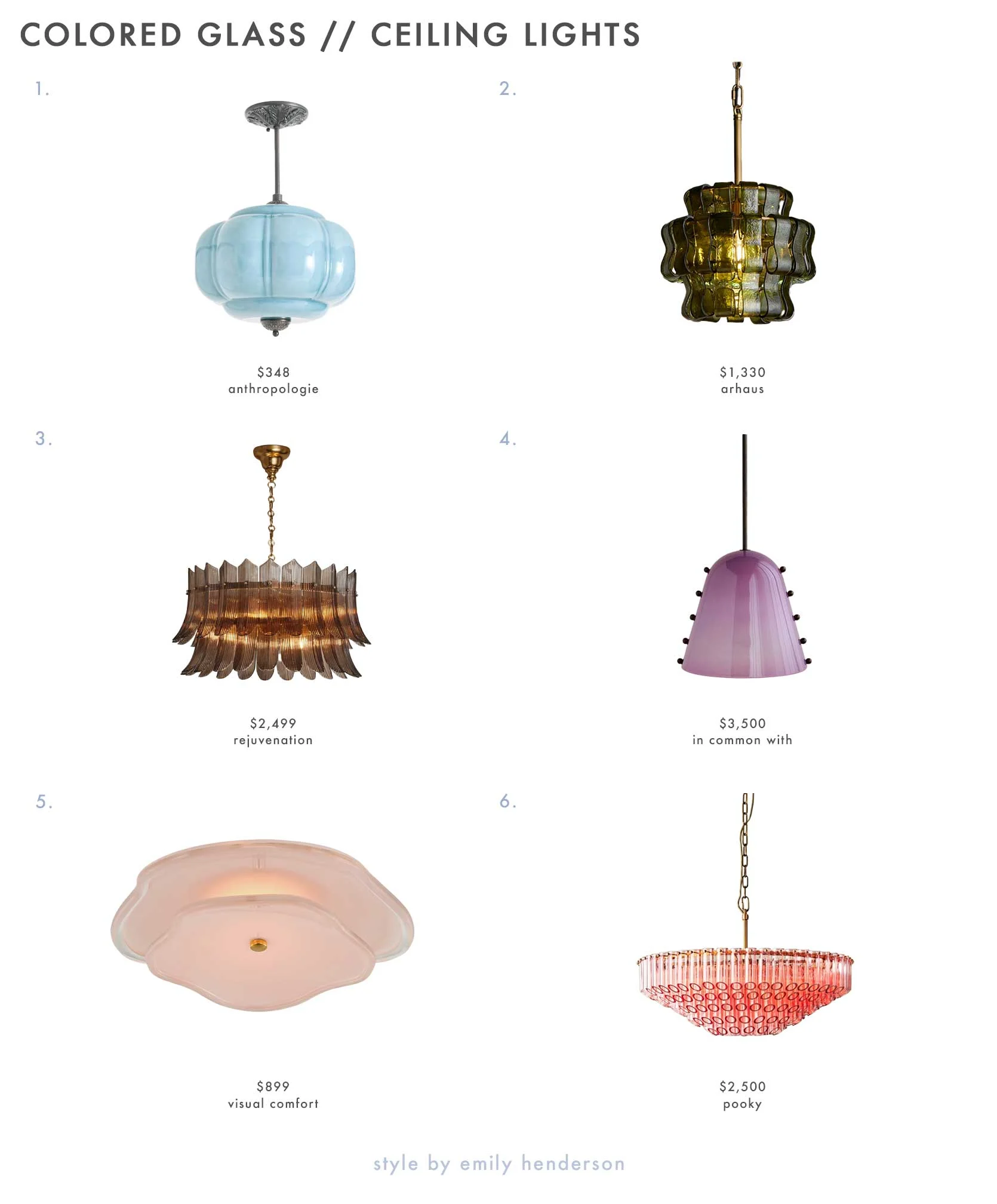
1. Eloise Milk Glass Scalloped Semi-Flush Mount Light | 2. Ghiaccio Pendant | 3. Providence Double Tier Chandelier, 32″ Width | 4. Gemma Pendant in Lilac with Amber Embellishments | 5. Leighton 14″ Layered Flush Mount | 6. Larger Oldfield Chandelier in Pink Glass
Blue, green, pink, lilac, brown, coral…I mean, WOWOWOW. This is the stuff of CFAOHC dreams! I could see the blush pink flush mount from Visual Comfort quietly punching up the ceilings of a mostly neutral entryway or hallway. Pooky’s tubular design reminds me of rigatoni, and trust me when I tell you that’s one of my favorite pasta shapes. 😉 In Common With’s purple pendant is the ultimate “cool-girl” light right now; its steep price tag gets you an original design from the Brooklyn-based lighting design studio.
There they are: The Vera sconces I keep mentioning. These are ALLLLLL over Etsy, dupe sites; heck, you could probably even get a cheap version on Amazon. So perhaps they’ve flown the coop, but if you’re new to them…aren’t they just so pretty?!?
A Murano glass wall light adds gravitas (but also a little playfulness) to a kitchen that’s stunning but also very much “now.”
I have always loved the juxtaposition of antique and modern. This sconce is new, by Arluci Lighting, but it’s reminiscent of an old-world Murano design.
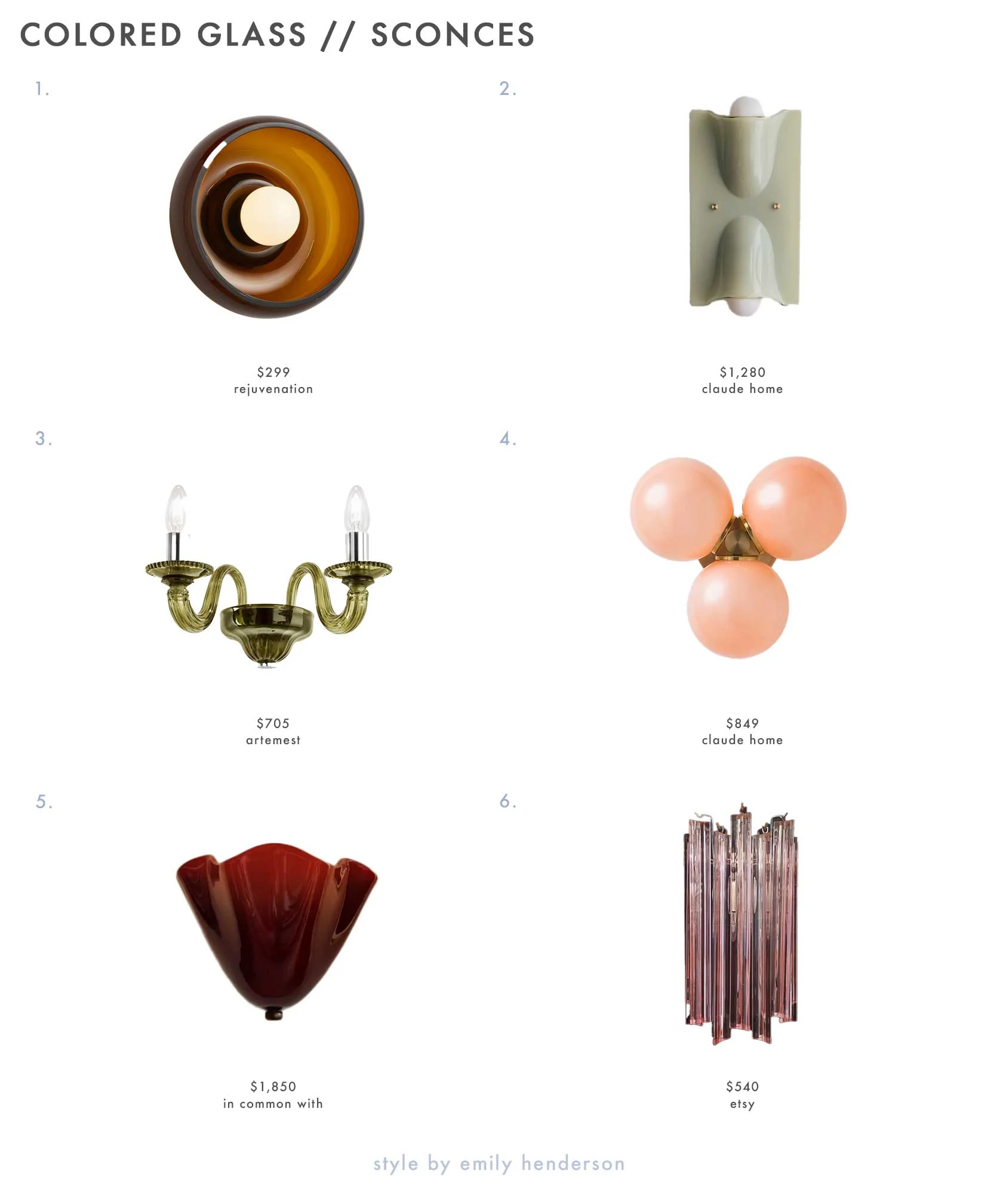
1. Augustine Sconce | 2. Double Calle Wall Sconce in Artichoke | 3. Asia 2-Light Olive-Green Mouth-Blown Glass Sconce | 4. Trio Wall Light in Blush/Natural Brass | 5. Vera Sconce in Cherry | 6. Pair of Vintage Murano Wall Sconce
Another viral lighting design right now is the Calle Wall Sconce from Claude Home. Its milky glass comes in a few different colors, like artichoke shown here. And while it is hard to select a favorite from the array above (especially with that vintage pink Murano sconce in the #6 spot), I think #3, with its candelabra style, is my pick of the litter. Gorgeous!
Colored Glass Furniture
For a more niche application of colored glass, you’ll want to go the route of furniture. Take heed: This one is only for those of us who can stand the sound of constantly clinking glass, or who do not have young children. I can appreciate what the look does to a room (to me, it’s similar to the Unexpected Red Theory—basically anything edgy or “unexpected” will make a room feel far more interesting by default), but in practicality, it’s not for me. If it’s for you, keep scrolling!
I mean, just so cool. It’s undeniably modern, but that doesn’t mean you can’t mix it with a more traditional design for a touch of edge.
Even a small side table somewhere (maybe off in a corner you don’t sit in often) can make someone stop and say, “Wait, that’s so cool!”
Imagine this prismatic beauty next to a slipcovered sofa for intense visual contrast?!?
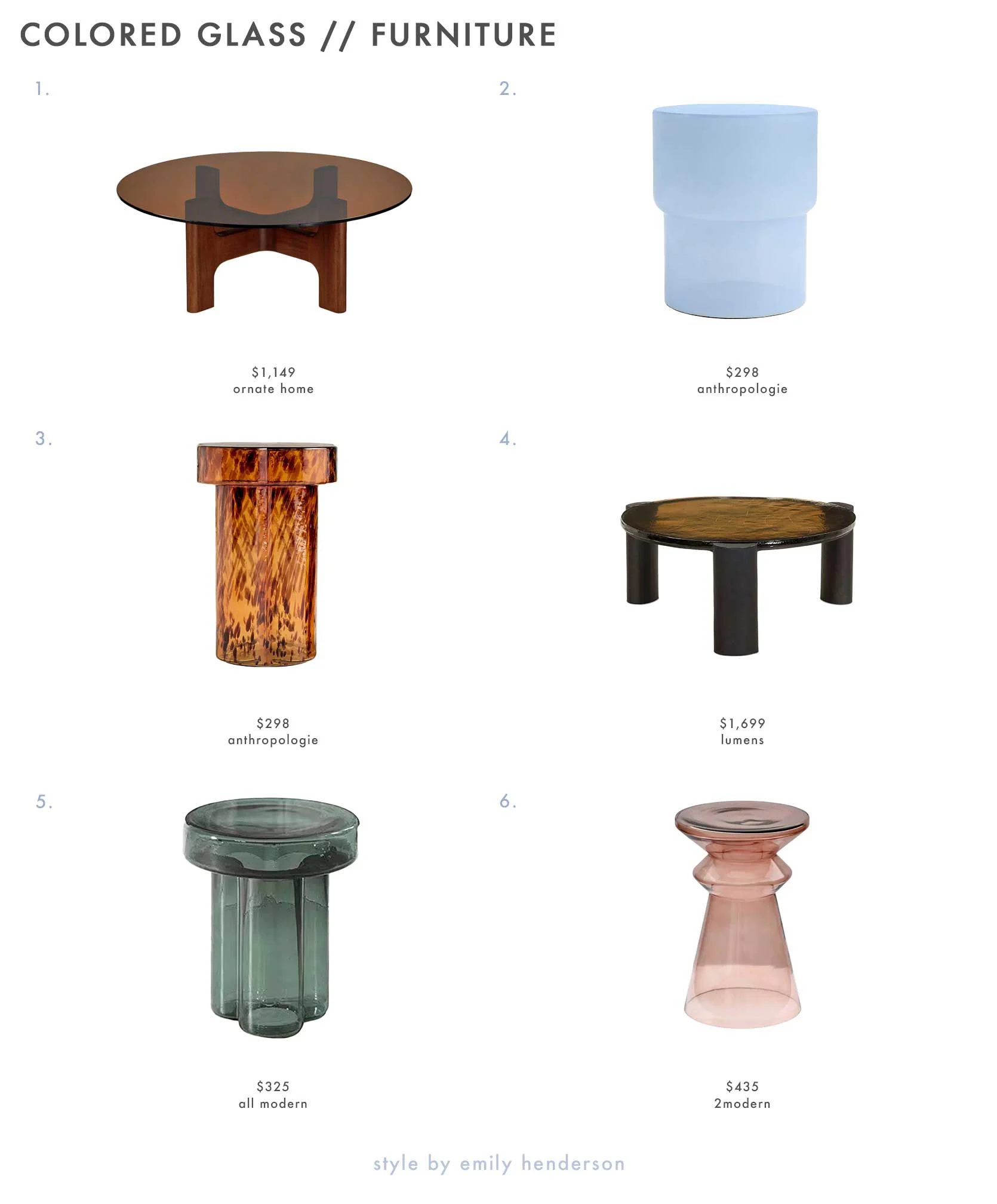
1. Luke Amber Coffee Table | 2. Bruno Glass Side Table | 3. Manor Glass Side Table – Tall | 4. Rover Nesting Table | 5. Glass End Table | 6. Surya Donora End Table
Colored Glass Vases
In most cases, a vase is going to be your lowest bar of entry into the colored glass world in terms of price tag, though don’t be fooled: There are some incredibly premium versions out there. Glassblowing is an art form, so if it was made by hand rather than mass-produced, you’ll notice that immediately in the cost.
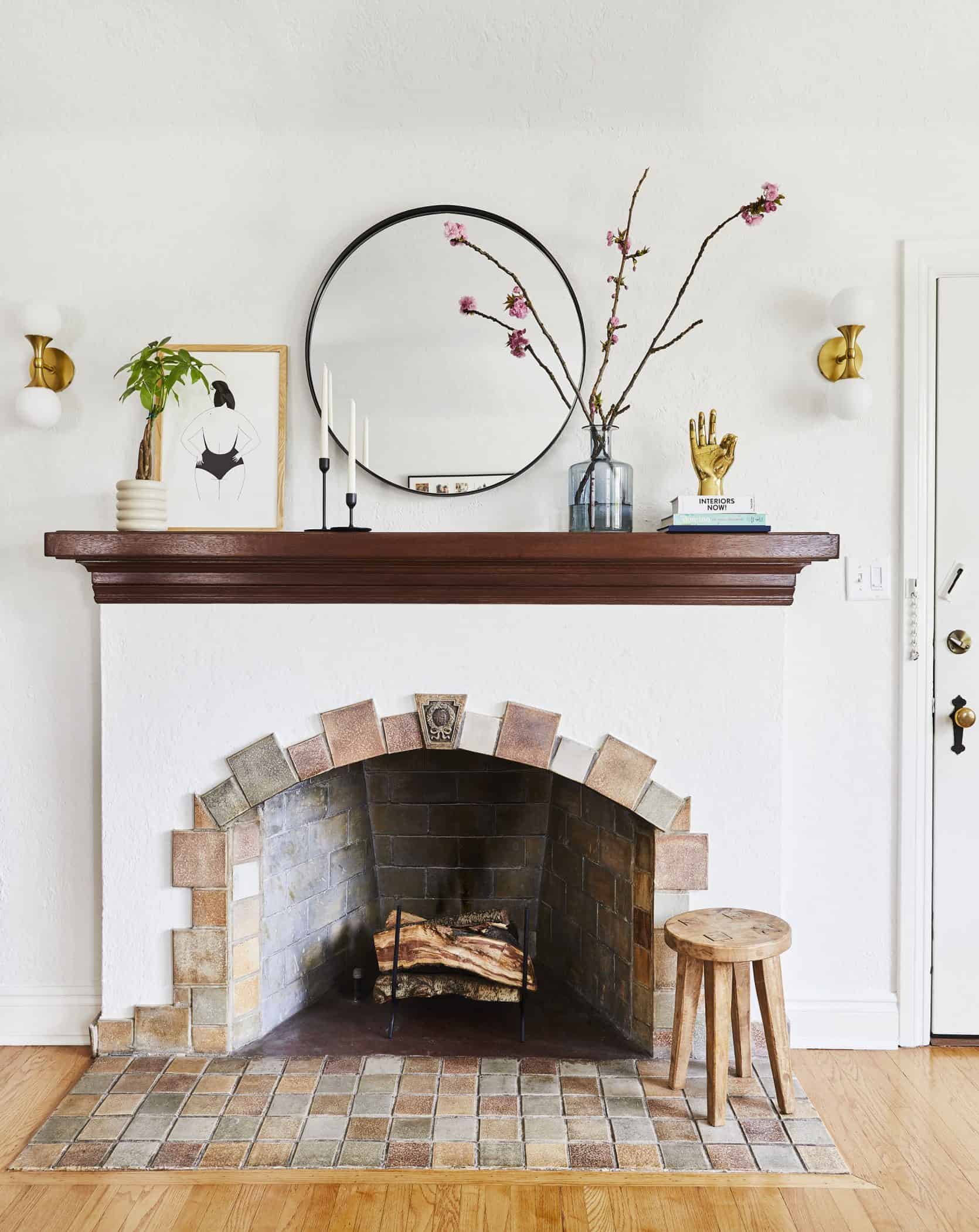
I borrowed that slate blue vase from Sara (who also shot my home way back when in Los Angeles), and if I cover it up with my thumb to imagine the vignette without it, it really is just kind of boring. I eventually found something similar, but then had to take it (and that solid brass hand sculpture) down when I babyproofed.
If you don’t follow Alvin Wayne, please go do so if you want inspiration from a designer who takes a ton of chances and never picks the “safe” option. Either way, the wavy yellow vase/bowl on his coffee table caught my eye.
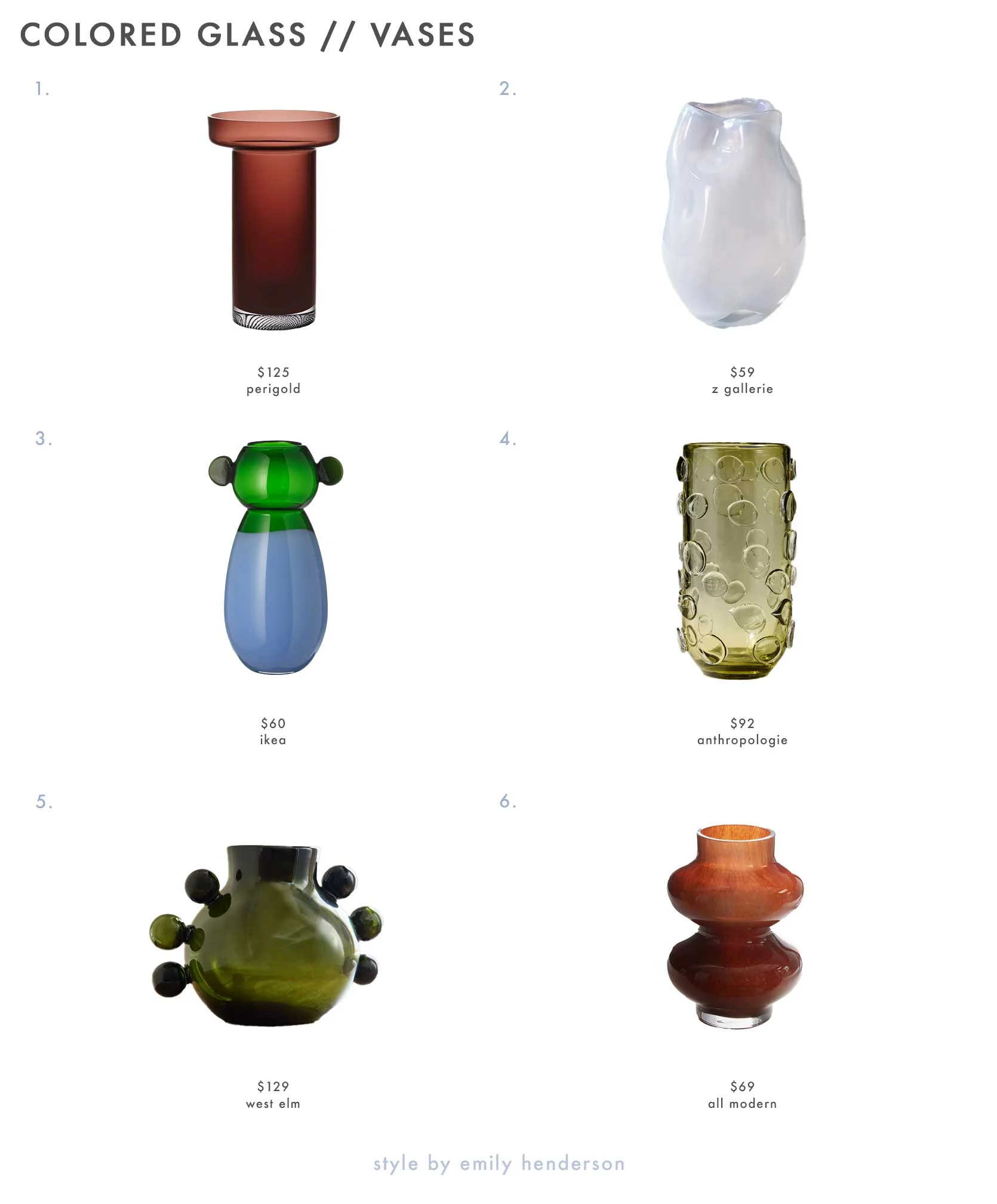
1. Kosta Boda Limelight Crystal Table Vase | 2. Melt Glass Vase – Amethyst | 3. IKEA PS 2026 Vase, Glass/Blue/Green, 15″ | 4. Dewdrop Pebble Glass Vase | 5. Jade Artisanal Glass Vase | 6. Malden 7.75” Glass Table Vase
Colored glass vases can be found just about everywhere right now, including all of our mainstream favorites: Love the bulbs on the side of this green one from West Elm; I’m very into the statuesque silhouette of the crystal table vase I found on Perigold; even IKEA is in the game, though they’ve been doing colored glass for a long time now, some of which I own.
Colored Glass Tabletop & Dining
Did I say lighting was my favorite way to bring in colored glass into the home? Well…maybe it’s also tabletop and dining. Do not fault a girl who loves beautiful things, okay?!? I found some burgundy glass champagne coupes on major sale at Anthro a few years back, and they remain one of the prettiest things in my kitchen. That makes me feel confident that even if it’s an investment, something like this will be a prized possession for the long haul…just don’t break it. Godspeed.
I’m currently on the hunt for a piece of colored glass to style my coffee table with. Perhaps an old ashtray, bowl, trinket box, or match cloche. This photo from Fenton & Fenton is a fun inspiration.
I’m absolutely swooning over this hand-blown bowl from Catskill Glassworks. I checked his Etsy shop, and a similar piece is in the $600 range. Not something I’m scooping up right away, but it’s on my list of things to ask my husband for when he wants to buy me something (very) nice and has no clue what to get. I have enough jewelry…I don’t have enough glass art.
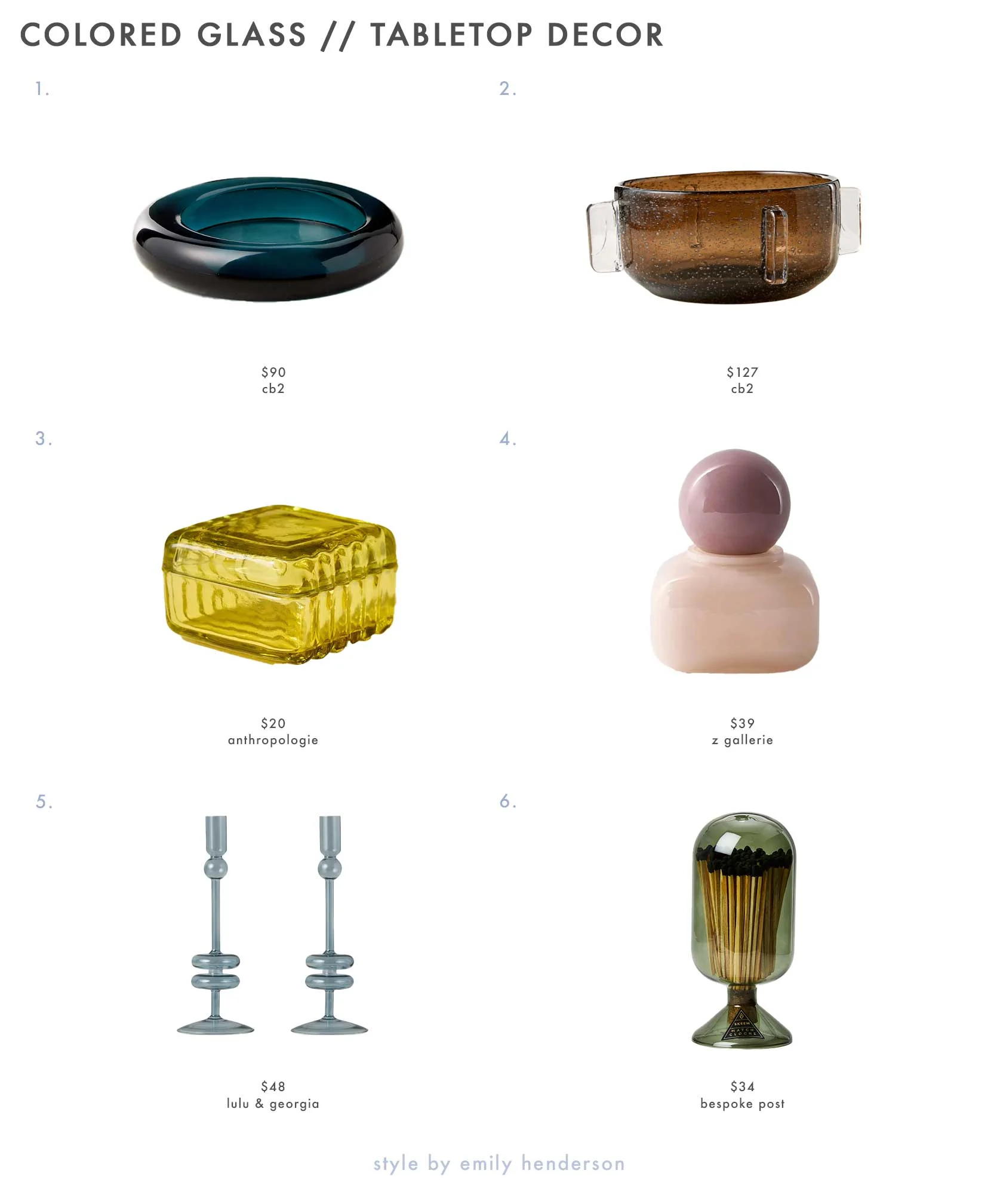
1. Bangle Teal Glass Decorative Bowl | 2. Felena Handblown Brown Glass Decorative Bowl | 3. Eloise Glass Trinket Box | 4. Camilla Mouth Blown Antique Mauve Blush Glass Canister 4.5″ | 5. Glass Candlestick Pair (Set of 2) | 6. Jewel Match Cloche
I’m very tempted by those blue glass candlesticks from Lulu & Georgia if I had somewhere to display them. But I can always find a spot for something like #6, especially for something under $35! The brown glass bowl would be gorgeous at the center of a dining table or on a large coffee table or credenza. And if I say trinket box one more time in this post, I may lose my writer license (but this one is very cute).
I’m not sure which is more delightful: The glassware shown in this photo above, or the fact that the account that shared it is named “Gloobles.”
I’ve already mentioned Estelle Colored Glass here, so I had to pull a pretty little table set up from the brand’s account before sharing some of my picks.
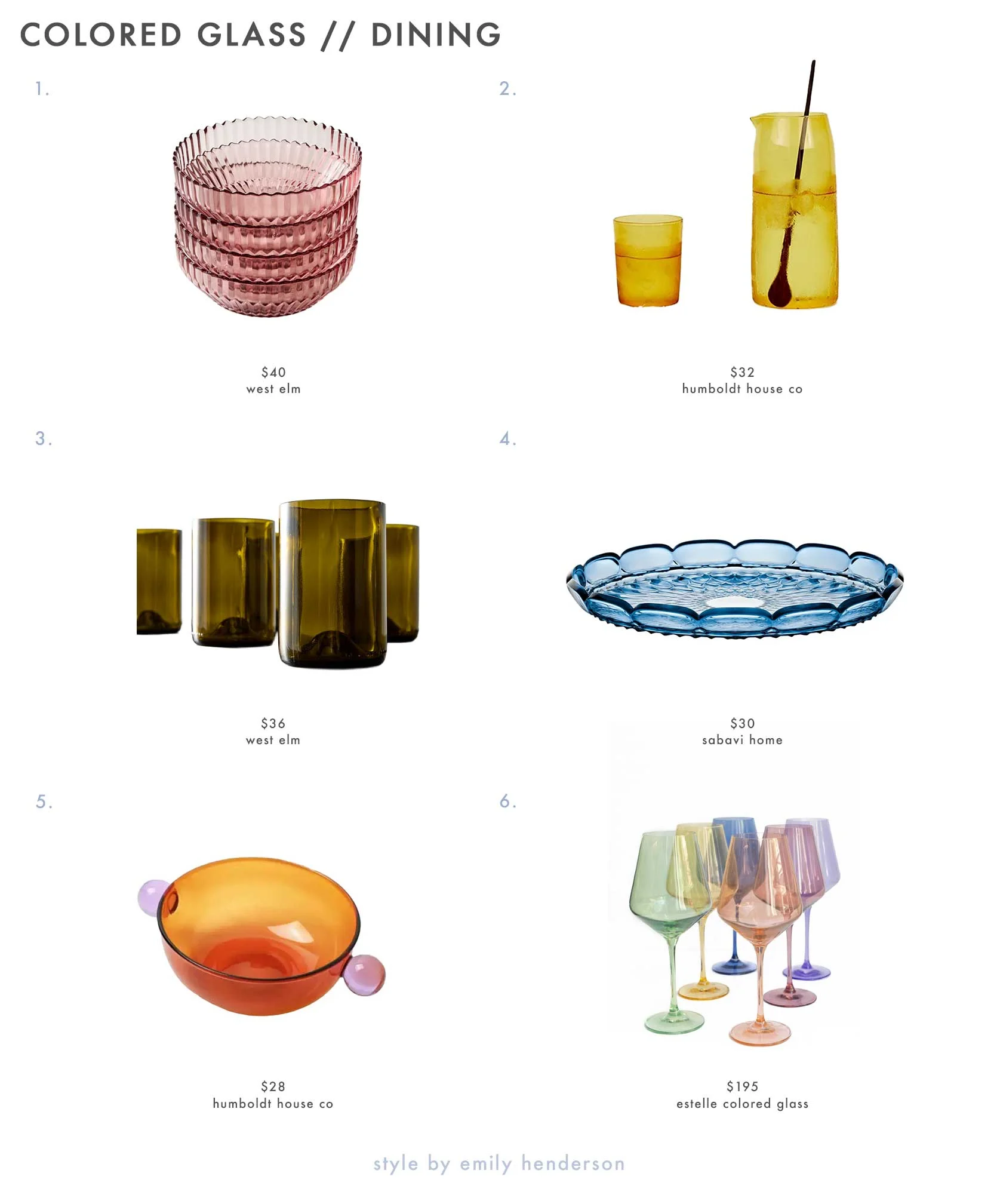
1. Archie Glass Cereal Bowls (Set of 4) | 2. Essential Glassware Pitchers | 3. Vintage Drinking Glass (Set of 6) | 4. Guzzini Vanity Round Tray | 5. Colorful Glass Dessert Bowl | 6. Estelle Colored Wine Stemware – Set of 6 (Pastel Mixed Set)
Here to say that I WANT EVERYTHING LINKED ABOVE! It all just makes my heart absolutely swell with desire.
—
So my friends, I hope today’s post helped you learn a little something and made you itch to be more playful in how we style and outfit our homes. Why buy a clear glass wine glass when we can buy a rose-colored wine glass?!? Live, laugh, and buy colored glass.
Until next time…
Opening Image Credits: Design by Arlyn Hernandez | Photo by Sara Ligorria-Tramp | From: Arlyn’s Moody Dining Room Reveal Is All About the Insane Power of Paint
It’s like you read my mind! I just recently got obsessed with vintage colored glass. I’ve started to collect Fire King jadeite (the not uranium kind) but I really enjoy looking at depression glass in antique stores too. It’s so beautiful! Great call-out to Estelle Colored Glass, I remember being stunned when I first came across them too.
Almost 2 decades ago, a friend and colleague of mine would spend her weekends going to shops and shows with her parents, who collected Depression glass. They also collected milk glass, and way back then, at the time, I thought “eh…not my flavor.” And now I LOVE it. Our tastes change so much over time, don’t they?
Nice post! A shout out for a nice little company in Seattle, Glassy Baby, that makes handblown candle holders and other items. They support craftsman as well as nonprofits with each sale.
I used to live in Seattle and treasure the collection of Glassy Babies in various colors that I built over the years!
Their candle holders are stunning!!
Love the history lesson with this! Very cool to hear more about how the art form evolved. Would love to see a series of how different cultures have led to the current world of interior design.
I’m surprised you didn’t mention Mosser glass— made in America, pretty reasonably priced colored glass tableware. Love this trend, so pretty.
There was SO much to mention that I just kept it super brief mostly to touch on the science of colored glass.
If anyone is ever in the area, check out the Corning Museum of Glass in Corning, NY. It’s fantastic! And, bonus, kids get free admission.
I’ve actually been! Years ago, I had to go to some Nascar races up in the finger lakes for work (very different job than I have now), and I stayed in Corning. Cute little town!
Yes, highly recommend!! Everything glass from ancient to incredible contemporary works.!
Beautiful roundup with so much eye candy! I just want to point out, especially for anyone looking at contemporary options, that sometimes glass is painted to emulate this colored look, but the paint sits on the surface and can be damaged or removed with use and/or cleaning. I used to have some lovely colored drinking glasses from Anthropologie that quickly taught me that I’d wasted my money on drinkware that wasn’t all that useable. So, just something to check if you’re considering a purchase.
Same thing happened to me with a light fixture from a very reputable brand. Unfortunately, this isn’t often disclosed in the description…beware of “dry cloth only” care instructions. I believe that is the case for a few of the tables listed above.
Love your passion for this! But I grew up in the 70s, and this stuff reads as tired and dated to me. Each to their own – what goes around (always) comes around!