Design
The 16th-Century Version of Instagram Was Completely Unhinged (+ Filled With Design Inspo)
You know how the Internet used to be a place? Like, you had your big, clunky, taupe desktop. You had a dedicated computer nook (or, if you were lucky, a whole computer room). You’d saddle up in your swivel chair, you’d spend 30 seconds listening to a cacophonous series of beeps and screeches, you’d do your browsing, you’d log off, and life would just…go on.
But then the smartphone was invented, Instagram was released, and the internet morphed from a place into a weird, 24/7 version of show-and-tell. (It’s about time someone writes a long think piece on this, right? I KID, I KID.) And I know that this all seems like a uniquely modern ailment – the need to perform for others in hopes of being liked, literally – but it turns out that humans are humans and we’ve been trying to flex for our friends and neighbors for centuries, with or without internet. So today, I have to introduce you to the 16th-century version of Instagram: the Wunderkammer. (Yeah, I did learn something new recently, and yeah, now I’m going to make it everyone’s problem.)
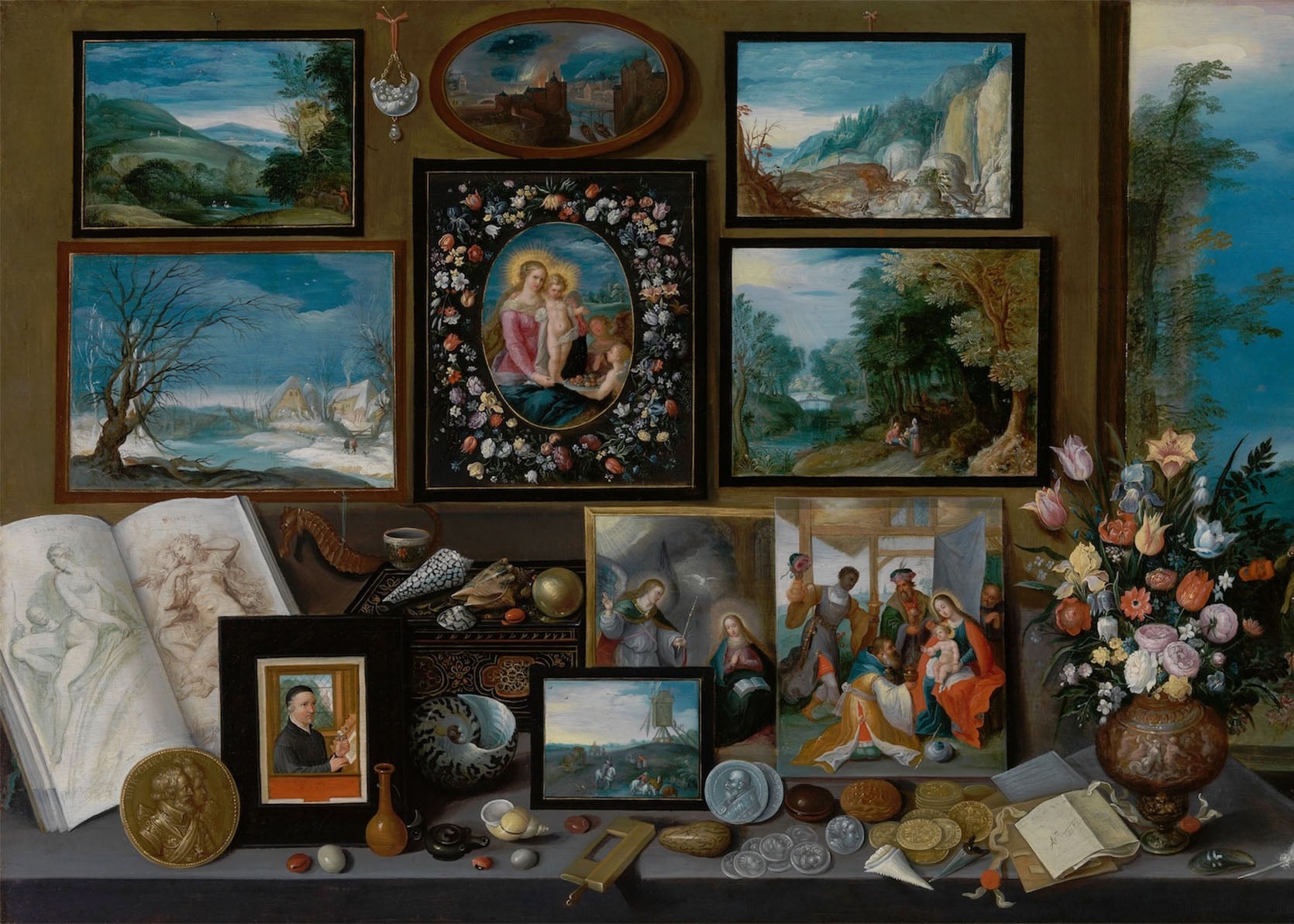
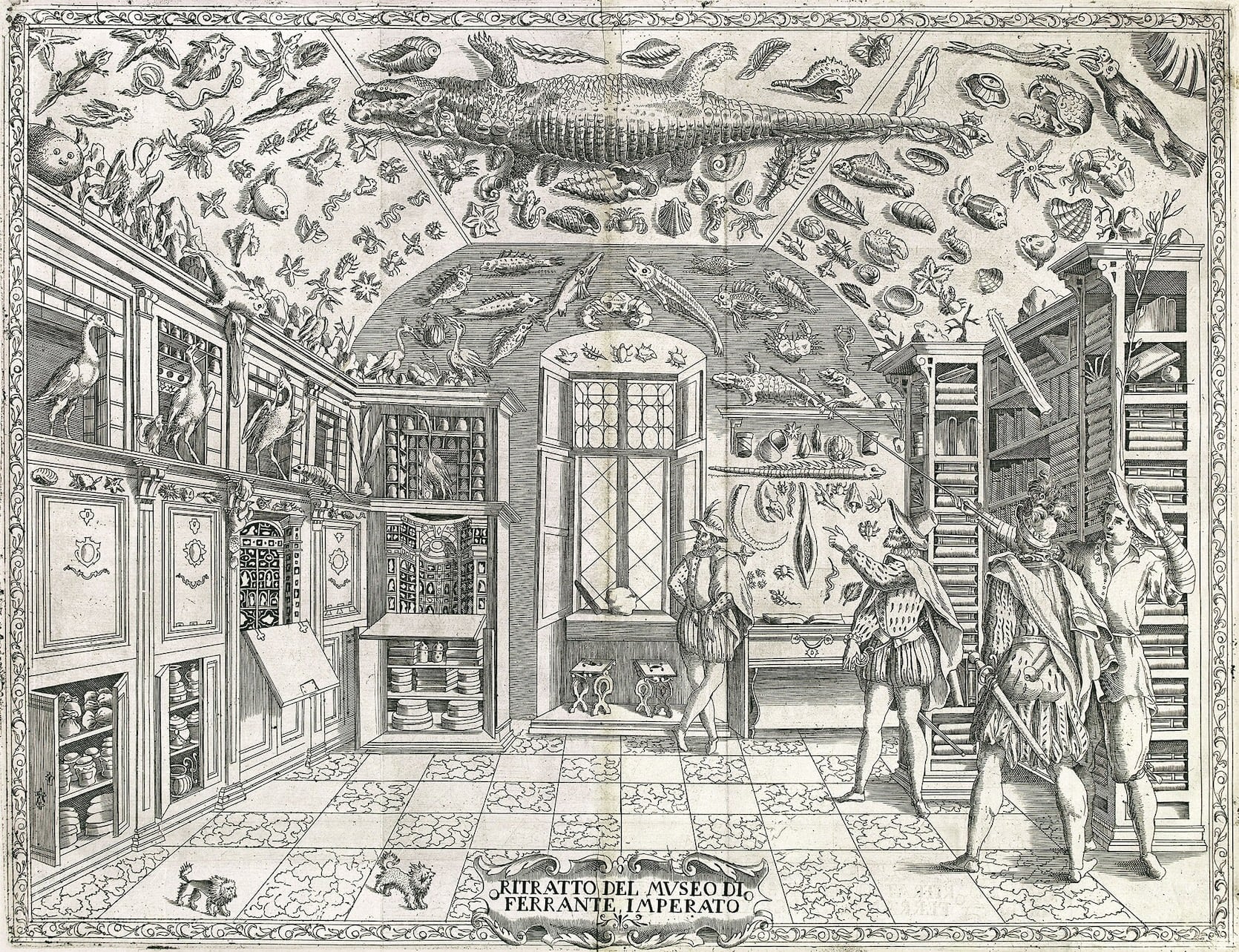
Here’s the gist: a wunderkammer directly translates to “wonder room” or “wonder chamber.” They were the 1500s version of flexing on Instagram – beautifully-decorated rooms filled with physical evidence that the owner was rich, worldly, and cultured. Before search engines, global shipping, and factual accuracy, wunderkammers pre-dated museums and served as places where people went to learn about a rapidly expanding world. (Or if you just wanted to stare at, like, a taxidermied crocodile, you’d do that in here, too.) They were part science lab, part art gallery, part status symbol, and part late-night conversation starter. (I mean, what else are you talking about in the 1500s? Horses? Shipping routes? Might as well look at some coral, or a book, or something novel.)
Maximalist, Structured Chaos
But there were RULES for designing your wunderkammer, you guys. (Rule one: be a man. Rule two: be a rich merchant, noble, or scholar. Rule three: follow the below rules.) You couldn’t just throw any old thing onto a shelf – there was a method to the madness. Was it scientific? Of course not! (Linnaeus hadn’t yet shown up to ruin everyone’s fun.) But any respectable wunderkammer did follow a series of vibe-based taxonomies:
- Naturalia (Things Created by Nature): This was the core of any good room. We’re talking preserved taxidermy, dried botanical specimens, giant clam shells, pressed leaves, and gemstones. Strangeness reigned supreme here. Who wants to see an everyday fish when they could be looking at a preserved pufferfish? (Not this girl, that’s for sure.)
- Artificialia (Things Created by Humans): This category celebrated craft, ingenuity, and patience. Think micro-carvings in cherry pits, intricate metalwork, carved ivory spheres, delicate Venetian glass…honestly, this taxonomy is pretty normal in comparison to the former and feels like the stuff we’re still tossing in our own libraries and bookshelves today.
- Exotica (Things Brought from Far Away): In the early era of global trade and colonization, items from Asia, Africa, and the Americas were treated with mystical reverence. Aztec leatherwork, Ming porcelain, Ottoman daggers – these were the cornerstone pieces of a world-class wunderkammer. (Half the time, owners had no idea what their objects were even used for, which somehow added to the mystique and prestige.)
- Scientifica (Things Built to Understand the Universe): This section is the precursor to modern scientific tools. Astrolabes, celestial globes, hourglasses, armillary spheres, and measuring devices. This signaled to your visitors that you didn’t just hoard weird stuff – you were a man of the Enlightenment, actively measuring the heavens. (Can you guys imagine if I, like, posted a picture of all my calculators and compasses on Instagram? Would that be a flex? Would you think I’m smart and worldly?)
- Ethnographica (Things from Foreign People): It focused explicitly on the human artifacts, attire, and ceremonial objects of newly encountered global cultures. Exotica leaned decorative, but Ethnographica was more like a predecessor to cultural anthropology – collectors valued Japanese Samurai armor, Inuit kayaks, ceremonial masks from the Pacific, and the like.
- Antiquitas (Things of Classical Antiquity): This would have been my favorite to collect, I think – this category focuses on material evidence of human history and classic scholarship. Think ancient coins, Etruscan pottery fragments, medieval manuscripts, and ancestral heraldic pieces.
- Scurrilia (Things That are Silly or Weird): People 500 years ago – they’re just like us! Wunderkammers weren’t just for solemn collections – they also housed the strange, monstrous, and deliberately bizarre. Scurrilia, like “dragons” (read: carved, contorted, and dried manta rays), grotesque caricatures, and trick drinking vessels were designed to break up intellectual debate with moments of shock and laughter.
- Theologia (Things that are Sacred): Of course there’s a religious bend! (This is Renaissance Europe, after all.) Placing sacred items in your wunderkammer demonstrated that pursuit of worldly wealth was ultimately subordinate to divine order and your religious devotion. Reliquaries, vials of dried martyr blood, rosaries, crucifixes, and fragments of saintly vestments all did the trick.
- Mirabilia (or Miracula, aka The Unexplained): These items defied both natural law and human explanation. Imagine: “unicorn horns” (read: narwhal tusks), “vegetable lambs” (wooly ferns – they believed these plants grew sheep), magical amulets, and crystal gazing orbs. It sounds like a junk drawer for folklore (let’s be real – you know these rich guys were getting ripped off), but folks in the 1500s believed that these items offered tangible, physical proof of the supernatural operating in our world.
Here’s the catch: this was NOT a museum. There was no space between objects, no glass cases, no partitions, no guards, no breathing room. On the contrary: the wunderkammer was a room for maximalists. The goal was sensory overload. These rich dudes wanted their guests to stand in the center of the room, spin around, and feel like they were adrift in the marvels of creation.
The OG Lifestyle Influencers
Alright, alright. It’s easy to write off these rich weirdos and their treasure rooms as an experiment in eccentric hoarding, but the wunderkammer was actually a deeply social spot – think of it as the original interactive home tour. (Do any of you have a parade of homes in your neighborhood? Like that, except no one has any idea what any item in their home really is, or where it’s from, or what it was actually used for. It sounds like it would have been fun!)
When a host invited you over to view their collection, it was a big deal (and a multi-hour performance). They’d guide you around the room, physically hand you objects, and narrate their (believed) histories. The total lack of organization and maximalism of the space was the point – it allowed conversation to jump from marine biology to classical architecture to alchemy to global trade. (Admittedly, this sounds like a normal conversation to me – do you think some undiagnosed ADHD contributed to the creation of these cabinets of curiosity?)
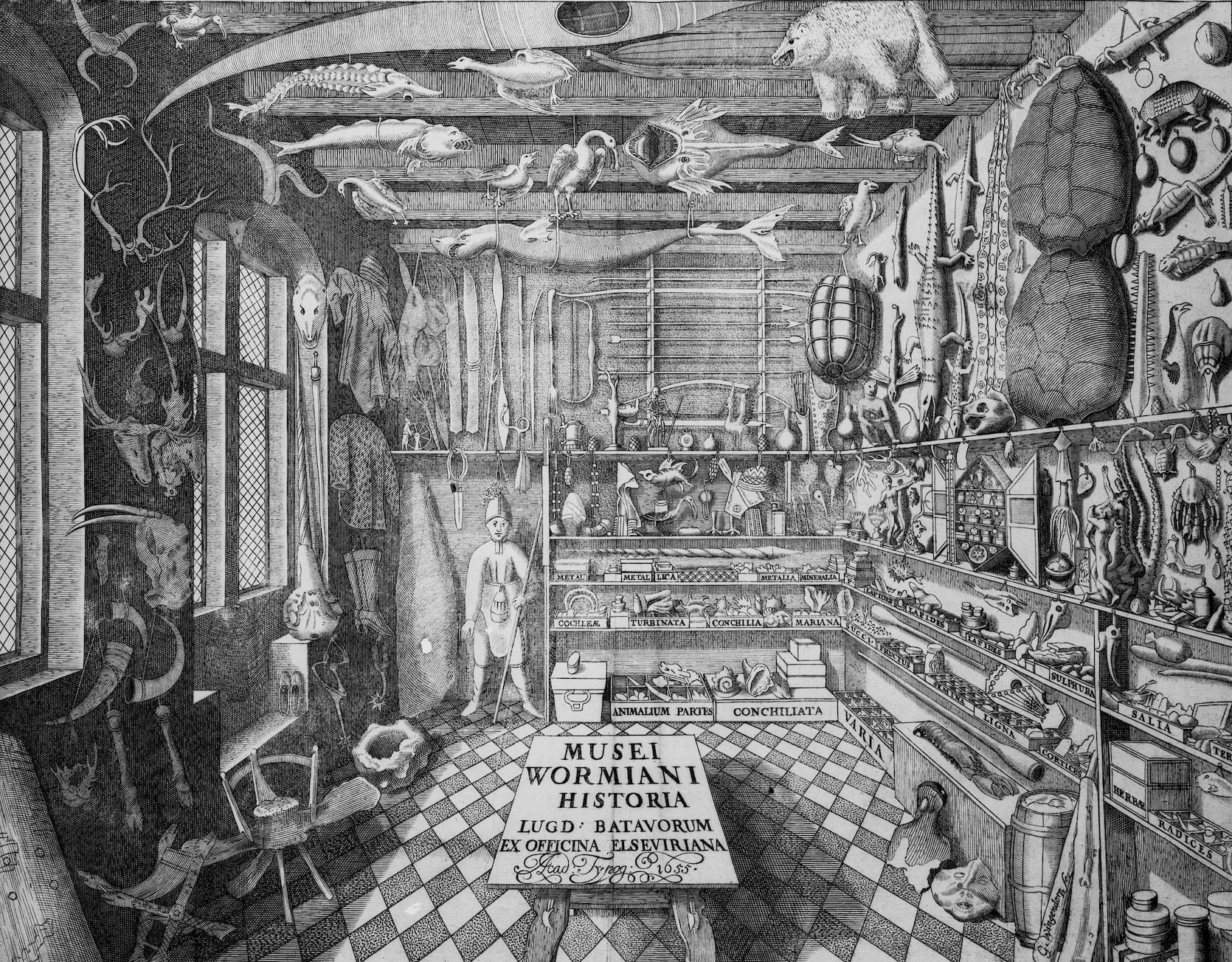
A few of these fellows designed rooms so elaborate that they’ve stood the test of time, but the best-known is a guy named Ole Worm (yes, seriously – that was the Latin version of his Danish name, Olaus Wormius). He lived in the late 1500s through the mid-1600s, was a professor at the University of Copenhagen, and his wunderkammer was so extraordinary that artists travelled to make drawings and engravings of his space. Rightfully so, too – his great hall was packed to the brim with taxidermied giant tortoises, polar bear skulls, spears, kayaker paddles, suits of armor, runic inscriptions, folklore manuscripts, shells, bronzes, and hundreds of meticulously labeled drawers. After Worm passed (from the plague – an especially unfortunate fate for a professor of medicine), the King of Denmark absorbed the entire wunderkammer into the Royal Danish Collection. Many of Worm’s original specimens still reside today in the Natural History Museum of Denmark, which is pretty neat. (If you liked this story, you’ll love learning about Emperor Rudolf II’s collection.)
The Modern Wunderkammer
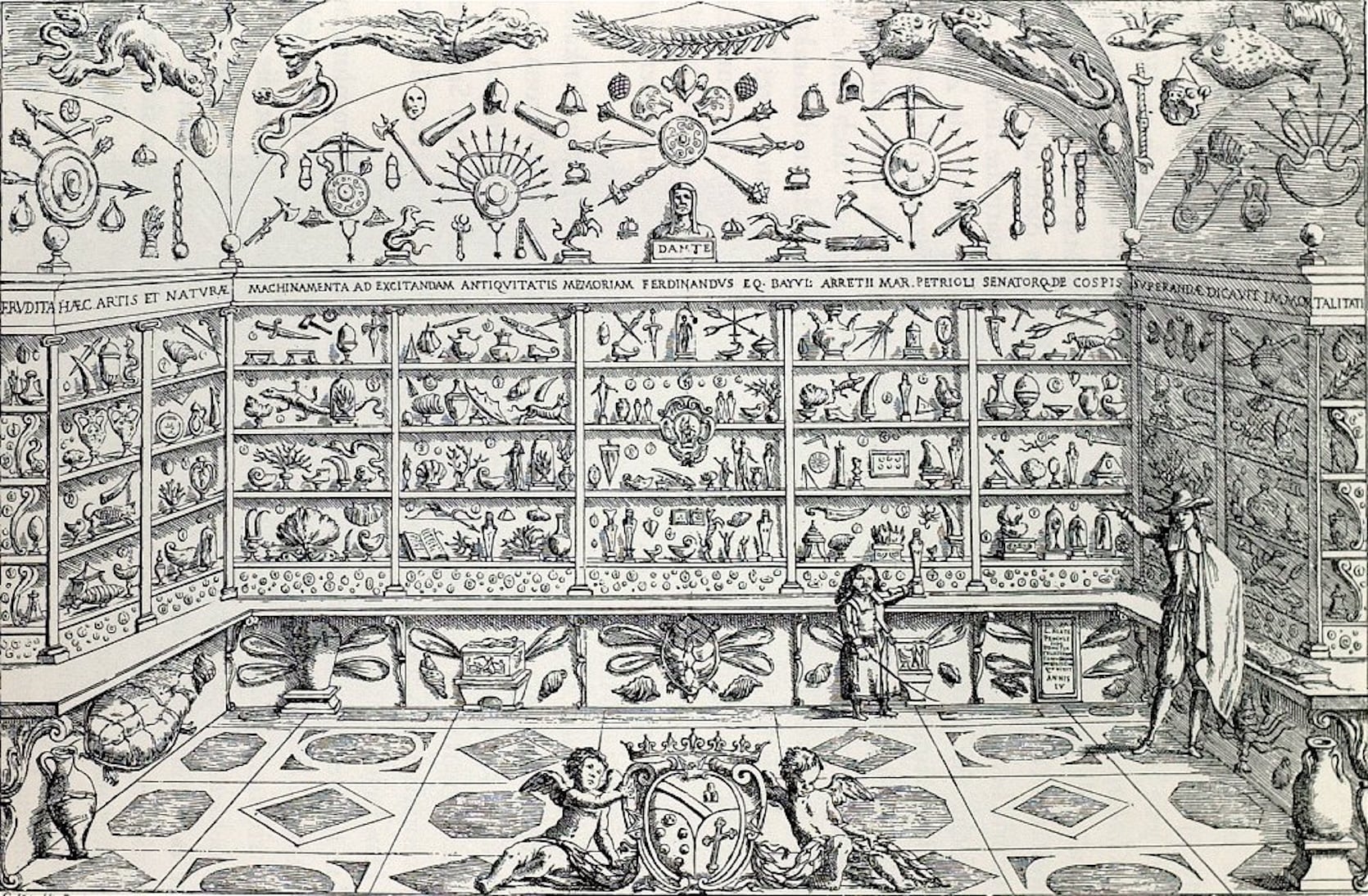
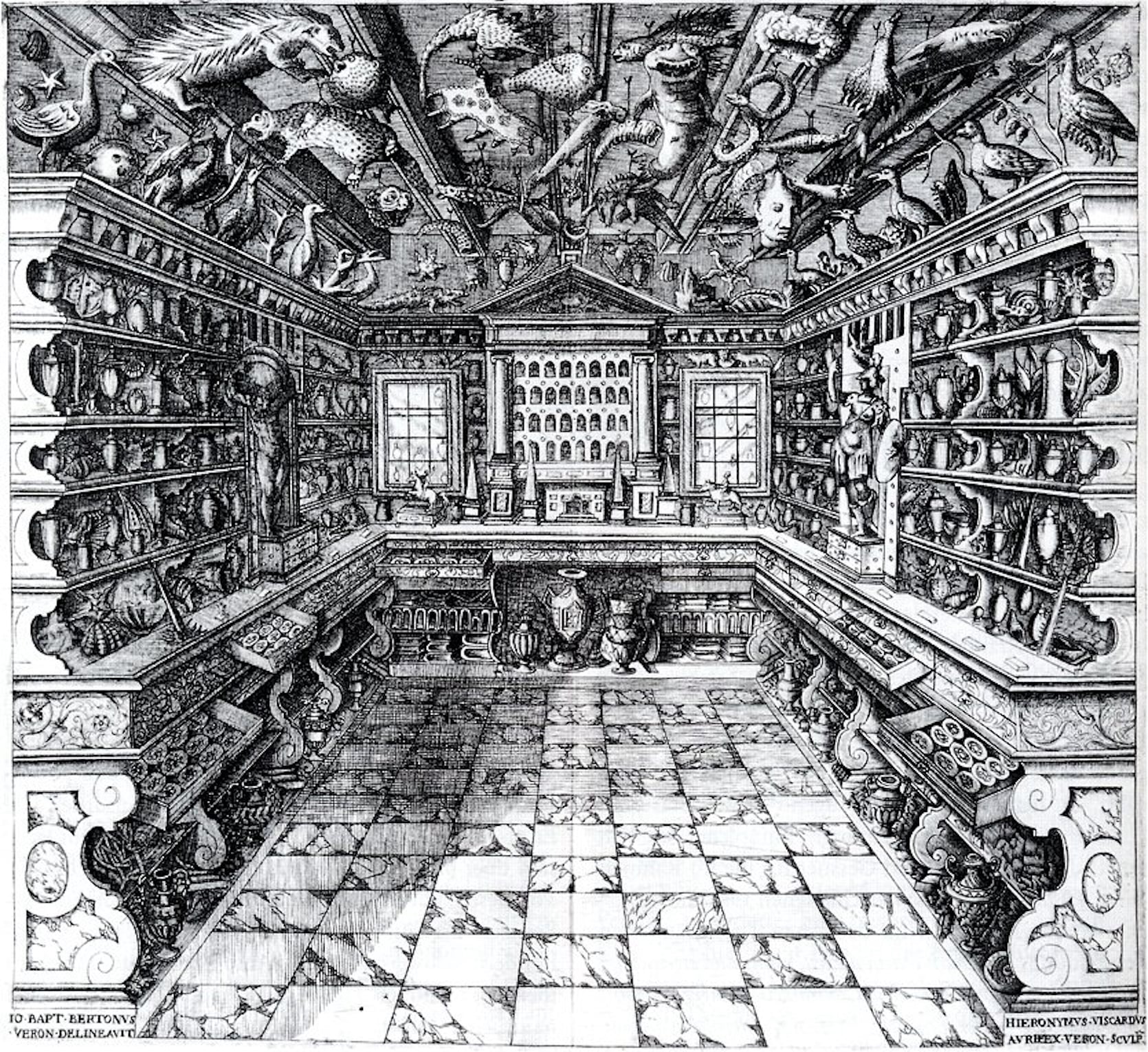
Eventually, the party had to end – the Age of Enlightenment demanded order. (I mean, folks were launching new democracies and building new nations. It was no longer reasonable to be showing people your fake unicorn horn, you know?) The wunderkammer concept was dismantled, stripped of its maximalist chaos, and split into specialized institutions: naturalia went to natural history museums; artificialia to art galleries; scientifica to science centers…you get the picture.
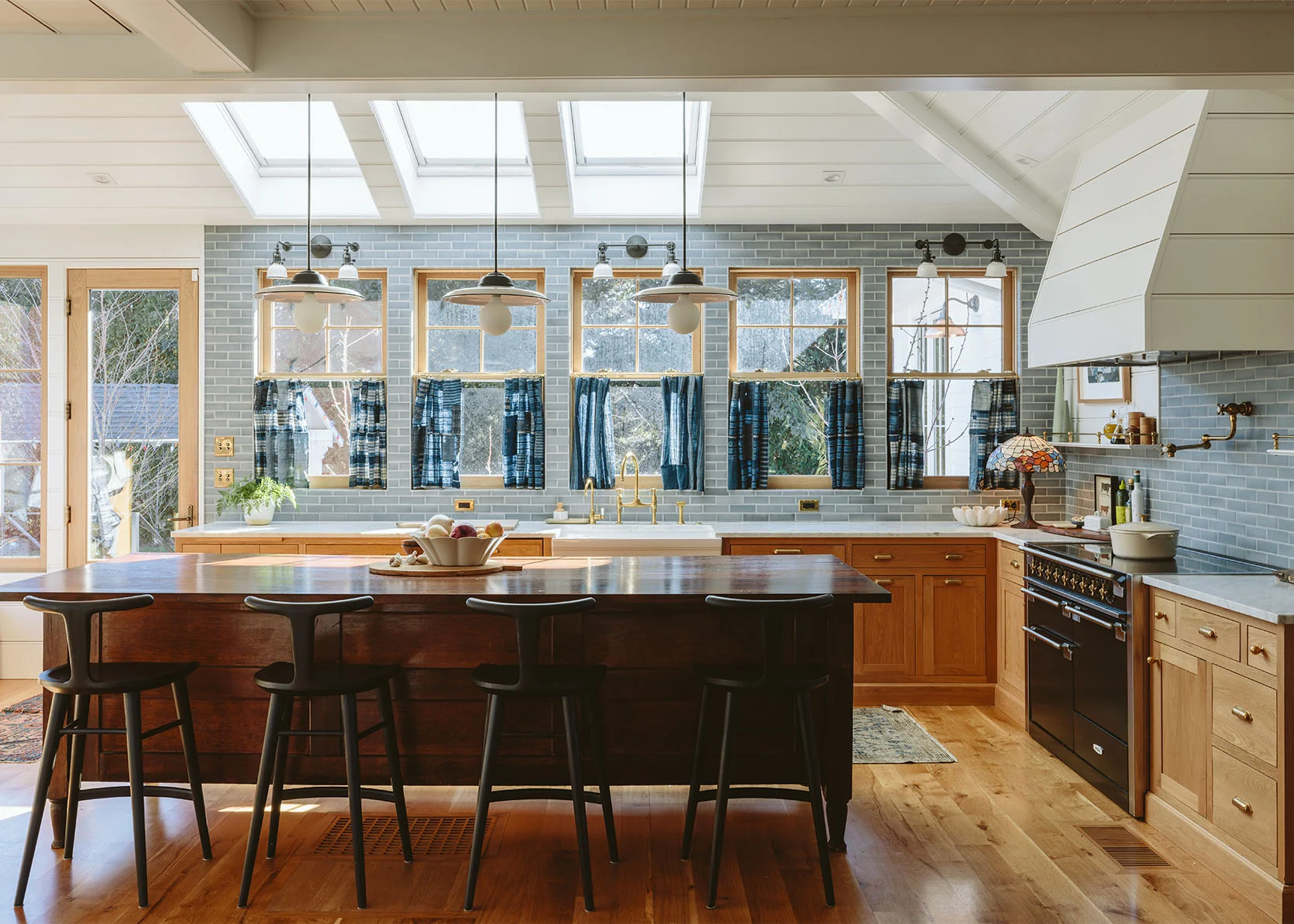
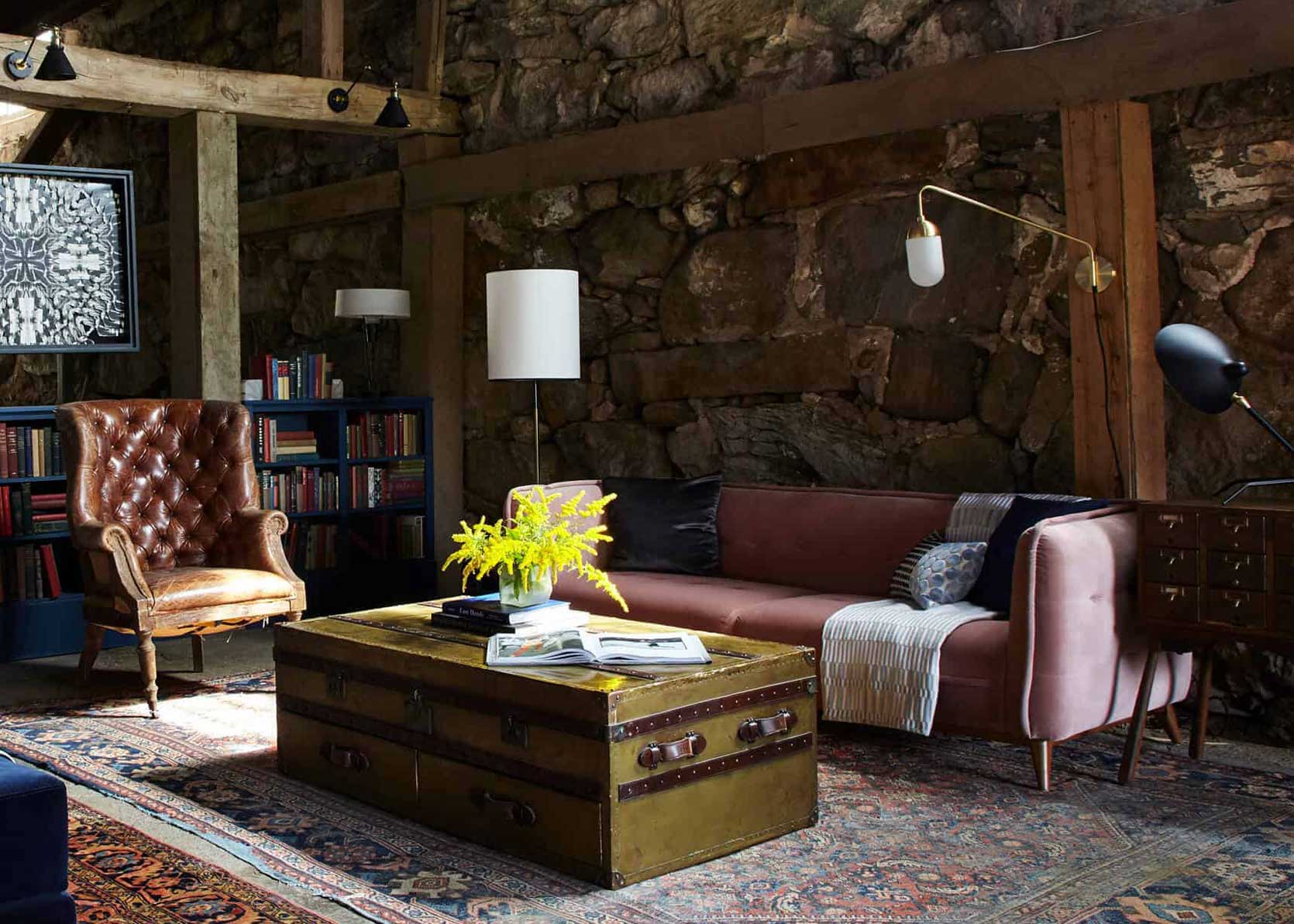
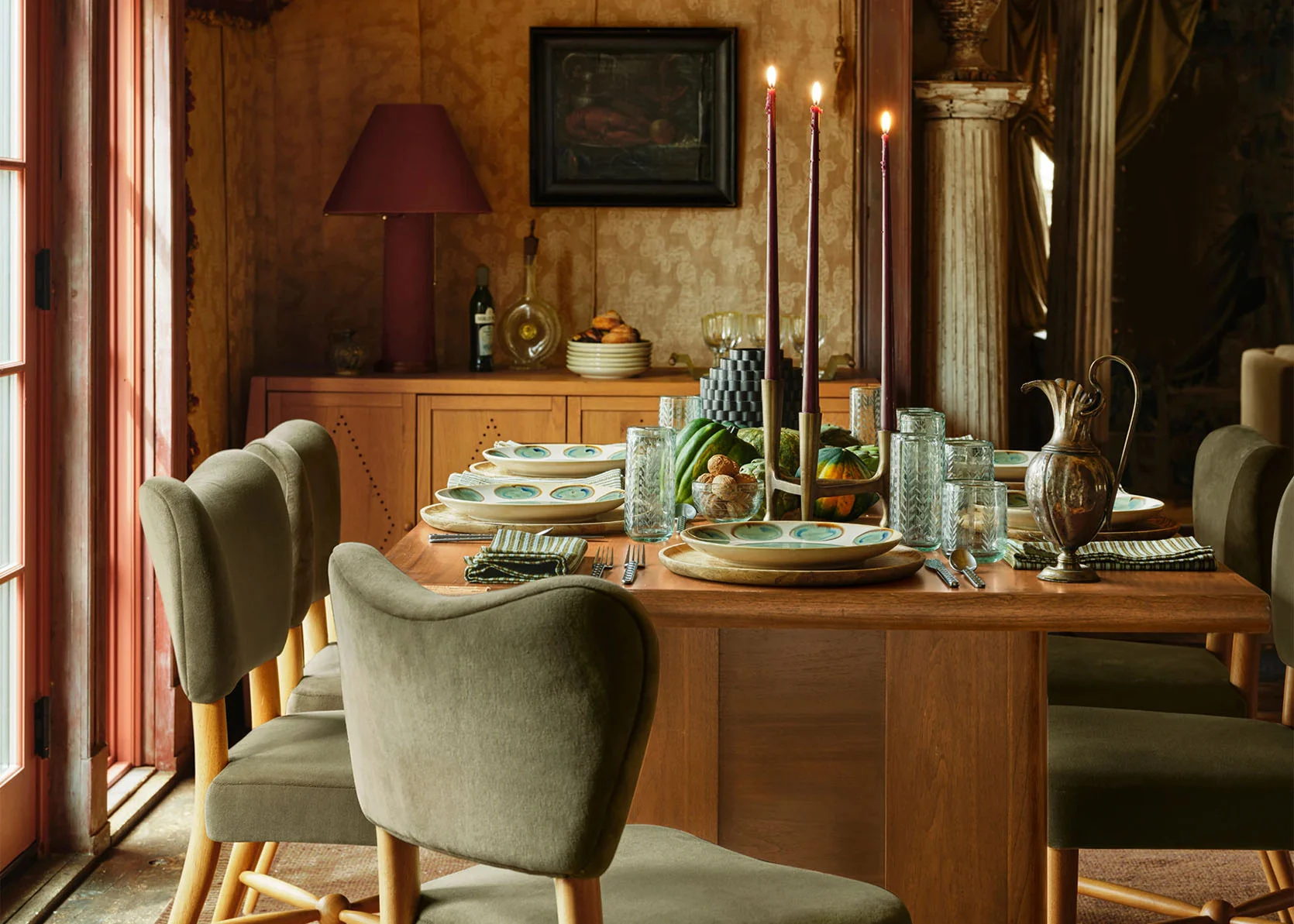
But I think the wunderkammer still lives on! (And not just because I’m staring at an office filled with yet-to-be-sorted clutter curiosities.) It exists on the shelves where books share space with your travel souvenirs and vintage finds; it exists in your gallery walls and in your patinated furniture; it exists any time you choose something weird for your home solely because it’ll evoke a reaction. (After years of nothing but white oak and minimalism, I’m happy to welcome some weirdness back into the fold.)
I want to bring this around to where we started: the internet, and Instagram, and performing for others, and all that jazz. In the spirit of the wunderkammer, I hereby issue you a permission slip to stop curating for the algorithm and to start prioritizing your own delight. (You’ll be joining a centuries-old tradition of storied, history-making maximalists.) Buy the little vintage brass insect! Save the cool shell you found on the beach! Hang up your strange thrift store painting that no one else likes. Fill your home with things that spark conversation, provoke questions, and keep the spirit of wonder alive. Then invite me over – I’d love to marvel at your own little creation 🙂
What a fun article to wake up to! Thank you, this is easily the best thing I’ve read on this site in years. I’d love to hear more from Caitlin
agree!!
Love this…I’ve always dug a “cabinet of curiosities’ vibe!
This was a delightful read! And I can attest that our quirky acquisitions and collections have sparked the best conversations when new friends come over.
Yes!!! I enjoyed today’s class! What a delight!
delightful post, as always, Caitlin! you’re a gentlewoman and a scholar.
Love this post! What an interesting thing to read on this site today. Thanks for the education! In the spirit of weird, I recently collected a ton of sea glass on a trip. I had always wanted to find a single piece of sea glass, and I hit the jackpot and found 30ish. I currently have them in a bowl, but I’d love anyone else’s idea of how I could display these even more prominently in my home. They’re all about the size of bottle caps, give or take a small margin of error. Any ideas ?!
You could display them in a grid or free arranged in a shadowbox on the wall. That would look really neat.
I’ve seen a beautiful display of sea glass pieces arranged in a floral pattern and adhered to a display tile…kind of like a mosaic design. Might also be interesting to make a design on a planter/pot or vase.
My sister-in-law made a windchime with her collection.
Thank you everyone for these ideas!!
“Start prioritizing your own delight” is such great advice! Thanks for the inspo and a very fun read.
MORE LIKE THIS, PLEASE! This is what blogging is about. Feels like it’s 2006 again. Caitlin, you’ve got the gift of digital gab!
I love this post so much, both the style and the substance. Caitlin, thanks for taking us down all the interesting rabbit holes!
You made my morning with this piece! Thank you so much. My 9 yearolds room is a perfect example of a cabinet of wonders, and you’ve inspired me to have more fun on our book shelves.
What a fascinating look into design history! Thank you, Caitlin!
Wow ! Thankyou Caitlin for bringing Us into Your Interesting and Multi faceted world. This reminds me of one of My favorite places in London, the Sir John Soane house. Very happy to be able to read posts like this !
This article made me so happy this morning. Thank you all for being such a bright spot on the internet, a place to learn, laugh, admire, and grow.
Thank you Caitlin! About to google Astrolabes!
Always fun to read your design history pieces. More winderkammer info and pics here-
dailyartmagazine.com/cabinets-of-curiosities
What a breath of fresh air! I love Caitlin’s posts—curious people are the best. Thank you!
This is very vindicating for those of us whose decorating style leans less curated and more “Howl’s bedroom in Howl’s Moving Castle.”
This was so freaking amazing. Love this post!!
LOVE THIS! I’ve worked in museums my whole career (I currently work at an art museum but prior to that worked at history museums for 20 years) and I love to see this topic explored on a design site. Very fun and well-done!
Such a great post! THIS is the type of long-form writing I still come here for! Great job Caitlin
Goodness what a delight to read! Caitlin you are truly gifted and clearly have amazed and thrilled many a reader this morning. Brava on a fantastic post!
Great post. Perhaps there was a bit of erotica included in some of these rooms?
I was wondering that too.
Educational, no links, fun to read – this is a GREAT blog post!!
Im so glad you wrote this, Ive been on a mission the past year to make my home weirder. I was initially inspired by Pierce and Ward, there weirdo maximalism really hit me in the feels. Im all about whimsy and strangeness, its so much more interesting than straight minimalism, which I do still love. I now have a fish platter in my kitchen, an evil eye above the stove, and some disturbing pelicans that watch me watch tv. This is the best article here in a long time, no offense intended.
Caitlin, I love this. Thanks for sharing the deep dive. Two things for you: 1) Did you learn about this on Antiques Road Trip? I recall an episode that featured a historical visit related to this topic. No idea which season – I’m still working through them on my PBS Passport thanks to your previous hot tip that I could watch old seasons there! And 2) semi-adjacent podcast recommendation: Aaron Mahnke’s Cabinet of Curiosities. Bite-sized episodes about interesting and random stuff. It’s how my husband got me re-interested in podcasts after a few I used to listen to all closed up shop.
This post is the best thing on this site in a long time! I would have loved it to end with some modern design inspo of houses (living rooms, bookshelves, studies) that were using these various categories in interesting ways. Tying the old to the new and giving us some modern examples would take this over the top!
You might be interested in reading about Margaret Cavendish Bentinck, the Duchess of Portland. She had the biggest natural history wunderkammer in the UK and was best friends with Mary Delany, of the paper-cut flowers fame <3
This was so fun! I just had to leave a comment to say that and ask for more content like this!
I love this post so much! And as a scientist I’ve fallen in love with the phrase “vibe-based taxonomies.”
Caitlin’s articles are always a favorite. Leave it to my fellow J-school graduate to report on absolutely the most random but also somehow-timely subject! <3
Love this post! Incredibly interesting! And I feel a personal connection, as I have a tiny “craft room” where I’ve decided to display all the little treasures I’ve collected over the years—on the walls, in front of all the books on bookshelves, basically every nook and cranny. I love being in this room and looking at all the keepsakes which bring me joy and memories! Now I need a sign for the door identifying the room as a Wunderkammer. Anyway, love this article so much for the connection and also the history! Your humor is great too 😉 ! Thank you!
Oh this is fun! I’d love to see your craft room! Now I need to find a little nook in my house for just me…
Love this post! Fascinating and inspiring! Reminds me to admire, and ask people, the stories behind their quirky household items. And add more quirk to my own home. Long live weird!
GIVE CAITLIN A RAISE
I love all of this–topic, approach to it, overall vibe, and last paragraph especially–so much. Well done Caitlin!!
Another interesting post from Professor Higgins! Always enjoy these. 🙂
Loved reading this!
Loved this. Thank you, Caitlin!
This is definitely one of the best pieces I’ve read on this site. It really speaks to my love of art history and anthropology, and it’s written in such a fun and clever way.
What a great read! Your post got me remembering a room at the Pasadena showcase house a few years back. The designer called it the artist wunderkammer room and included things she would have collected on her travels. Very cool.
This reminds me of the Pitt Rivers Museum in Oxford! Worth a visit if anyone is there and wants to see a collection with this vibe.
I love all of Caitlins posts like this!
The quirky stuff is the most interesting thing about other people’s houses! That said, I am not into dusting (oh my word the JOB it must have been for these rooms) and I am not that into collections per se… the odd oddity or three scattered around, yes. Or a really large conversation piece. Personality is trending in decor and I’m so glad.